
Featured Industrial Heating Alloys & Precision Elements
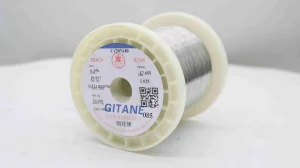
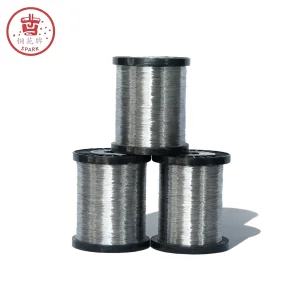
Select engineered resistance wires, radiant tube cores, and high-resistivity nickel-chromium alloys directly from primary certified manufacturing facilities.

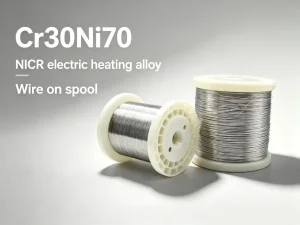
Global Market Dynamics of High Resistivity Nichrome Alloys
In modern thermal processing, advanced metallurgy, and industrial furnace design, selecting the optimal electrothermal material is crucial for thermal efficiency, operational longevity, and lifecycle cost management. High resistivity nichrome (Ni-Cr) alloys represent the benchmark standard for non-ferrous electric heating applications across global manufacturing ecosystems.
Thermal Efficiency & Density
High resistivity enables higher power density per linear meter of wire, allowing furnace engineers to design compact heating elements without compromising heating output or thermal uniformity.
Cyclic Oxidation Stability
Unlike iron-chromium-aluminum (FeCrAl) alloys, high-nickel alloys form an adherent chromium oxide ($Cr_2O_3$) layer that resists spallation during aggressive thermal cycling.
Hot Mechanical Strength
Superior creep resistance at temperatures up to 1250°C prevents sag, deformation, and structural collapse of suspended coils, radiant tubes, and ceramic heating frames.
Metallurgical Principles of High Resistivity Nichrome Systems
The high electrical resistivity of Nickel-Chromium systems originates from disordered solid-solution hardening and electron scattering within the face-centered cubic (FCC) austenitic matrix.
Chemical Composition & Phase Stability
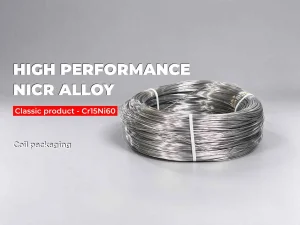
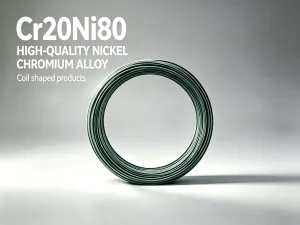
Standard industrial grades such as Cr20Ni80, Cr30Ni70, and Cr15Ni60 are meticulously balanced. The addition of rare-earth reactive elements (such as Cerium, Yttrium, or Lanthanum) enhances the key-locking effect of the protective surface oxide layer, dramatically reducing grain boundary oxidation under continuous high-temperature exposure.
Technology Roadmap & Future Outlook
Future high-temperature alloy development relies on powder metallurgy (PM) synthesis and ultra-low carbon vacuum melting processes. Next-generation alloys integrate micro-alloyed dispersoids ($Y_2O_3$) to maintain mechanical ductility even after tens of thousands of thermal duty cycles in protective reducing or nitrogen atmospheres.
| Alloy Grade | Nominal Composition | Resistivity at 20°C (μΩ·m) | Max Element Temp (°C) | Microstructure | Primary Industrial Use |
|---|---|---|---|---|---|
| Cr20Ni80 (NiCr 80/20) | 80% Ni, 20% Cr | 1.09 ± 0.05 | 1200°C | Austenitic (FCC) | Precision Kilns, Appliances, High-Duty Industrial Elements |
| Cr30Ni70 (NiCr 70/30) | 70% Ni, 30% Cr | 1.18 ± 0.05 | 1250°C | Austenitic (FCC) | Continuous Industrial Furnaces, Carburizing Environments |
| Cr15Ni60 (NiCr 60/15) | 60% Ni, 15% Cr, Bal. Fe | 1.12 ± 0.05 | 1150°C | Austenitic (FCC) | Medium-Temperature Heaters, Tempering Furnaces |
| Cr20Ni40 (NiCr 40/20) | 40% Ni, 20% Cr, Bal. Fe | 1.00 ± 0.05 | 1100°C | Austenitic (FCC) | Domestic Heating, Cost-Effective Industrial Elements |
China Supply Chain Resilience & Infrastructure Efficiency
As a primary manufacturing base, Chinese metallurgical facilities—such as Shougang Gitane New Materials—combine state-of-the-art smelting with end-to-end quality assurance systems. This integrated ecosystem ensures rapid production scaling, rigorous metallurgical consistency, and global competitiveness.
Vacuum Induction Smelting (VIM)
Ultra-clean melting under vacuum minimizes non-metallic inclusions, ensuring high dielectric strength and uniform wire ductility during cold drawing.
Precision Cold Drawing & Rolling
Advanced multi-pass drawing dies maintain wire cross-sectional ovality under 0.002mm for high-precision ribbon and micro-diameter wires.
Integrated Annealing Lines
Continuous hydrogen atmosphere bright annealing prevents surface oxidation, delivering pristine, scale-free finished products ready for coiling.
Global Export Logistics Network
Strategic proximity to major international deep-water ports guarantees accelerated shipping schedules and seamless customs clearing.
Localized Application Scenarios & Engineering Implementations
High resistivity nichrome wire, strip, and fabricated elements are engineered for diverse thermal environments across global industrial sectors.
🏭 Industrial Heat Treatment & Metallurgy
Used extensively in annealing furnaces, hardening lines, nitriding systems, and tempering kilns. Cr30Ni70 wire coils withstand carburizing gas atmospheres without suffering green rot embrittlement.
💎 Glass, Ceramics & Semiconductor Kilns
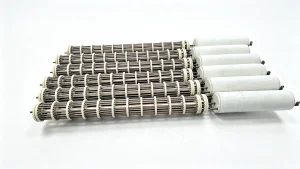
Ceramic bundle rod radiant tube cores and heavy-gauge spiral wire elements deliver stable infrared radiation for glass bending, ceramic tile sintering, and photovoltaic wafer processing furnaces.
🚗 Automotive & Aerospace Thermal Systems
Crucial for brake resistor grids, catalytic converter pre-heaters, cabin heating modules, and high-temperature testing equipment demanding immediate thermal response and high vibration resistance.
Global Compliance, Certification & Local Technical Support
Procuring wholesale resistance alloy wire requires uncompromised material traceability. Our production processes adhere strictly to international manufacturing standards, including ISO 9001:2015, GB/T 1234-2012, and ASTM B344.
- Full Metallurgical Mill Test Certificates (MTC) accompanying every batch shipment.
- 100% Eddy current testing and physical diameter tolerance verification.
- RoHS & REACH compliance for environmentally restricted substance control.
- Custom technical engineering consultation for surface load calculation ($W/cm^2$).
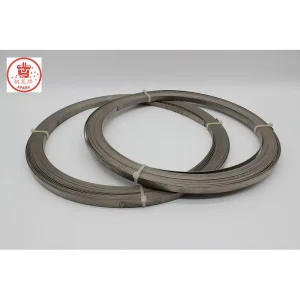
📦 Customized Delivery Forms
We cater to specific engineering drawings and processing requirements:
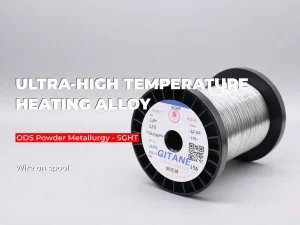
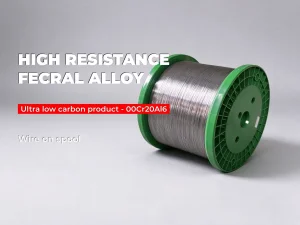
Ultra-High Temperature & FeCrAl Resistance Alloys
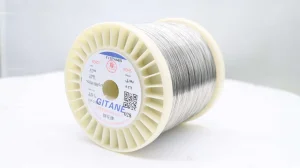
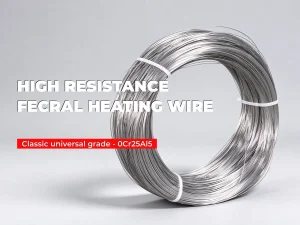
Explore additional high-grade electrothermal solutions engineered for heavy-duty industrial furnaces operating up to 1425°C.
Frequently Asked Questions (FAQ) for Procurement & Design Engineers
Critical answers regarding selection criteria, thermal calculations, and procurement practices for wholesale high resistivity nichrome wire.
R = (λ × L) / A
Where
λ is resistivity in μΩ·m, L is length in meters, and A is cross-sectional area in $mm^2$. During operation, the resistance increases due to the temperature coefficient of resistance ($C_t$). The operating resistance is R_t = R_{20} × C_t.