
High-Performance Heating Alloy Supply Portfolio
Direct factory-engineered resistance wires, strips, and heating elements engineered for thermal processing, furnaces, and high-temperature industrial systems.



Global Commercial & Industrial Status of High-Performance Heating Alloys
The Decarbonization Paradigm Shift in High-Temperature Metallurgy
The global industrial thermal processing market is undergoing a structural transition. Driven by stringent carbon-neutrality mandates (such as EU ETS and US IRA industrial decarbonization frameworks), heavy industries are systematically replacing fossil fuel-fired burners with zero-emission electric thermal systems. Consequently, the demand for Wholesale High Performance Heating Alloy Manufacturers & Suppliers capable of delivering consistent resistance materials rated between 1100°C and 1425°C has experienced exponential growth.
Modern electric resistance heating relies fundamentally on two main metallurgical metallurgical families: Ferritic Iron-Chromium-Aluminium (FeCrAl) alloys and Austenitic Nickel-Chromium (NiCr) alloys. High-performance heating alloys are no longer treated as simple commodity consumables; they are engineered structural components designed to maintain precise electrical resistivity, high creep strength, and superior surface oxidation protection under extreme continuous mechanical and thermal stress.
Leading industrial equipment manufacturers (OEMs) require heating elements with predictable degradation rates to minimize unscheduled furnace shutdowns. Modern alloy synthesis leverages micro-alloying—incorporating reactive elements (RE) such as Yttrium (Y), Zirconium (Zr), Hafnium (Hf), and Niobium (Nb)—to modify grain boundaries and refine protective oxide layers ($\alpha\text{-Al}_2\text{O}_3$ and $\text{Cr}_2\text{O}_3$), drastically extending thermal cycle endurance.
Key Industry Metrics
Metallurgical Matrix: FeCrAl vs. NiCr Alloys
Comprehensive comparative study of high-temperature electrical resistance materials manufactured under ISO 9001:2015 & GB/T 1234-2012 compliance standards.
FeCrAl Alloys (Ferritic Structure)
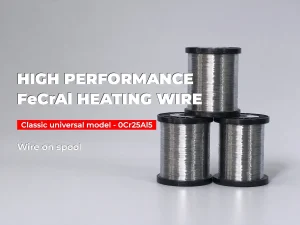
FeCrAl alloys (e.g., 0Cr25Al5, 0Cr21Al6Nb, 0Cr23Al5, SPARK SGHYZ 1400°C, SPARK SGHT 1425°C) are defined by their body-centered cubic (BCC) crystal lattice. When heated above 1000°C in oxygen-containing environments, FeCrAl forms a continuous, slow-growing, highly insulating sub-layer of pure alpha-alumina ($\alpha\text{-Al}_2\text{O}_3$).
- Higher Maximum Operating Temperature: Capable of reaching up to 1425°C, making them essential for ceramic sintering and powder metallurgy kilns.
- Higher Electrical Resistivity: Typically 1.35 to 1.45 μΩ·m, allowing heating element designs with larger cross-sectional wire diameters and extended operational life.
- Lower Specific Mass/Density: At approximately 7.10 g/cm³, FeCrAl provides up to 17% material weight savings compared to NiCr, translating directly to lower procurement costs per heating coil unit.
NiCr Alloys (Austenitic Structure)
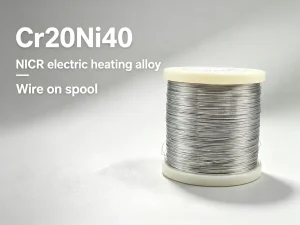
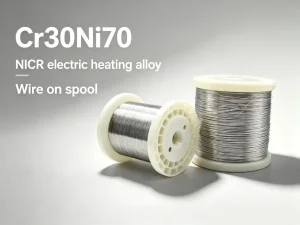
NiCr alloys (e.g., Cr20Ni80, Cr30Ni70, Cr15Ni60, Cr20Ni40) feature a face-centered cubic (FCC) crystal lattice. NiCr elements develop a protective chromium oxide ($\text{Cr}_2\text{O}_3$) scale when operated at temperatures up to 1250°C.
- Post-Use Ductility: NiCr retains its mechanical ductility even after long exposure at high temperatures, enabling non-destructive element repair and re-coiling.
- Superior Hot Creep Strength: The austenitic micro-structure exhibits high resistance to sag, thermal deformation, and mechanical stress under high temperature.
- Non-Magnetic Characteristics: Fully non-magnetic at operating temperatures, making NiCr optimal for precision medical, laboratory, and high-frequency electronic heating applications.
| Alloy Grade | Alloy Family | Max Temp (°C) | Electrical Resistivity (20°C, μΩ·m) | Density (g/cm³) | Primary Protective Scale | Target Industrial Applications |
|---|---|---|---|---|---|---|
| SPARK SGHT | Powder Metallurgy FeCrAl | 1425°C | 1.45 | 7.10 | $\alpha\text{-Al}_2\text{O}_3$ (Ultra-Dense) | Semiconductor, Advanced Ceramics, Solar Wafer Kilns |
| SPARK SGHYZ | FeCrAl + RE + Nb | 1400°C | 1.42 | 7.15 | $\alpha\text{-Al}_2\text{O}_3$ | High-temp Powder Metallurgy, Sintering Furnaces |
| 0Cr21Al6Nb | Ferritic FeCrAl | 1350°C | 1.45 | 7.18 | $\alpha\text{-Al}_2\text{O}_3$ | Heavy Industrial Heat Treatment, Radiant Tubes |
| 0Cr25Al5 | Ferritic FeCrAl | 1250°C | 1.42 | 7.25 | $\alpha\text{-Al}_2\text{O}_3$ | Industrial Kilns, Domestic Appliances, Brake Resistors |
| Cr20Ni80 | Austenitic NiCr | 1200°C | 1.09 | 8.40 | $\text{Cr}_2\text{O}_3$ | Precision Thermal Processing, Air Heating, Appliances |
| Cr30Ni70 | Austenitic NiCr | 1250°C | 1.18 | 8.10 | $\text{Cr}_2\text{O}_3$ | Extreme Thermal Cycling, Chemical Reactivity Control |
Sector-Specific Application Scenarios
Tailored thermal solutions engineered to overcome critical material degradation challenges across major industrial sectors.
1. Semiconductor & Photovoltaic Wafer Manufacturing
In quartz tube diffusion furnaces, MOCVD epitaxy systems, and solar ingot growth kilns, thermal uniformity within ±0.5°C is mandatory.
The Engineering Solution: Grade SPARK SGHT (1425°C) synthesized via powder metallurgy eliminates trace impurity spallation. The robust, self-healing alumina layer prevents metal oxide vapor contamination inside cleanroom environments, maintaining total wafer yield rates.
2. Lithium-Ion Battery Cathode/Anode Sintering
Roller Hearth Furnaces (RHF) calcining Lithium Iron Phosphate (LFP) or High-Nickel NCM materials operate under severe corrosive vapor load (alkali metal emission and fluoride trace gases).
The Engineering Solution: Heavy gauge 0Cr21Al6Nb strip elements paired with ceramic hangers offer extreme resistance to alkaline attack, preventing element embrittlement and thermal runaway.
3. Heavy Industry Heat Treatment & Annealing Lines
Continuous car-bottom furnaces, gas carburizing systems, and aluminum solution treatment plants demand rugged heating elements capable of handling high surface loads ($W/cm^2$).
The Engineering Solution: High-purity 0Cr25Al5 and Cr20Ni80 wire coils mounted inside radiant tubes maintain structural alignment, protecting furnace charges from electrical shorting.
4. Precision Commercial & Laboratory Thermal Systems
High-frequency cycling medical sterilizers, laboratory muffle furnaces, and rapid response industrial hot air guns require zero electrical drift.
The Engineering Solution: Precision drawn Cr20Ni80S and Cr30Ni70 fine wire delivers constant resistance values over tens of thousands of power-on/power-off thermal cycles.
Technology Roadmap & Future Outlook (2025–2035)
Key metallurgical innovations shaping the next decade of ultra-high temperature resistance materials.
Powder Metallurgy (PM) & Dispersion Strengthening
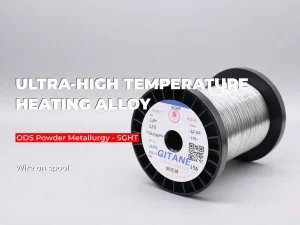
Standard ingot-melting FeCrAl suffers from grain growth above 1100°C, causing reduced room-temperature strength. Next-generation PM manufacturing synthesizes fine alloy powders mixed with Yttrium Oxide ($\text{Y}_2\text{O}_3$) nanoparticles, creating Oxide Dispersion Strengthened (ODS) alloys. These offer up to 4x higher sag resistance at 1400°C.
Green Hydrogen Atmosphere Compatibility
As green hydrogen ($H_2$) replaces natural gas in industrial reduction kilns, heating elements operate in highly reducing dry atmospheres. R&D focuses on pre-oxidized core-shell alloy wires that maintain an impermeable oxide barrier despite $H_2$ partial pressure, preventing hydrogen embrittlement.
Smart Thermal Monitoring Alloys
Integration of embedded nano-thermocouple phases directly within the resistance core structure. This permits real-time non-destructive monitoring of local watt density, temperature gradient, and residual oxidation thickness via automated IoT furnace control modules.
Macro Industry Heating Element Selection Matrix
How thermal engineers calculate element surface watt loading ($p$) and choose furnace atmosphere compatibility.
Calculation Formula for Surface Watt Loading
Designing long-life electrical resistance heating elements requires calculating the Surface Load ($p$, expressed in $W/cm^2$). Exceeding maximum recommended surface loading leads to localized overheating and early element burnout:
Where: P = Total Power required per phase (Watts), d = Wire Diameter (cm), L = Active Heated Length of Wire (cm).
Recommended maximum surface load for continuous furnace operation in air:
• FeCrAl Alloys (1200°C–1300°C): 1.5 – 2.5 $W/cm^2$
• NiCr Alloys (1000°C–1150°C): 2.0 – 3.2 $W/cm^2$
Furnace Atmosphere Tolerance Matrix
Furnace atmospheres radically change maximum allowable temperature limits due to oxidation/reduction chemical reactions with element protective oxides:
- Air / Oxygen: Optimal for both FeCrAl (forming $\alpha\text{-Al}_2\text{O}_3$) and NiCr (forming $\text{Cr}_2\text{O}_3$).
- Nitrogen ($N_2$): NiCr performs exceptionally well up to 1200°C. FeCrAl is prone to nitridation above 1050°C unless a pre-oxidized oxide film is preserved.
- Carburizing (CO / Gas): FeCrAl superior to NiCr. NiCr suffers from internal "Green Rot" oxidation/carburization attack between 800°C and 1000°C.
- Vacuum: NiCr volatilizes (Chromium evaporation) at extreme high vacuum and temperature; FeCrAl or PM FeCrAl is preferred.
Wholesale Heating Alloys & Structural Elements
Order factory-direct ISO certified resistance wire spools, bare elements, and precision cut strips.


Frequently Asked Engineering Questions
Expert answers regarding heating alloy selection, customization, quality assurance, and global supply logistics.