
Featured Green Rot & Temperature Resistant Wire Series
Explore our wholesale catalog of high-resistivity heating alloys engineered for severe industrial atmospheres.



Understanding Green Rot Corrosion in High-Temperature Resistance Alloys
In industrial furnace environments operating within the critical temperature band of 800°C to 1050°C (1472°F to 1922°F), conventional Nickel-Chromium (NiCr) electric heating elements frequently suffer catastrophic degradation known as "Green Rot". This phenomenon is a severe form of localized intergranular carburization coupled with selective chromium oxidation.
When heating wires operate in reducing atmospheres containing carbon monoxide ($CO$), hydrocarbons ($CH_4$, $C_3H_8$), or endothermic gas mixtures with low partial oxygen pressures ($P_{O2}$), carbon diffuses rapidly into the alloy matrix. Chromium ($Cr$) possesses an extremely high chemical affinity for carbon, causing the precipitation of chromium carbides ($Cr_{23}C_6$) along metallic grain boundaries.
This carbide precipitation strips the surrounding alloy matrix of free chromium, dropping localized chromium concentrations far below the critical threshold required to maintain a protective oxide scale. Upon subsequent exposure to trace oxygen or cycling atmospheres, the chromium-depleted nickel matrix oxidizes rapidly, forming a friable, porous green oxide scale ($NiO \cdot Cr_2O_3$). This leads to internal embrittlement, hot-spot formation, and sudden element fracture.
Green Rot Thermodynamic Mechanism
- Carburization Phase: $3CO + CH_4 + Alloy(Cr) \rightarrow Cr_{23}C_6 + H_2O + CO_2$
- Matrix Depletion: Grain boundary Cr level drops from ~20% to <7%.
- Selective Attack: Low $P_{O2}$ prevents continuous $Cr_2O_3$ passivating scale formation.
- Green Rot Mitigation: Substitution with Iron-Chromium-Aluminum (FeCrAl) alloys (e.g., 0Cr21Al6Nb, SGHYZ) forming dense $\alpha-Al_2O_3$ scales impenetrable to carbon diffusion.
Global Industrial Furnace Electrification & Green Rot Prevention
As heavy industry shifts from fossil fuel combustion to electrified thermal processing, managing atmospheric corrosion in continuous furnaces has become a top priority for thermal engineers.
Decarbonization Trends
Global net-zero mandates are accelerating the conversion of gas-fired carburizing furnaces to electric resistance heating. This transition requires alloy elements capable of enduring aggressive endothermic gas atmospheres without thermal degradation.
Alloy Micro-Alloying
Modern FeCrAl chemistry incorporates Rare Earth Elements (REE) such as Yttrium ($Y$), Zirconium ($Zr$), and Niobium ($Nb$). This micro-alloying enhances oxide scale adhesion, preventing spallation during rapid thermal cycling.
Operational Cost Optimization
Unplanned furnace downtime caused by premature element failure can cost industrial plants thousands of dollars per hour. Utilizing green-rot-resistant alloys increases mean time between failures (MTBF) by over 300%.
Technical Comparison: FeCrAl vs. NiCr Alloys in Carburizing Environments
Selecting the optimal resistance heating alloy requires analyzing furnace operating temperatures, gas compositions, surface load ratings (W/cm²), and resistance to green rot attack.
| Alloy Grade | Chemical Composition (%) | Max Temp (°C) | Resistivity at 20°C ($\mu\Omega\cdot\text{m}$) | Green Rot Resistance | Recommended Atmospheres |
|---|---|---|---|---|---|
| 0Cr21Al6Nb (SPARK) | Fe-Bal, Cr 21-23, Al 5.5-6.5, Nb 0.5 | 1350°C | 1.45 | Exceptional | Carburizing, Endothermic, Reducing, Oxidizing |
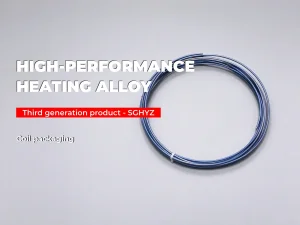
| SGHYZ Ultra-Temp | Fe-Bal, Cr 24-26, Al 6.0-7.5, REE Controlled | 1400°C | 1.50 | Superior | High-Carbon, Sintering, Vacuum, Low $P_{O2}$ |
| 0Cr25Al5 | Fe-Bal, Cr 23-26, Al 4.5-5.5 | 1250°C | 1.42 | Very Good | Industrial Furnaces, Air, Neutral Gas |
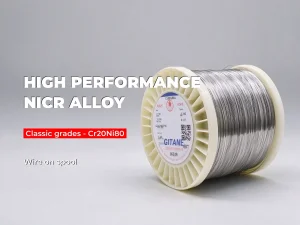
| Cr20Ni80 (Nichrome) | Ni 77-80, Cr 20-23, Fe < 1.0 | 1200°C | 1.09 | Poor (Vulnerable) | Clean Air, Oxidizing, Dry Nitrogen (No Carbon) |
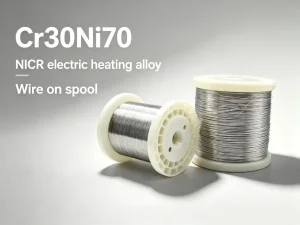
| Cr30Ni70 | Ni 65-71, Cr 28-31, Fe < 1.0 | 1250°C | 1.18 | Moderate | Exothermic, Low-Carbon Heat Treatment |
* Note: FeCrAl alloys form an alpha-alumina ($\alpha-Al_2O_3$) protective scale that acts as a absolute physical barrier to carbon diffusion, completely eliminating green rot corrosion mechanisms under normal operating parameters.
Global Standards Compliance & Localized Engineering Support
As a enterprise manufacturer operating out of Beijing, Shougang Gitane New Materials enforces strict quality control systems certified to ISO 9001:2015 and ISO 14001:2015. Our green rot resistant heating wires are engineered to conform with major international engineering benchmarks:
- ASTM B603: Standard Specification for Fe-Cr-Al Electrical Heating Alloys.
- DIN 17470: High-resistance materials for electric heating elements.
- JIS C2520: Electric resistance wires and ribbons for heating elements.
- GB/T 1234-2012: National Standard of China for High Resistance Electric Heating Alloys.
We maintain localized technical support networks across North America, Europe, Southeast Asia, and the Middle East, offering on-site thermal modeling, coil dimension calculations, and rapid wholesale dispatch.
Factory Verification & Export Packaging
To ensure zero degradation during sea freight transit, our wholesale heating wire spools and coils undergo multi-tier packaging:
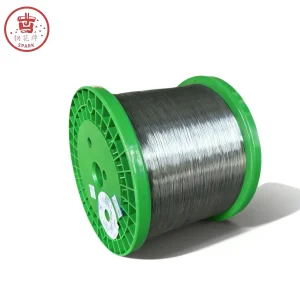
- Precision spooling (DIN 200, DIN 250, K355 spools) with uniform tension control.
- Vacuum-sealed aluminum foil barrier wrap with silica gel desiccant.
- Fumigated reinforced wooden cases with high-density foam dampening.
- 100% Spectrometric chemical verification (XRF/ICP) and resistance testing per master spool.
Industrial Application Scenarios for Green Rot Resistant Wire
Engineered to deliver exceptional thermal life across demanding continuous heating applications.
Automotive Heat Treating
Pusher kilns, mesh belt furnaces, and pit furnaces utilized for gas carburizing, carbonitriding, and case hardening of transmission gears and engine components.
Powder Metallurgy Sintering
High-temperature continuous belt sintering furnaces operating under cracked ammonia ($N_2/H_2$) or hydrocarbon gases where atmospheric dew points fluctuate.
Ceramic Kilns & Electronics
Firing kilns for technical ceramics, MLCC capacitors, and lithium battery cathode materials requiring contamination-free, non-spalling heating element surfaces.
Semiconductor Processing
Quartz heating cassettes and vertical diffusion furnaces demanding precise thermal uniformity ($\pm 0.5^\circ\text{C}$) up to 1350°C without creep-induced deformation.
R&D Roadmap: The Next Generation of High-Resistance Alloys
Shougang Gitane continues to advance high-temperature alloy research through our national-level metallurgy laboratories. Our 2025–2030 technology roadmap focuses on overcoming physical alloy limits in extreme conditions:
Oxide Dispersion Strengthened (ODS) FeCrAl
Integrating nano-scale Yttria ($Y_2O_3$) particles via powder metallurgy to boost high-temperature creep strength by 400%, allowing wire operation up to 1425°C without sags or deformation.
Ultra-Low Carbon Melting Technology
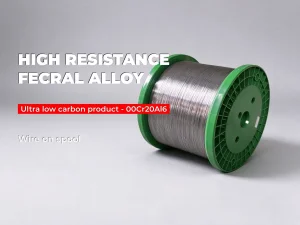
Refining VIM (Vacuum Induction Melting) processes to achieve carbon contents below 0.010% in FeCrAl (e.g., 00Cr20Al6), drastically lowering grain boundary sensitization.
Self-Healing Pre-Oxidation Treatments
Factory-applied pre-oxidation protocols that grow an optimized 2-micron thick $\alpha-Al_2O_3$ skin before shipment, providing immediate protection upon initial furnace ramp-up.
Partner with Shougang Gitane
Need custom alloy chemical ratios, specialized wire diameters (0.05mm to 12.0mm), or ribbon sizes for your furnace OEM production?
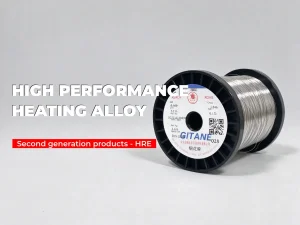
High Performance Resistance Alloys & Furnace Heating Elements
Complete product range available for global distribution, wholesale orders, and OEM equipment manufacturing.



Frequently Asked Questions on Green Rot & Resistance Wire Selection
Expert insights compiled by Senior SEO & Metallurgical Engineering Directors at Shougang Gitane.
What causes "Green Rot" in high-temperature heating wires, and how is it identified?
Green rot is a form of severe internal corrosion that attacks Nickel-Chromium (NiCr) alloys operating between 800°C and 1050°C in carburizing or reducing atmospheres with low oxygen activity. Carbon penetrates the alloy, binding with chromium to form chromium carbide ($Cr_{23}C_6$) precipitates along grain boundaries.
This strips chromium from the metallic matrix. When exposed to trace oxygen, the remaining nickel-rich matrix oxidizes into a characteristic bright green, powdery, porous scale ($NiO$). Visually, affected wires display severe swelling, a greenish fracture surface, high brittle fracture susceptibility, and a sudden drop in electrical resistance prior to burning out.
Why are FeCrAl alloys naturally immune to green rot compared to 80/20 Nichrome (Cr20Ni80)?
FeCrAl alloys (such as 0Cr21Al6Nb, 0Cr25Al5, and SGHYZ) contain 4.5% to 7.5% aluminum. When heated above 900°C, aluminum rapidly diffuses to the wire surface to form a continuous, thermodynamically stable alpha-alumina ($\alpha-Al_2O_3$) scale.
Unlike chromium oxide ($Cr_2O_3$) scales formed on NiCr alloys—which breakdown in carbon-rich, low-oxygen environments—the $\alpha-Al_2O_3$ ceramic layer possesses near-zero carbon permeability. It acts as an absolute physical barrier against carbon ingress, preventing carbide formation and totally eliminating green rot.
Which heating wire grade should be selected for endothermic gas carburizing furnaces?
For endothermic atmospheres containing elevated carbon potential ($CO$, $H_2$, $N_2$ mixtures), 0Cr21Al6Nb or SGHYZ FeCrAl alloys are strongly recommended. Niobium ($Nb$) additions in 0Cr21Al6Nb refine grain structure and enhance high-temperature creep strength, preventing sags in coiled element configurations.
If NiCr alloys must be utilized for structural design reasons, high-chromium/high-silicon grades such as Cr30Ni70 should be chosen, and atmosphere dew points must be closely monitored to prevent low $P_{O2}$ chromium stripping conditions.
How does Niobium (Nb) addition in 0Cr21Al6Nb improve high-temperature performance?
At temperatures above 1100°C, standard FeCrAl alloys can experience rapid grain growth, leading to low hot-yield strength and structural sagging under their own weight. Niobium forms stable niobium carbonitrides ($Nb(C,N)$) that pin grain boundaries, drastically inhibiting thermal grain coarsening. This improves creep resistance and structural rigidity, allowing longer spans between ceramic element support pins.
What surface load (W/cm²) limits should be applied when designing elements for reducing environments?
In reducing or carburizing atmospheres, surface load ratings must be de-rated by 20% to 35% compared to operation in clean air. While standard FeCrAl elements in air can run at 2.5 to 4.0 W/cm², operation in endothermic gas or hydrocarbon-rich kilns should be restricted to 1.4 to 2.2 W/cm² to prevent localized hot spots and maintain oxide skin integrity.
What are the wholesale ordering options, packaging standards, and lead times from Shougang Gitane?
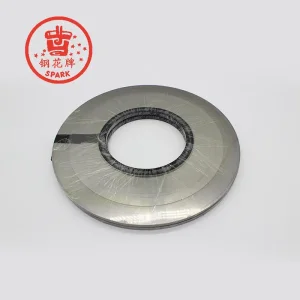
Shougang Gitane offers flexible factory-direct wholesale procurement. Wires are available in diameters from 0.05mm ultra-fine wire up to 12.0mm heavy industrial rod, as well as cold-rolled strip/ribbon (0.1x1.0mm to 4.0x50mm).
Standard export lead times range from 10 to 20 days depending on chemistry and drawing specifications. All orders ship with ISO 9001 quality certificates, 3.1 chemical analysis mill test reports, and fully vacuum-sealed moisture-proof export packaging.