
Featured Resistance Alloy Wires, Strips & Heating Elements
Explore our high-demand FeCrAl and NiCr electrothermal products manufactured under ISO9001:2015 strict quality management protocols.




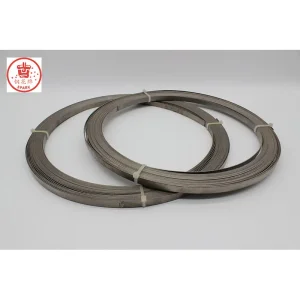

Engineering Depth: FeCrAl Resistance Strip Thermodynamics & Oxidation Kinetics
Iron-Chromium-Aluminum (FeCrAl) resistance strips are specialized electrothermal alloy products engineered for high-efficiency electric thermal energy conversion. Characterized by high electrical resistivity, extremely low thermal mass, and a remarkably low specific gravity compared to Nickel-Chromium (NiCr) alternatives, FeCrAl strips represent the premier solution for industrial thermal processing up to 1425°C.
Self-Healing Alpha-Alumina (α-Al₂O₃) Oxide Layer
Upon thermal activation above 1000°C, FeCrAl strips form a dense, non-porous monolayer of alpha-alumina oxide. This thermodynamically stable ceramic layer acts as an electrical insulator and diffusion barrier, preventing further inner metallic oxidation and protecting against corrosive ambient gases.
Weight-Saving Density Advantage
With a nominal density of ~7.10 g/cm³, FeCrAl is approximately 15% lighter than 80/20 Nickel-Chromium alloys (8.40 g/cm³). Procurement engineers receive greater total surface area and linear length per kilogram, yielding direct material cost savings without sacrificing power output.
Exceptional Electrical Resistivity
High electrical resistivity (ranging from 1.25 to 1.45 μΩ·m) permits smaller cross-sectional strip geometries and shorter element lengths. This maximizes power density while reducing overall furnace footprint and ceramic element support mass.
China FeCrAl Resistance Strip Factory Advantages & Quality Control
As a core manufacturing hub within the Shougang Group ecosystem, Beijing Shougang Gitane New Materials Co., Ltd. brings over six decades of metallurgical experience to global enterprise buyers.
Full Industry-Chain Integration
From initial vacuum induction melting (VIM) and electroslag remelting (ESR) through hot rolling, precision cold strip rolling, continuous bright annealing, and micro-slitting, our complete in-house manufacturing guarantees total metallurgical consistency across heats.
Micro-Alloy Rare Earth Modification
Our proprietary FeCrAl strip formulations incorporate trace additions of Reactive Elements (RE) such as Yttrium (Y), Zirconium (Zr), and Lanthanum (La). These rare-earth additives anchor the surface oxide film, drastically diminishing oxide spallation during rapid thermal cycling.
Ultra-Tight Dimensional Tolerances
Utilizing high-precision multi-roll cold rolling mills and automated laser gauge monitoring, our FeCrAl ribbons and strips achieve strip thickness tolerances within ±0.01mm, ensuring uniform electrical resistance and zero localized hot-spots.
FeCrAl Resistance Strip Industry Development & Roadmap
The global demand for high-performance FeCrAl resistance strips is accelerating due to aggressive global decarbonization mandates, industrial electrification, and the expansion of high-temperature processing sectors such as semiconductor ingot growth, lithium-battery material calcination, and green hydrogen synthesis.
| Technology Evolution Era | Primary FeCrAl Material Grades | Max Temp Range | Key Performance Drivers & Metallurgical Breakthroughs |
|---|---|---|---|
| 1st Gen: Standard Casting Alloys | 0Cr25Al5, 0Cr23Al5 | 1100°C – 1250°C | Basic oxidation resistance; prone to high-temperature grain growth and sag. |
| 2nd Gen: RE-Doped Alloys | 0Cr21Al6Nb, 0Cr27Al7Mo2, HRE | 1250°C – 1350°C | Addition of Niobium and Molybdenum increases hot yield strength and reduces grain boundary sliding. |
| 3rd Gen: Advanced Dispersion | SGHYZ, SG140 | 1350°C – 1400°C | Optimized rare-earth distribution; dense oxide adhesion for continuous industrial furnace operations. |
| 4th Gen: Powder Metallurgy (PM) | SGHT (SPARK Ultra-Grade) | 1400°C – 1425°C | Zero-decarburization, ultra-high creep resistance, non-sagging properties under structural tension. |
Localized Application Scenarios & Engineering Requirements
1. High-Power Braking Resistors
Deployment: Electric locomotives, heavy-duty mining trucks, wind turbine pitch control systems.
Strip Spec: Thick FeCrAl strips (1.5mm – 3.0mm thickness) with corrugated geometries for rapid heat dissipation and high surge power resistance.
2. Industrial Heat Treatment Furnaces
Deployment: Annealing, carburizing, tempering, and ceramic sintering lines.
Strip Spec: Meander/wavy folded strip elements suspended on ceramic tubes or embedded in refractory fiber modules operating at 1100°C – 1350°C.
3. Semiconductor & Solar Wafer Processing
Deployment: Photovoltaic diffusion furnaces and semiconductor thermal oxidation units.
Strip Spec: Ultra-pure SGHT powder metallurgy FeCrAl strips minimizing thermal drift and particle contamination.
4. Industrial Duct Heaters & Air Dryers
Deployment: Chemical process drying, HVAC industrial heaters, commercial food dehydrators.
Strip Spec: Slit ribbons with high surface-to-mass ratios for maximum convective heat transfer to high-velocity airflow.
Macro-Industry Engineering Solutions: Surface Load & Life Optimization
Maximizing FeCrAl strip element lifespan requires precise balance between surface power load ($W/\text{cm}^2$), furnace atmospheric environment, and mechanical mounting geometry.
Recommended Surface Load ($W/\text{cm}^2$) for FeCrAl Strip Elements
Surface load directly dictates the temperature differential between the element strip body and the surrounding furnace chamber. Operating beyond critical threshold limits leads to accelerated aluminum depletion and prematurely destroys the oxide scale.
| Furnace Operating Temperature | Air / Oxidizing Atmosphere | Nitrogen ($N_2$) Atmosphere | Hydrogen ($H_2$) / Reducing Atm |
|---|---|---|---|
| 800°C – 1000°C | 3.0 – 5.0 W/cm² | 2.0 – 3.0 W/cm² | 1.5 – 2.5 W/cm² |
| 1000°C – 1200°C | 1.8 – 3.0 W/cm² | 1.2 – 2.0 W/cm² | 1.0 – 1.8 W/cm² |
| 1200°C – 1350°C | 1.0 – 1.8 W/cm² | 0.8 – 1.2 W/cm² | Not Recommended |
Global Procurement Demands & Vendor Qualification Framework
When evaluating FeCrAl resistance strip manufacturers, international B2B procurement heads and OEM engineering teams must audit critical parameters to ensure long-term operational safety and compliance.
1. Chemical Composition & Mill Test Certificates
Insist on EN 10204 3.1 Mill Test Certificates detailing spectral heat analysis for Cr, Al, Fe, and trace RE additions. Ensure aluminum content matches design standards (e.g., 5.0–6.5% for 0Cr25Al5).
2. Cold Bend & Ductility Compliance
FeCrAl strips must pass 180° cold bend tests without edge cracking or micro-fractures prior to winding, ensuring effortless processing on automatic CNC winding equipment.
3. Packaging & Export Anti-Oxidative Protection
Strips must be delivered in moisture-sealed VCI (Vapor Corrosion Inhibitor) plastic wrapping within reinforced fumigated wooden cases to prevent salt-fog contamination during ocean transport.
Frequently Asked Technical Questions (FAQ)
Find authoritative answers to common engineering, procurement, and installation questions regarding FeCrAl resistance strips.
Expanded Resistance Alloys & Industrial Heating Tube Solutions
Complete electrothermal product range manufactured for extreme durability and global distribution.



Partner with China's Premier FeCrAl Resistance Strip Manufacturer
Get direct factory wholesale quotes, mill certificates, and custom strip sample kits. Our engineering team assists with power calculations and alloy selection for your specific industrial heating applications.