Featured FeCrAl & High-Temperature Alloy Products
Direct factory supply of precision resistance heating wires, ceramic tube cores, and specialty electrothermal elements engineered for extreme thermal operational envelopes.
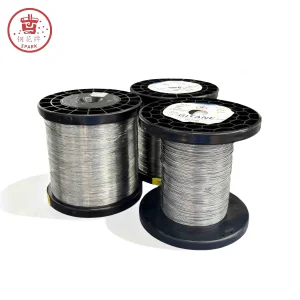
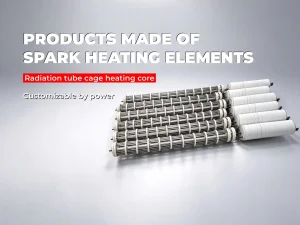





1. Metallurgical Foundations of Iron-Chromium-Aluminum (FeCrAl) Resistance Alloys
In modern high-temperature electrothermal engineering, FeCrAl (Iron-Chromium-Aluminum) heating alloys represent the premier material choice for continuous operating temperatures ranging from 1100°C up to 1425°C. Compared to conventional Nickel-Chromium (NiCr) alloys, FeCrAl alloys offer significant thermodynamic advantages, primarily driven by their microstructural phase composition and the unique self-passivating oxide scale mechanism that develops under high-temperature oxidative environments.
At the crystallographic level, FeCrAl alloys consist of a solid-solution ferritic ($\alpha$-Fe) matrix stabilized by high concentrations of Chromium (typically 20% to 24% by weight) and Aluminum (4.5% to 6.5% by weight). The presence of the ferritic structure yields a body-centered cubic (BCC) lattice, which inherently exhibits a higher electrical resistivity ($\rho \approx 1.25 - 1.45 \ \mu\Omega\cdot\text{m}$) and lower specific density ($\approx 7.10 \ \text{g/cm}^3$) than austenitic (FCC) NiCr resistance wires.
The core mechanism behind the extended life of FeCrAl heating wire lies in the selective oxidation of Aluminum. When exposed to temperatures above 1000°C, Aluminum rapidly migrates to the alloy surface, reacting with ambient Oxygen to form an ultra-dense, thermodynamically stable layer of alpha-alumina ($\alpha\text{-Al}_2\text{O}_3$). This ceramic oxide layer acts as a formidable diffusion barrier against further oxygen penetration and metallic volatilization, possessing superior electrical insulation properties at elevated temperatures compared to the chromium oxide ($\text{Cr}_2\text{O}_3$) scale formed on NiCr wires.
0Cr25Al5 & 0Cr23Al5 Grades
Standard industrial workhorses engineered for temperatures up to 1250°C. Offering high specific electrical resistance, robust resistance to sulfurized atmospheres, and exceptional price-to-performance metrics for kilns and heat-treating furnaces.
HRE & 0Cr20Al6 Wires
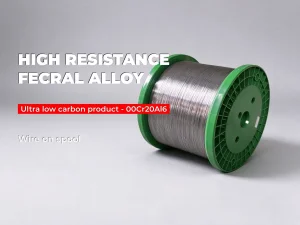
Enhanced with Rare Earth (RE) micro-alloying elements (such as Yttrium, Zirconium, and Cerium). RE additions refine grain boundaries, dramatically improve oxide scale adhesion, and eliminate spallation during thermal cycling up to 1350°C.
Powder Metallurgy SGHT Alloy
Manufactured via advanced dispersion-strengthened powder metallurgy. Designed for ultra-high temperature applications up to 1425°C, providing structural resistance against hot creep, sagging, and grain growth deformation.
2. Engineering Data & Comparative Technical Specifications
To assist electrothermal design engineers and industrial buyers in selecting the optimal resistance wire grade, the following matrix outlines the core physical, chemical, and thermal properties of standard and ultra-high-performance FeCrAl alloys alongside traditional NiCr variants.
| Alloy Grade | Alloy Type | Max Continuous Temp (°C) | Resistivity at 20°C (μΩ·m) | Density (g/cm³) | Melting Point (°C) | Atmosphere Suitability |
|---|---|---|---|---|---|---|
| SGHT (Powder Met) | FeCrAl (ODS) | 1425°C | 1.45 ± 0.05 | 7.10 | 1500°C | Air, Inert, Vacuum, Reducing |
| SGHYZ / HRE | FeCrAl + RE | 1350°C - 1400°C | 1.42 ± 0.05 | 7.10 | 1500°C | Air, Oxidizing, Sulfurous |
| 0Cr25Al5 | FeCrAl Standard | 1250°C | 1.42 ± 0.05 | 7.10 | 1500°C | Air, Carburizing-resistant |
| 0Cr23Al5 | FeCrAl Standard | 1250°C | 1.35 ± 0.05 | 7.25 | 1500°C | Air, General Industrial |
| Cr20Ni80 | NiCr Premium | 1200°C | 1.09 ± 0.05 | 8.40 | 1400°C | Air, Nitrogen, Ammonia |
| Cr15Ni60 | NiCr Standard | 1150°C | 1.11 ± 0.05 | 8.20 | 1390°C | Domestic Appliances, Low Temp |
Calculating Thermal Surface Load ($W/\text{cm}^2$): The surface load of an electric heating element is defined as the thermal output power divided by the surface area of the heating element wire. For FeCrAl heating wire operating in high-temperature industrial furnaces, maintaining an appropriate surface load ($1.5 - 3.2 \ \text{W/cm}^2$) ensures that the wire temperature does not exceed its maximum rating, preventing thermal runoff and premature element burn-out.
3. Integrated Manufacturing & China Supply Chain Capabilities
Leveraging deep industrial metallurgy ecosystems, state-of-the-art cold-drawing technology, and vertical integration to deliver global procurement confidence.
Full Vertical Integration
From vacuum induction melting (VIM) and electroslag remelting (ESR) to hot rolling, continuous wire drawing, bright annealing, and spooling. Full control over heat numbers guarantees batch-to-batch chemical homogeneity.
Strict ISO & GB/T Compliance
All FeCrAl resistance wire products strictly adhere to international standards including GB/T 1234-2012, ASTM B603, DIN 17470, and ISO 9001:2015 quality frameworks, accompanied by complete EN 10204 3.1 Mill Test Reports.
Cost Competitiveness
Eliminate intermediary markups through direct factory procurement. Optimized production scaling allows Chinese suppliers to deliver top-tier FeCrAl wire matching European equivalents at a 25% to 40% overall cost advantage.
4. Localized Application Scenarios & Engineering Implementations
FeCrAl heating wires are deployed globally across severe industrial operations where thermal precision, structural reliability, and energy efficiency are mandatory. Below are primary field application domains:
Industrial Kilns & Heat Treatment
Widely integrated into continuous tunnel kilns, box furnaces, roller hearth furnaces, and pit furnaces for annealing, hardening, normalizing, and ceramic firing operations up to 1350°C.
Semiconductor & Photovoltaic Ingot Growth
Utilized in high-purity single-crystal silicon ingot furnaces and polysilicon diffusion furnaces where strict resistance tolerances and low gas outgassing maintain wafer cleanliness.
Petrochemical & Radiant Heating Tubes
Formed into heavy-gauge spools and ceramic tube cores inside radiant heating tubes, supplying clean electric heat for hydrocarbon cracking and chemical processing lines.
5. Industry Trends & Technology Roadmap (2025–2030)
Driven by global industrial decarbonization mandates, the electrothermal equipment sector is rapidly transitioning from fossil fuel combustion to clean electric heating systems. This macro shift is driving technological innovation in FeCrAl alloy metallurgy along three key vectors:
1. Powder Metallurgy & ODS Development: Oxide Dispersion Strengthened (ODS) FeCrAl alloys, created by incorporating sub-micron Yttrium oxide ($\text{Y}_2\text{O}_3$) particles via mechanical alloying, represent the frontier of thermal performance. ODS FeCrAl eliminates high-temperature creep and grain growth, pushing continuous service limits past 1425°C while matching the mechanical robustness of ceramic elements.
2. Ultra-Low Carbon & Micro-Purification: Advanced VIM-ESR melting processes now allow mass production of ultra-low carbon FeCrAl alloys ($\text{C} < 0.015\%$). Low carbon content suppresses the formation of brittle Chromium carbides at grain boundaries, dramatically increasing the room-temperature ductility and re-usability of used heating wire.
3. Intelligent Coil Geometry & Pre-Oxidation: Leading manufacturers are providing pre-oxidized heating elements delivered with fully formed $\alpha\text{-Al}_2\text{O}_3$ coatings directly from the factory, reducing installation commissioning times and mitigating initial oxidation damage.
6. Localized Logistics, Packaging & Compliance Safeguards
International procurement of bulk electrothermal wire demands seamless packaging logistics and regulatory compliance. Direct factory exporters implement comprehensive shipping protocols to protect fine and heavy-gauge wires during long-haul ocean and air transit:
Custom Spooling & Coil Packing
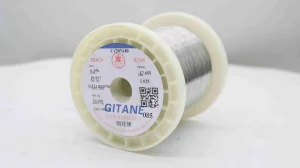
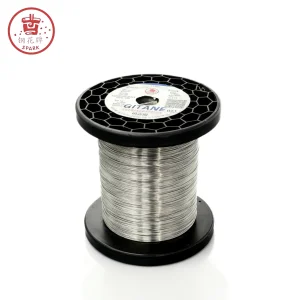
Fine wires ($\varnothing 0.05\text{mm} - 0.80\text{mm}$) are precision-wound on ABS plastic spools (DIN 100 to DIN 355), sealed in vacuumed anti-corrosion moisture foil bags. Heavy wires ($\varnothing > 1.0\text{mm}$) are supplied in bound coils wrapped with protective plastic film and burlap wrapping.
Seaworthy Fumigated Crating
All wholesale shipments are packaged in reinforced ISPM-15 compliant export plywood cases to withstand dynamic maritime stresses, humidity variation, and mechanical stacking forces.
Environmental & REACH Compliance
FeCrAl wires are fully compliant with EU Directive 2011/65/EU (RoHS 2.0) and REACH (EC 1907/2006) regulations, containing zero restricted heavy metals, lead, or toxic chemical residue.
Frequently Asked Questions (Technical Procurement FAQ)
Expert answers to critical engineering, metallurgical, and sourcing questions regarding FeCrAl wholesale supply.
Why choose FeCrAl heating wire over Nickel-Chromium (NiCr) wire for industrial furnaces?
How does furnace atmosphere impact the lifespan of FeCrAl heating elements?
What prevents FeCrAl heating wire from sagging at ultra-high temperatures?
What are the recommended manufacturing tolerances and resistivity testing standards?
What is the typical delivery time and Minimum Order Quantity (MOQ) for factory direct orders?
Additional Alloy Wires & Industrial Heating Solutions
Explore our complete catalog of precision Nickel-Chromium resistance wires, ultra-low carbon alloys, and specialized industrial electrothermal elements.