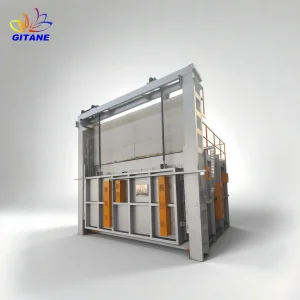
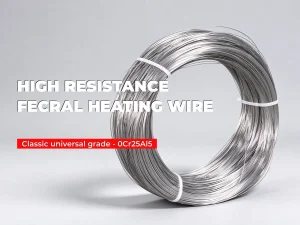
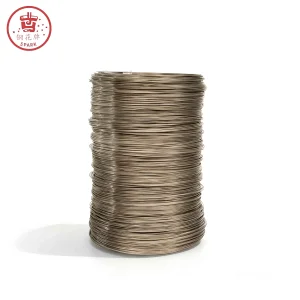
Featured FeCrAl & Electrothermal Wire Series (Part I)
Explore our factory-direct, high-temperature FeCrAl and NiCr electrothermal resistance wires engineered as fully compatible equivalents to European and American standard grades (including Kanthal A1, APM, AF, and Nichrome 80).



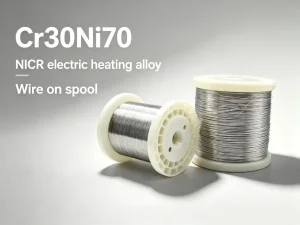

Metallurgical Foundations of Equivalent Iron-Chromium-Aluminum (FeCrAl) Alloys
In modern high-temperature thermal processing, selecting the right electrothermal resistance material dictates thermal efficiency, system longevity, and overall operational expenditure. Iron-Chromium-Aluminum (FeCrAl) alloys stand at the pinnacle of solid-state electrical resistance heating. Renowned for their exceptionally high electrical resistivity ($\rho_{20} \approx 1.25 - 1.45 \ \mu\Omega\cdot\text{m}$), low mass density, and superior oxidation kinetics, high-grade FeCrAl resistance wire serves as the back-bone of industrial kilns, semiconductor annealing furnaces, automotive exhaust systems, and high-wattage household appliances.
When global original equipment manufacturers (OEMs) and furnace engineering firms search for wholesale equivalent FeCrAl resistance wire manufacturers, they seek strict metallurgical parity with benchmark brand names such as Kanthal® A-1, APM, AF, and D. Equivalent wire manufacturing does not mean compromised quality; rather, it refers to precise chemical composition engineering, vacuum induction melting (VIM), controlled grain-boundary micro-doping with reactive elements (Yttrium, Zirconium, Hafnium, and Neodymium), and exact physical-property matching compliant with international standards such as ASTM B603, DIN 17470, and GB/T 1234-2012.
Global Alloy Equivalency & Physical Specification Matrix
To streamline engineering procurement, our manufacturing facilities produce equivalent grades that precisely correspond to global designation codes. The table below details chemical formulations, thermal characteristics, and international equivalence for high-temp FeCrAl resistance wires.
| Chinese Standard Grade | Global Equivalent Grade | Nominal Chemical Composition (%) | Max Temp (°C) | Resistivity ($\mu\Omega\cdot\text{m}$) | Primary Industrial Application |
|---|---|---|---|---|---|
| 0Cr27Al7Mo2 / SGHT | Kanthal® APM / APME | Fe-Bal, Cr 26-28, Al 6.5-7.5, Mo 2.0+RE | 1425°C | 1.45 | Diffusion furnaces, ceramic sintering, heavy kilns |
| 0Cr25Al5 / HRE | Kanthal® A-1 / Alkrothal 720 | Fe-Bal, Cr 23-26, Al 4.5-5.5, Y/Zr Doped | 1400°C | 1.42 | Industrial heat treatment, radiant tube heaters |
| 0Cr21Al6Nb | Kanthal® AF / Resistance 135 | Fe-Bal, Cr 21-23, Al 5.3-6.2, Nb 0.5+RE | 1350°C | 1.39 | Precision lab furnaces, embedded ceramic heaters |
| 0Cr23Al5 | Kanthal® D / Alloy 815 | Fe-Bal, Cr 22-24, Al 4.8-5.3 | 1250°C | 1.35 | Commercial appliances, braking resistors, air heaters |
| 0Cr21Al4 | Alchrome / Kanthal® L | Fe-Bal, Cr 20-22, Al 3.5-4.5 | 1100°C | 1.25 | Domestic heating elements, defrosting rods |
Electrical & Thermal Physics Benchmarks
FeCrAl wires exhibit a positive temperature coefficient of resistance (CT). As temperatures climb from ambient to 1400°C, the resistivity factor $C_t$ scales predictably ($R_T = R_{20} \times C_t$). This stable resistance curve allows furnace control systems (PID / SCR triggers) to maintain pinpoint thermal balance without catastrophic current surges.
Mechanics of Reactive Element Doping (REE)
By introducing trace amounts of Yttrium ($Y$), Zirconium ($Zr$), and Niobium ($Nb$), our powder metallurgy (PM) and melt refinement routes key into the "Reactive Element Effect". This eliminates grain growth creep at elevated temperatures and prevents catastrophic oxidation spallation during rapid thermal cycling.
Global Industrial Landscape & Supply Demand Drivers
The global transition toward decarbonization and industrial electrification has catalyzed unprecedented demand for high-performance electric heating elements. Traditional fossil-fuel-fired industrial kilns in Western Europe and North America are rapidly being retrofitted with zero-emission electric resistance heating systems. This macro shift has placed tremendous pressure on traditional alloy suppliers, resulting in extended lead times (often exceeding 26–40 weeks) and inflated unit costs.
Semiconductor & Photovoltaic Boom
The expansion of silicon wafer manufacturing, solar cell diffusion furnaces, and MOCVD equipment requires consistent high-purity heating wire capable of operating in ultra-clean, controlled atmospheres without contaminating process wafers.
Lithium-Ion Battery Processing
Production of LFP and NCM cathode active materials relies heavily on continuous roller hearth kilns (RHK). These kilns demand thousands of meters of ultra-stable 0Cr21Al6Nb and 0Cr27Al7Mo2 FeCrAl resistance wire operating non-stop at 1150°C–1250°C.
Supply Chain Diversification
Industrial buyers are shifting from single-source monopolies to agile OEM manufacturing partners in China who can deliver fully traceable, certified FeCrAl equivalent wires with identical thermal life cycles at a significantly optimized total cost of ownership (TCO).
Localized Application Scenarios & Field Engineering
FeCrAl resistance wires are adapted across diverse technical environments. Understanding localized operating dynamics ensures optimal alloy selection and element longevity.
1. High-Temperature Industrial Kilns
In ceramic sintering, brick firing, and glass melting kilns, furnace elements are subject to high surface watt loadings ($1.5 - 2.5 \ \text{W/cm}^2$). Using 0Cr27Al7Mo2 (APM Equivalent) wire in rod or heavy-gauge coiled form prevents sagging and structural fatigue. The continuous $\alpha\text{-Al}_2\text{O}_3$ layer resists sulfur oxide ($SO_x$) gas attack present in mineral clays.
2. Semiconductor Thermal Processing
Horizontal and vertical wafer diffusion furnaces require zero particulate spallation. Equivalent 0Cr21Al6Nb (Kanthal AF Equivalent) is precision-drawn into clean-finish wire. Its low iron-oxide vapor pressure ensures ultra-clean operations during high-temp silicon oxidation steps up to 1200°C.
3. Heat Treating & Carburizing Furnaces
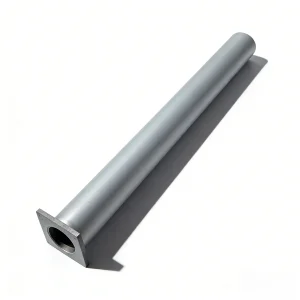
In automotive component hardening furnaces operating under endothermic or carburizing atmospheres, standard wires risk green rot and carbon pickup. Pre-oxidized FeCrAl wire elements, protected by dense ceramic radiant tubes, deliver superior service life compared to traditional Nickel-Chromium alloys.
4. Commercial & Home Appliances
For quartz heaters, mica-insulated hair dryers, toaster elements, and convection ovens, thin-gauge fine wire (0.10mm to 0.80mm of 0Cr23Al5) offers maximum electrical resistance in compact physical envelopes, reducing total element weight by up to 15% versus NiCr wire.
China Factory Supply Chain Resilience & Manufacturing Efficiency
As a primary manufacturing base for specialized electrothermal alloys, China's integrated industrial ecosystem provides unparalleled structural advantages for global wholesale buyers seeking high-reliability FeCrAl resistance wire.
Upstream Raw Material Security
Direct proximity to high-purity chromium deposits, primary aluminum refineries, and abundant rare-earth element (Yttrium, Neodymium, Hafnium) processing centers guarantees uninterrupted production and precise chemical purity control down to parts-per-million (PPM) thresholds.
Fully Integrated Production Lines
From Vacuum Induction Melting (VIM) and Electroslag Remelting (ESR) to hot rolling, multi-pass cold drawing, hydrogen bright annealing, and automated spooling—every process step occurs in-house. This seamless flow eliminates third-party transport delays and maintains strict metallurgical traceability.
Scale & Lead Time Superiority
Our partner facilities house over 50 wire-drawing machines and continuous strand annealing lines capable of outputting hundreds of metric tons per month. Standard wire gauges (0.5mm to 8.0mm) can be dispatched within 10–14 business days, reducing inventory downtime for international buyers.
Technical Roadmap & Future Outlook: Next-Gen Resistance Alloys
As thermal processing demands push closer to physical limits, advanced metallurgical research is steering the evolution of Iron-Chromium-Aluminum resistance alloys over the coming decade.
1. Oxide Dispersion Strengthened (ODS) FeCrAl
By introducing nano-scale yttria ($\text{Y}_2\text{O}_3$) particles through mechanical alloying and powder metallurgy, next-generation FeCrAl wire achieves virtually zero creep at 1400°C. ODS FeCrAl elements will enable horizontal suspended elements to operate without ceramic support tube sagging.
2. Engineered Micro-Pre-Oxidation Coatings
Factory-applied plasma or thermal pre-oxidation treatments build a dense, uniform $3-5 \ \mu\text{m}$ $\alpha\text{-Al}_2\text{O}_3$ shell prior to wire delivery. This eliminates the customer's initial conditioning phase, preventing early oxidation failures in corrosive process gases.
3. Smart Thermal Monitoring & Digital Twins
Integration of real-time electrical resistance monitoring with AI-driven digital twin models allows predictive maintenance. By tracking tiny incremental changes in wire resistance ($\Delta R$), operators can schedule element replacement prior to catastrophic physical rupture.
Localized Technical Support, Quality Control & Compliance Assurance
Deploying specialized resistance alloys requires comprehensive engineering verification and strict international compliance standards.
ISO 9001:2015 & Mill Inspection
Every batch of wholesale equivalent FeCrAl wire is shipped with certified 3.1 Mill Test Certificates (MTC). Chemical analysis (via ICP-OES), electrical resistivity testing at 20°C, yield strength, tensile elongation, and spool tension uniformity are comprehensively documented.
RoHS & REACH Compliance
All alloys comply fully with EU RoHS 3 directives and REACH chemical safety frameworks, ensuring zero hazardous substance contamination (Lead, Cadmium, Hexavalent Chromium free), making them safe for sanitary and domestic appliance usage globally.
Application Engineering Support
Our dedicated engineering team assists client procurement departments with precise element sizing calculations, coil pitch ratio ($\text{S}/\text{D}$) recommendations, maximum surface load ($W/cm^2$) modeling, and custom drawing design for pre-formed helical coils or wave-shaped strip elements.
Frequently Asked Questions (Technical Procurement Q&A)
Get direct technical insights into selecting, installing, and maintaining equivalent FeCrAl resistance wire products.
Featured FeCrAl & Electrothermal Wire Series (Part II)
Browse our complete line of industrial heating elements, specialty alloys, and precision furnace wires available directly from our certified manufacturing plants with full OEM/ODM support.