
Featured Industrial Resistance Alloys & Heating Cores
Precision-engineered electrical resistance heating materials certified for ultra-high temperature industrial furnaces, thermal processing, and heavy equipment manufacturing.





Engineering Metallurgy of Electric Heating Materials
An authoritative guide to material selection, oxide dynamics, and thermodynamic degradation mechanisms in extreme industrial thermal processing environments.
FeCrAl Metallurgy & $\alpha$-Alumina Passivation
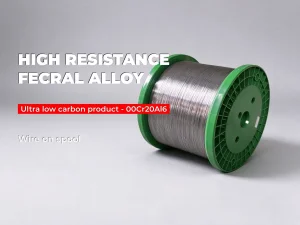
FeCrAl alloys (e.g., 0Cr25Al5, 0Cr21Al6Nb, SGHYZ) rely on the formation of a self-healing, non-porous $\alpha\text{-Al}_2\text{O}_3$ oxide layer at temperatures exceeding 1000°C. This scale exhibits exceptional electrical resistivity and chemical inertness against oxidizing and sulfurous environments up to 1425°C.
NiCr Alloys & High Hot Strength
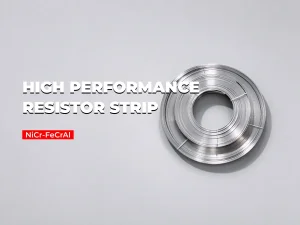
Nickel-Chromium alloys (e.g., Cr20Ni80, Cr15Ni60) develop a tenacious Chromia ($\text{Cr}_2\text{O}_3$) scale. While limited to 1200°C maximum continuous operation, NiCr provides superior mechanical ductility post-heating, higher hot yield strength, and immunity to green-rot embrittlement under reducing atmospheres.
Surface Loading Optimization ($W/\text{cm}^2$)
Extending element lifespan requires balancing power density against thermal dissipation. Designing elements within conservative surface load limits ($1.5 - 3.5 W/\text{cm}^2$ for industrial kilns) prevents localized hot spots, sagging, and dielectric breakdown of supporting ceramic refractory bricks.
Industrial Resistance Alloy Specification Matrix
Comparative analysis of standard and proprietary metallurgical formulations for industrial furnace designers and wholesale procurement managers.
| Alloy Grade | Composition Class | Max Temp (°C) | Resistivity at 20°C ($\mu\Omega\cdot\text{m}$) | Density ($\text{g/cm}^3$) | Primary Industrial Applications |
|---|---|---|---|---|---|
| SGHT | Powder Metallurgy FeCrAl | 1425°C | 1.45 | 7.10 | Semiconductor diffusion, ceramic sintering, high-temperature kilns. |
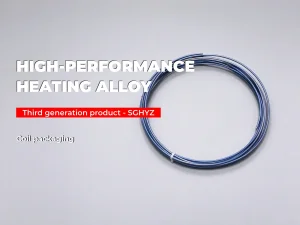
| SGHYZ | Advanced FeCrAl + Rare Earth | 1400°C | 1.42 | 7.10 | Heavy industrial heat-treatment furnaces, powder metallurgy. |
| 0Cr21Al6Nb | Niobium-Doped FeCrAl | 1350°C | 1.45 | 7.10 | Radiant tube heating cores, industrial annealing lines. |
| 0Cr25Al5 | Standard FeCrAl | 1250°C | 1.42 | 7.10 | Industrial tempering, ceramic kilns, domestic heating elements. |
| Cr20Ni80S | Premium NiCr Alloy | 1200°C | 1.09 | 8.40 | Precision medical devices, heat-treating in controlled atmospheres. |
| Cr15Ni60 | Economy NiCr Alloy | 1150°C | 1.11 | 8.20 | Appliance heating, braking resistors, low-temperature ovens. |
Technology Roadmap & Future Outlook for Electric Heating Materials
Accelerating global industrial decarbonization through next-generation powder metallurgy, oxide dispersion strengthening, and digital thermal modeling.
Powder Metallurgy (PM) & ODS Processing
Traditional ingot melting suffers from grain growth and sagging at temperatures above 1300°C. Advanced Powder Metallurgy (PM) combined with Oxide Dispersion Strengthening (ODS)—dispersing Yttrium oxide ($\text{Y}_2\text{O}_3$) nanoparticles within the metallic matrix—prevents high-temperature creep and extends element operating lifetime by up to 300% under continuous thermal stress.
Industrial Decarbonization & Fossil-to-Electric Transition
Global net-zero mandates are compelling steelmakers, glass producers, and chemical processing facilities to retrofit gas-fired burners with zero-emission electric resistance heating systems. High-power radiant tube heating cores and megawatt-scale electric furnace elements represent the backbone of sustainable heavy industrial thermal processing.
Micro-Alloying & Rare Earth Tuning
Precision micro-doping with Zirconium (Zr), Hafnium (Hf), and Niobium (Nb) fundamentally modifies oxide scale nucleation kinetics. This creates an engineered interfacial bonding lock between the alumina scale and the bulk alloy, eliminating spallation caused by severe thermal shock during rapid power cycling.
Macro Industry Solutions & Tailored Thermal Architectures
Delivering specialized alloy compositions and element geometries tailored to unique chemical, physical, and thermal operational boundaries.
Semiconductor & Photovoltaics
Single-crystal silicon ingot pulling (Czochralski process) and solar cell diffusion furnaces demand ultra-pure, iron-contamination-free environments. Our SGHT PM alloys ensure extreme thermal uniformity across wafer zones without generating airborne metallic particulates.
Automotive EV Battery & Metallurgy
Sintering lithium-ion cathode active materials (CAM) and heat-treating EV aluminum structural castings require precise atmosphere control. High-density FeCrAl ribbon elements deliver efficient radiative transfer in continuous roller hearth kilns.
Petrochemical & Clean Hydrogen
High-temperature cracking, steam methane reforming (SMR), and hydrogen superheating require high creep resistance and resistance to carburization ("dusting"). Specialized Cr20Ni80S and 0Cr21Al6Nb alloys maintain integrity in hydrocarbon-rich gas streams.
Glass Tempering & Advanced Ceramics
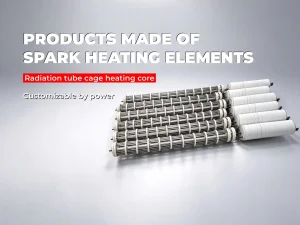
Bending and tempering architectural glass plus firing technical structural ceramics require thermal stability up to 1350°C. Ceramic radiant tube cores powered by SPARK resistance spirals guarantee uniform heat distribution without local hot spots.
China Factory 4.0: Metallurgical Precision & Supply Chain Resilience
Leveraging over six decades of metallurgical heritage under Beijing Shougang Gitane New Materials Co., Ltd. to set global standards in alloy purity and manufacturing consistency.
Vacuum Induction Melting (VIM) & ESR Refining
Our integrated mill process begins with ultra-clean raw material selection melted via Vacuum Induction Melting (VIM) followed by Electroslag Remelting (ESR). This minimizes tramp elements (Lead, Sulfur, Phosphorus), preventing grain boundary segregation during high-temperature service.
Precision Cold Drawing & Continuous Annealing
State-of-the-art multi-pass wire drawing machines with real-time laser diameter gauge control ensure strict dimensional tolerances ($\pm 0.01\text{ mm}$). Hydrogen-atmosphere bright annealing lines maintain shiny, oxide-free surfaces with consistent tensile strength and ductility.
Full Traceability & Digital Batch Control
Every coil, strip, and fabricated element is tagged with a unique digital QR identifier. From ladle chemical spectroscopy to final resistance testing, complete heat traceability is archived, enabling zero-defect quality assurance for critical global projects.
Global Enterprise Procurement Requirements & Selection Framework
A strategic roadmap for industrial buyers, EPC contractors, and OEM purchasing managers seeking to optimize Total Cost of Ownership (TCO).
1. Total Cost of Ownership (TCO) Evaluation
While FeCrAl raw material unit costs are typically lower than NiCr, evaluating TCO requires accounting for element lifetime, energy efficiency (due to lower alloy density), maintenance downtime, and refractory wear. FeCrAl provides up to a 15% weight saving over NiCr for identical power output.
2. Standards Compliance Verification
Wholesale procurement must verify adherence to international metallurgical standards including GB/T 1234-2012, ASTM B603 (FeCrAl), ASTM B344 (NiCr), and DIN 17470. Mill Test Certificates (MTC) according to EN 10204 3.1 are provided with every shipment.
3. Custom Fabrication & Delivery Forms
To eliminate onsite manufacturing bottlenecks, we offer fully finished delivery forms: pre-wound spiral coils, meander ribbons, ceramic radiant tube cores, and pre-formed heating frame assemblies customized to engineering blueprints.
Localized Support, Compliance Assurance & Quality Governance
Combining global manufacturing scale with localized engineering consulting and international environmental compliance.
RoHS & REACH Environmental Compliance
All SPARK electrical resistance heating alloys strictly conform to EU RoHS 3 (Directive 2015/863) and REACH regulations, confirming zero hazardous heavy metals (Cadmium, Lead, Mercury, Hexavalent Chromium) in industrial output.
Export Logistics & Protective Packaging
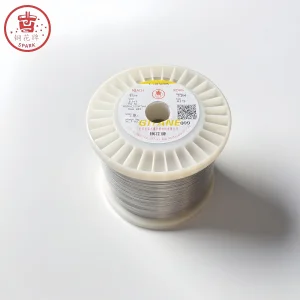
Resistance wires and strips are vulnerable to physical impact and atmospheric moisture during ocean transport. We utilize vacuum-sealed moisture-proof foil wrapping, plastic spools, and heavy-duty ISPM-15 compliant wooden cases for global export.
Direct Application Engineering Support
Our team of metallurgical and thermal engineers assists buyers with furnace power calculations, surface loading optimization, pitch-to-diameter ratio selection, and life expectation modeling prior to order placement.
Frequently Asked Questions (FAQ)
In-depth technical answers addressing user search intent, material selection challenges, and operational considerations.
Wholesale Resistance Heating Wire & Structural Elements
Explore our complete range of certified wire, strip, radiant heating cores, and high-temperature alloy grades ready for global dispatch.



Optimize Your Thermal Process Efficiency Today
Contact our engineering team for detailed technical datasheets, customized element calculations, or factory-direct wholesale quotations.
Connect With Engineering Team