
High-Performance Electric Heating Alloy Products
Engineered for high temperature resistance, superior oxidation protection, and prolonged structural service life in harsh industrial furnace environments.


Global Trends in Electric Heating Alloy Tube Manufacturing
How decarbonization, advanced powder metallurgy, and thermal automation are redefining high-temperature industrial heating standards.
Decarbonization & The Shift to All-Electric Thermal Processing
The global industrial sector is undergoing a monumental energy transition. Heavy industries—including steel annealing, ceramic sintering, aluminum processing, and petrochemical refining—are aggressively replacing gas-fired combustion burners with high-efficiency electric radiant tube heating systems. Driven by stringent carbon tax frameworks and global net-zero commitments, industrial operators are leveraging direct electric resistance heating to eliminate scope-1 combustion emissions.
Electric heating alloy tubes play a dual critical role in this transition: serving as high-resistivity internal heating elements and as robust, thermal-shock-resistant protective sheathing (radiant tubes) that isolates heating elements from corrosive furnace atmospheres. As operating temperatures scale toward 1400°C, material demands shift heavily toward advanced Iron-Chromium-Aluminum (FeCrAl) and Nickel-Chromium (NiCr) specialized alloy tubes.
Powder Metallurgy & Oxide Dispersion Strengthened (ODS) Alloys
Traditional ingot-metallurgy electrothermal alloys suffer from thermal creep and grain growth when exposed continuously to temperatures exceeding 1200°C. Modern industrial requirements have catalyzed the development of Powder Metallurgy (PM) FeCrAl alloy tubes (such as specialized SGHT and SGHYZ grades).
By utilizing rapid-solidification powder synthesis combined with dispersion of rare-earth oxides (Y2O3, Zr, Hf), PM alloys establish an exceptionally stable fine-grained microstructure. This metallurgical architecture provides unprecedented sag resistance, high temperature yield strength, and the formation of a dense, self-healing Alpha-Alumina ($\alpha-Al_2O_3$) protective scale that dramatically extends service lifespan under continuous thermal cycling.
FeCrAl vs. NiCr Electric Heating Alloy Tubes Engineering Comparison
Selecting the optimal alloy composition requires balancing maximum continuous service temperature, atmospheric compatibility, mechanical strength, and electrical resistivity.
| Alloy Grade / Family | Metallurgical Composition | Max Operating Temp (°C) | Electrical Resistivity (μΩ·m, 20°C) | Oxide Film Characteristics | Primary Application Environments |
|---|---|---|---|---|---|
| SGHT / SGHYZ (FeCrAl-PM) | Fe-Cr25-Al6 + Rare Earths (Y/Zr) | 1400°C - 1425°C | 1.45 - 1.50 | Adherent, continuous $\alpha-Al_2O_3$ (Alpha Alumina) | Semiconductor diffusion, high-temperature ceramic kilns, continuous annealing lines |
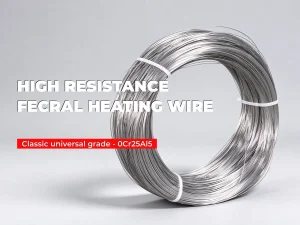
| 0Cr25Al5 / HRE (FeCrAl) | Fe-Cr25-Al5.5 | 1250°C - 1350°C | 1.42 | Dense Al2O3 scale, excellent electrical insulation | Industrial furnace radiant tubes, heat treating, powder metallurgy sintering |
| Cr20Ni80 (Nichrome) | Ni78-Cr20-Si-Fe | 1200°C | 1.09 | Cr2O3 (Chromium Oxide), high ductility post-heating | Carburizing atmospheres, rapid cycle heating, chemical immersion tubes |
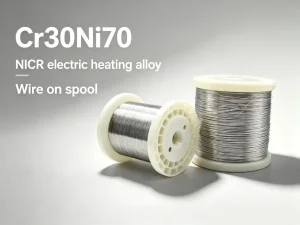
| Cr30Ni70 (High Cr NiCr) | Ni67-Cr30-Si | 1250°C | 1.18 | Heavy Cr2O3 scale, superior green-rot resistance | Petrochemical cracking heaters, aggressive sulfur-free chemical furnace tubes |
China Industry 4.0: Metallurgical Supply Chain Resilience & Cost Advantages
Leveraging state-of-the-art melt technology, fully integrated cold drawing, and automated non-destructive testing to deliver global excellence.
End-to-End Vertical Integration
From Vacuum Induction Melting (VIM) and Electro-Slag Remelting (ESR) to hot extrusion, cold rolling, precision tube drawing, and bright annealing—our fully integrated manufacturing chain eliminates intermediary supply risks and ensures absolute chemical homogeneity across every production batch.
Strict Quality Assurance & Standards
Operating strictly under GB/T 1234-2012, ASTM B603, DIN 17470, and ISO 9001:2015 certifications. Every electric heating alloy tube undergoes ultrasonic flaw detection, eddy current inspection, pneumatic pressure testing, and precise dimensional laser verification prior to global dispatch.
Cost Efficiency & Scale
Our 39,268 m² modernized production workshops and lean manufacturing frameworks deliver unmatched cost competitiveness. By optimizing material utilization and utilizing high-speed automated rolling lines, we offer wholesale buyers direct factory pricing without sacrificing premium quality.
Industrial Engineering & Localized Deployment Scenarios
Customized electric heating alloy tubes optimized for severe operational stress, corrosive gas protection, and uniform radiant flux.
Petrochemical Thermal Cracking & Superheating
In hydrocarbon refining and synthesis chemical production, heating tubes are exposed to aggressive sulfurized and high-pressure steam environments. Specialized SGHT and Cr30Ni70 sheaths prevent hydrogen embrittlement and resist high-temperature oxidation up to 1250°C, maintaining dimensional stability under severe thermal stress.
Photovoltaic & Semiconductor Crystal Growth
Photovoltaic silicon ingot furnace chambers demand ultrapure, non-contaminating heating environments. Powder metallurgy FeCrAl radiant tubes generate a impermeable $\alpha-Al_2O_3$ surface layer that prevents particle spallation, ensuring silicon purity and maintaining razor-thin temperature uniformity across the chamber.
Continuous Annealing Lines (CAL/CGL) in Metallurgy
Steel sheet processing facilities utilize W-type, U-type, and single-ended radiant heating tubes. High-resistance FeCrAl heating tubes provide ultra-high watt density output, rapid response to thermal management controllers, and low sagging characteristics across horizontal tube spans exceeding 3 meters.
Strategic B2B Sourcing Guide: Total Cost of Ownership (TCO) Optimization
How procurement managers and technical directors can reduce long-term operational costs by evaluating key metallurgical criteria.
Evaluating Beyond Initial Price Per Kilogram
When sourcing wholesale electric heating alloy tubes, focusing solely on purchase price per ton or meter often leads to premature furnace failure and costly operational downtime. A comprehensive Total Cost of Ownership (TCO) evaluation factors in:
- Specific Weight Efficiency: FeCrAl alloys possess a density of ~7.1g/cm³, compared to NiCr’s ~8.4g/cm³. This 15%+ weight reduction yields lower raw material weight for identical tube surface areas.
- Surface Watt Loading Capacity (W/cm²): Higher allowable watt density translates to fewer heating elements required to meet furnace kilowatt ratings.
- Resistance to Thermal Creep & Sagging: Advanced PM alloys eliminate frequency of manual tube realignment and sheathing replacement cycles.
Atmospheric Compatibility Criteria
Selecting the wrong alloy sheathing for controlled furnace atmospheres accelerates destruction via carburization ("green rot"), nitriding, or rapid oxidation:
- Oxidizing & Air Atmospheres: FeCrAl alloys excel due to dense Alumina formation up to 1425°C.
- Carburizing / Endothermic Gas: NiCr alloys (e.g., Cr20Ni80) form protective Chromia scales resilient against carbon ingress.
- Nitrogen / Ammonia Atmospheres: FeCrAl can form brittle Aluminum Nitride (AlN); NiCr or specialized low-Al alloys are strongly advised.
Frequently Asked Questions by Industrial Buyers & Procurement Teams
Expert answers to critical engineering and procurement inquiries regarding electric heating alloy tubes.
Explore Additional Resistance Alloy & Tube Solutions
Browse our complete line of factory-direct electrothermal wires, tubes, and specialty furnace alloys.




Ready to Optimize Your Industrial Thermal Systems?
Get direct factory quotes, technical consultation, custom drawing evaluations, and material samples directly from our engineering team.