
Featured Industrial Heating Alloy Wire & Elements
Direct factory supply of premium FeCrAl and NiCr thermal resistance alloys engineered for maximum thermal conductivity, oxidation resistance, and long-cycle stability.
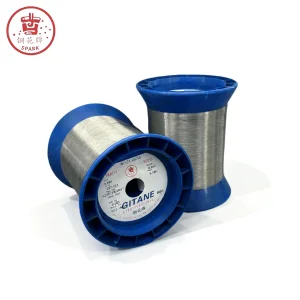

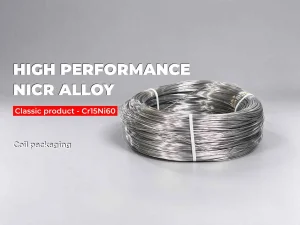
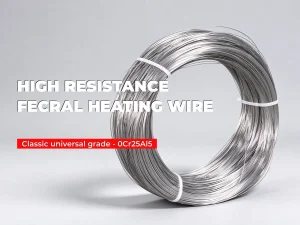
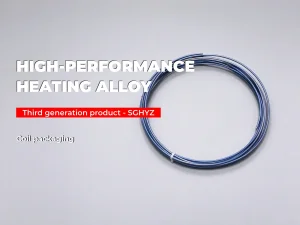


Technical Whitepaper: Thermodynamics & Metallurgy of Industrial Thermal Materials
An engineering deep-dive into high-efficiency electrothermal conversion, interface oxide kinetics, and material durability under continuous thermal stress.
In modern high-temperature process industries—ranging from semiconductor crystal growth and photovoltaic wafer diffusion to metallurgical annealing and advanced chemical synthesis—the selection of efficient heat transfer industrial heating materials dictates operational throughput, energy efficiency, and long-term equipment reliability. Efficient electrothermal resistance alloys convert electrical energy into precise radiant and convective thermal power via Joule heating ($P = I^2R$). However, maintaining precise thermal gradients under continuous duty cycles requires sophisticated metallurgical control.
Thermodynamics of Resistance Heating & Thermal Transfer Efficiency
The efficiency of an electrothermal heating element is defined by its ability to transfer generated heat to the work environment while maintaining microstructural stability. Key thermodynamic variables include specific electrical resistivity ($\rho$), thermal expansion coefficient ($\alpha$), temperature coefficient of resistance ($C_t$), and surface watt-density load ($W/\text{cm}^2$). Choosing the incorrect material composition often leads to early creep deflection, thermal fatigue, or rapid embrittlement.
| Alloy Grade / Family | Primary Composition | Max Temp (°C) | Resistivity @ 20°C (μΩ·m) | Thermal Conductivity (W/m·K) | Primary Application Environment |
|---|---|---|---|---|---|
| SGHT / SGHYZ (FeCrAl) | Fe-Cr25-Al6-Nb+RE | 1400°C - 1425°C | 1.45 | 13.5 | Ultra-high-temp kilns, ceramic sintering |
| 0Cr25Al5 (FeCrAl) | Fe-Cr25-Al5.3 | 1250°C | 1.42 | 15.0 | Industrial radiant heaters, heat treat furnaces |
| 0Cr21Al6Nb (FeCrAl) | Fe-Cr21-Al6-Nb | 1350°C | 1.40 | 14.0 | Tempering, heavy industrial furnace coils |
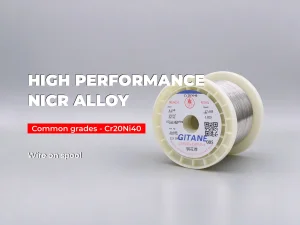
| Cr20Ni80 (Nichrome) | Ni78-Cr20-Si/Fe | 1200°C | 1.09 | 60.3 | Reducing atmospheres, precision appliances |
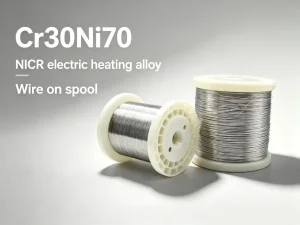
| Cr30Ni70 (Nichrome) | Ni68-Cr30 | 1250°C | 1.18 | 45.0 | Rapid-cycling industrial heaters, severe environments |
Global Industry Development Trends & Technological Breakthroughs
The transition toward zero-carbon thermal processing is driving demand for advanced electrothermal materials capable of replacing fossil-fuel combustion burners.
Powder Metallurgy (PM) Synthesis
Traditional melting techniques are being replaced by dispersion-strengthened powder metallurgy. PM FeCrAl alloys eliminate macro-segregation, yielding superior hot creep strength and dimensional stability up to 1425°C.
Rare Earth Micro-Alloying (RE)
Doping high-temperature alloys with precise micro-additions of Yttrium (Y), Zirconium (Zr), Hafnium (Hf), and Niobium (Nb) anchors the protective scale oxide film, drastically reducing oxidation spallation during continuous temperature cycling.
Decarbonization of Industrial Furnaces
Heavy industry is aggressively electrifying gas-fired furnaces. High watt-density electric heating materials allow manufacturers to retrofit existing kilns, reaching higher energy efficiency and net-zero operational carbon targets.
China's Manufacturing Superiority in Industrial Heating Materials
Leveraging fully integrated supply chains, advanced metallurgy infrastructure, and unmatched cost-to-performance efficiency.
China has established itself as the world’s powerhouse for advanced thermal alloy manufacturing. This position is supported by deep raw material integration (high-purity Nickel, Chromium, Aluminium, and Rare Earth elements), rigorous quality control protocols matching global standards (ASTM, DIN, JIS, GB/T 1234), and large-scale manufacturing capacity.
End-to-End Supply Chain Integration
From initial Vacuum Induction Melting (VIM) and Electroslag Remelting (ESR) to hot rolling, cold drawing, and continuous bright annealing, domestic Chinese factories control every metallurgical variable under one roof.
Precision Quality Assurance
State-of-the-art spectrographic composition verification, eddy current crack detection, continuous resistance scanning, and automated spooling ensure zero defects across millions of meters of wire.
Unmatched Procurement Flexibility
Whether sourcing ultra-fine resistance spools (0.05mm) or massive heavy-gauge industrial furnace rods, Chinese manufacturers offer rapid tooling customization, agile MOQ structures, and competitive wholesale pricing.
Macro Industry Engineering Solutions & System Integration
Tailored electrothermal alloy engineering across specialized industrial segments.
Photovoltaic & Semiconductor Manufacturing
Precision crystal pulling and diffusion furnaces require extreme spatial temperature uniformity ($\pm 0.5^\circ\text{C}$). Alloys such as SGHT and 0Cr21Al6Nb prevent thermal drift, off-gassing, and thermal deformation during continuous silicon processing.
Automotive & Lithium-Ion Battery Production
Continuous mesh-belt sintering furnaces for battery cathode active material (CAM) production rely on Cr30Ni70 and 0Cr25Al5 elements to withstand highly corrosive lithium and nickel chemical vapors while maintaining thermal efficiency.
Petrochemical & Industrial Fluid Heating
Heavy-duty immersion heaters and explosion-proof heat exchangers use stabilized Cr20Ni80 heating tubes to deliver rapid heat transfer in viscous fluid thermal cracking and gas preheating systems.
Localized Application Scenarios & Atmosphere Corrosion Dynamics
Selecting electrothermal materials based on chemical interactions within specialized furnace atmospheres.
The operating environment directly impacts heating element longevity. Exposure to carbonaceous gases, nitrogen, hydrogen, water vapor, and halogen compounds alters oxidation pathways and mechanical integrity.
| Atmosphere Type | Dominant Chemical Impact | Recommended Material Family | Design & Operating Precautions |
|---|---|---|---|
| Air / Oxidizing | Forms stable protective oxide ($\text{Al}_2\text{O}_3$ or $\text{Cr}_2\text{O}_3$) | FeCrAl (SGHT, 0Cr25Al5) & NiCr | Max temperature rating applies; avoid thermal shock. |
| Carburizing (CO, $\text{CH}_4$) | Carbon ingress causes internal carbide precipitation ("Green Rot") | FeCrAl alloys (0Cr21Al6Nb, SGHYZ) | FeCrAl outperforms NiCr due to dense alumina scale resisting carbon ingress. |
| Nitriding ($\text{NH}_3$) | Formation of brittle metallic nitrides | High-Ni Nichrome (Cr30Ni70, Cr20Ni80) | Keep temperatures lower; pre-oxidize elements prior to process gas injection. |
| Vacuum ($<10^{-2}$ Torr) | Chromium / Aluminium volatilization | FeCrAl or NiCr with reduced surface load | Derate watt density ($W/\text{cm}^2$) by 30-50% to prevent element burnout. |
Global Enterprise Procurement Demands & TCO Optimization
Strategic purchasing criteria for procurement directorships, plant engineers, and OEM designers.
Evaluating industrial heating materials solely on initial price per kilogram is a critical mistake in high-availability manufacturing environments. The true financial metric is Total Cost of Ownership (TCO), which incorporates element lifespan, energy efficiency loss, maintenance labor costs, and unplanned line downtime risks.
Quality Assurance Documentation
Global enterprises demand complete metallurgical traceability: EN 10204 3.1 Mill Test Certificates (MTC), chemical spectrum analysis, dimensional tolerance logs, and batch resistivity testing data.
Spooling & Packaging Integrity
Precision coil winding, zero-tangle spooling, moisture-proof vacuum packaging, and wooden crate reinforced shipping ensure materials arrive ready for automated winding machinery.
Vendor Consignment & Logistics
Strategic stock holding, quick-ship program availability for standard wire gauges (0.1mm to 10mm), and DDP global delivery streamline factory supply chains.
Technical & Commercial Frequently Asked Questions (FAQ)
In-depth answers to common engineering, procurement, and thermal design inquiries.
Additional High-Efficiency Industrial Heating Products & Elements
Explore our complete catalog of industrial resistance wires, alloy ribbons, and custom-formed heating spirals direct from our manufacturing facility.


Partner with China's Premier Electrothermal Alloy Factory
Consult with our senior metallurgical engineers to optimize your furnace element selection, lower watt density stress, and reduce operational energy costs.
Request Factory Technical Consultation & Quote