
Featured Cr30Ni70 & High-Temperature Alloy Products
Explore our certified mill-grade nickel-chromium and FeCrAl resistance wires engineered for severe industrial thermal cycles, high oxidation resistance, and long service life.
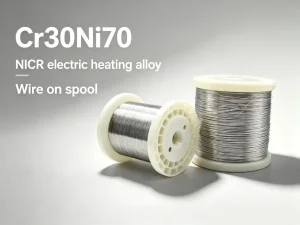
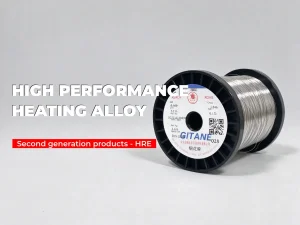


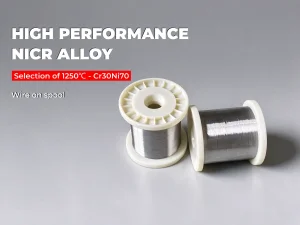

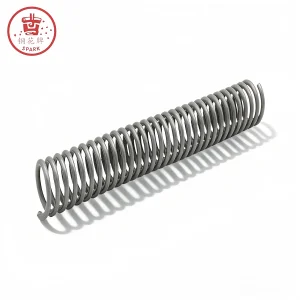
Understanding Cr30Ni70 Alloy Chemistry & Phase Stability
In modern high-temperature electrothermal engineering, selecting the optimal resistance wire grade dictates not only the thermal efficiency of heating elements but also the total life cycle expenditure of industrial furnace assets. Cr30Ni70 heating wire (nickel-chromium alloy consisting nominally of 70% Nickel and 30% Chromium, designated as Ni70Cr30) represents the pinnacle of austenitic resistance alloys engineered specifically for demanding, non-oxidizing, and oxidizing thermal atmospheres up to 1250°C (2282°F).
Unlike standard 80/20 Nickel-Chromium alloys (Cr20Ni80), the elevated chromium concentration in Cr30Ni70 fosters the rapid formation of a denser, highly adherent, micro-crystalline chromium oxide ($\text{Cr}_2\text{O}_3$) protective scale. This protective passive layer acts as a kinetic barrier against continued thermal degradation, hot corrosion, and atmosphere-induced embrittlement. Consequently, high-purity Cr30Ni70 wires exhibit superior dimensional integrity, reduced creep strain at maximum design temperatures, and exceptional ductility even after thousands of operational thermal cycles.
Austenitic Lattice Structure
The face-centered cubic (FCC) austenitic structure of Ni70Cr30 remains non-magnetic across room temperatures to operating thresholds, delivering stable electrical performance without magnetic field interference.
Enhanced Oxidation Kinetics
30% Chromium enrichment creates a self-healing $\text{Cr}_2\text{O}_3$ scale that suppresses chromium evaporation under high-vacuum or fluctuating temperature regimes, outperforming conventional NiCr alloys.
Thermal Cycling Resilience
Minimal thermal expansion matching and high hot yield strength prevent sagging, coil distortion, or intergranular cracking during aggressive rapid-heating and shutdown cycles.
Global Industry Trends & Procurement Demands
Macro Transition to Electric Thermal Processing
Global industrial sectors are accelerating the decarbonization of thermal manufacturing. Fossil-fuel-fired kilns and furnaces are rapidly being converted to electric heating element configurations powered by renewable microgrids. This shift has elevated the demand for high-reliability resistance wires like Cr30Ni70 that can withstand continuously high electrical energy density without premature burnout.
- Zero-Carbon Heat Treatment: Automotive and aerospace OEMs requiring carbon-neutral heat treatment processes.
- Precision Temperature Uniformity: Tight tolerance electric furnaces requiring stable resistance values ($\pm 3\%$).
- Reduced Planned Downtime: Procurement teams seeking alloys validated for extended maintenance intervals.
Procurement Focus: Total Cost of Ownership (TCO)
Strategic buyers and furnace design engineers are looking beyond raw upfront material cost per kilogram. Purchasing metrics are now anchored on lifetime cost efficiency: Total Hours of Continuous Heat Stability per Unit Cost. Cr30Ni70, with its superior accelerated life rating (50+ hours under rigorous GB/T 1234 test standards), dramatically lowers line stoppage costs and heating element replacement frequency.
- Grain Boundary Optimization: Micro-alloying elements prevent rapid grain growth at elevated temperatures.
- Custom Wire Geometry: Sourcing flat ribbons, micro-wires, and pre-coiled spirals directly tailored to OEM drawings.
- Traceable Mill Certifications: Full chemical ladle analysis and mechanical property validation per batch.
Technical Performance Comparison Matrix
Evaluate metallurgical properties across key nickel-chromium and iron-chromium-aluminum resistance alloys to make informed procurement decisions.
| Alloy Grade | Nominal Composition | Max Operating Temp (°C) | Electrical Resistivity (μΩ·m, 20°C) | Density (g/cm³) | Magnetism | Oxidation Scale Type | Primary Industrial Field |
|---|---|---|---|---|---|---|---|
| Cr30Ni70 (Ni70Cr30) | 70% Ni, 30% Cr | 1250°C | 1.18 | 8.10 | Non-Magnetic | Dense $\text{Cr}_2\text{O}_3$ Oxide | High-end Industrial Furnaces, Heavy Duty Elements |
| Cr20Ni80 (Ni80Cr20) | 80% Ni, 20% Cr | 1200°C | 1.09 | 8.40 | Non-Magnetic | Standard $\text{Cr}_2\text{O}_3$ Oxide | Home Appliances, Industrial Heaters |
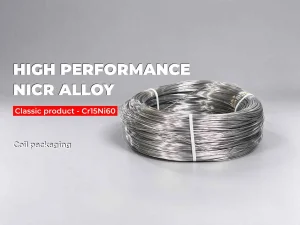
| Cr15Ni60 (Ni60Cr15) | 60% Ni, 15% Cr, Bal. Fe | 1150°C | 1.12 | 8.20 | Slightly Magnetic | Complex Ni-Fe-Cr Oxide | Medium-Temp Heating Elements, Resistors |
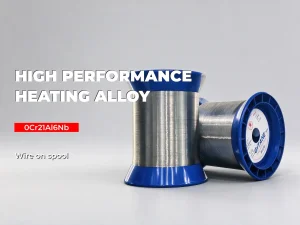
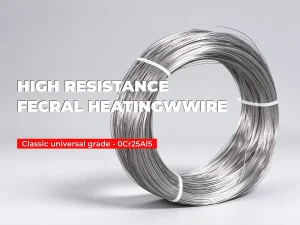
| 0Cr25Al5 (FeCrAl) | 25% Cr, 5% Al, Bal. Fe | 1250°C | 1.42 | 7.10 | Magnetic | $\text{Al}_2\text{O}_3$ Oxide | Industrial Kilns, Ceramic Heaters |
| HRE 1350 (FeCrAl) | High Cr-Al + Rare Earth | 1350°C | 1.45 | 7.10 | Magnetic | Refractory $\text{Al}_2\text{O}_3$ | Powder Metallurgy, High-Temp Sintering |
China Smart Factory: Quality Control & Supply Chain Resilience
How advanced metallurgical melting, precise drawing controls, and automated quality assurance guarantee batch-to-batch consistency for international buyers.
Vacuum Induction Melting (VIM) + ESR
Our raw materials undergo Vacuum Induction Melting coupled with Electroslag Remelting (ESR) to eliminate non-metallic inclusions, control sulfur/phosphorus impurities to ultra-low thresholds, and ensure chemical homogeneity throughout every melt ingot.
Precision Cold Drawing & Bright Annealing
Multi-pass continuous drawing dies achieve dimensional tolerances down to $\pm 0.01 \text{ mm}$. Hydrogen-atmosphere bright annealing prevents surface oxidation, leaving a clean, mirror-bright surface ready for coiling or automated winding.
Online Eddy Current & Tensile Testing
100% online non-destructive eddy current testing detects internal micro-cracks or voids during drawing. Every batch is supplied with full mechanical, electrical, and 50-hour accelerated life test validation data.
Localized Application Scenarios
Discover how Cr30Ni70 resistance wire solves critical heating challenges across diverse high-tech and heavy industrial environments.
1. Heavy-Duty Industrial Heat Treatment Furnaces
Used in continuous mesh belt furnaces, box furnaces, and pit furnaces operating under demanding carburizing, nitriding, or neutral protective gas atmospheres. Cr30Ni70 prevents "green rot" (intergranular oxidation caused by carbon accumulation) far better than lower-chromium nickel alloys.
2. Semiconductor & Solar Wafer Processing
Precision diffusion furnace cassettes and thermal processing chambers require non-magnetic resistance wire to avoid electromagnetic field pollution during semiconductor crystal growth or photovoltaic silicon wafer annealing.
3. Glass Tempering & Ceramic Sintering Kilns
High thermal radiation uniformity is required to avoid localized hot spots on architectural glass or fine technical ceramics. Cr30Ni70 pre-coiled elements maintain rigid coil spacing without drooping across long spans.
4. High-End Commercial & Medical Sterilization
In high-reliability medical autoclaves, analytical laboratory equipment, and aerospace testing chambers, Cr30Ni70 offers bulletproof reliability where component failure is simply not an option.
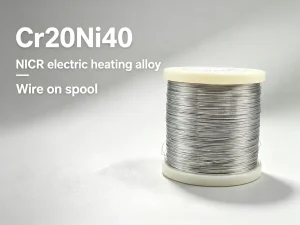
Specialized Heating Alloys, FeCrAl Wires & Furnace Components
Explore our full line of nickel-chromium, nickel-iron, and iron-chromium-aluminum alloys for specialized operating conditions.


Frequently Asked Questions (FAQ) for Thermal Engineers & Buyers
Technical clarity on alloy selection, life test standards, surface load calculation, and custom manufacturing capability.