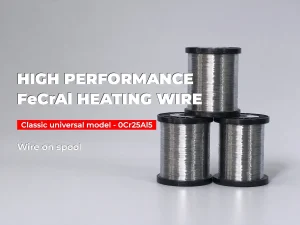
Featured Industrial Resistance & Furnace Products
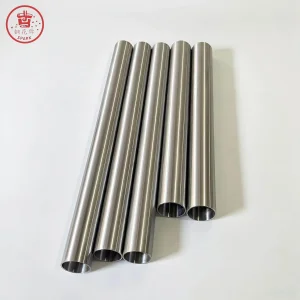
Premium grade FeCrAl and NiCr electric heating wire, seamless tubes, and furnace solutions manufactured to precise international metallurgical standards.
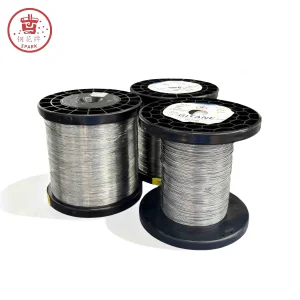


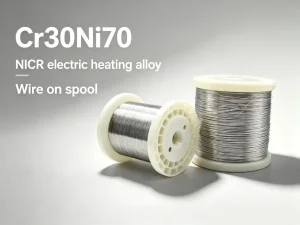
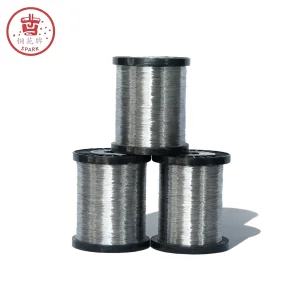
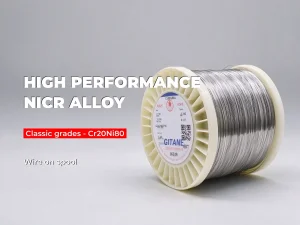
Technical Whitepaper: Precision Resistance Alloys Compatible with TIG Systems
A definitive guide for global procurement teams, thermal design engineers, and industrial heating manufacturers on material selection, supply chain scaling, and international compliance.
Metallurgical Engineering: FeCrAl vs. NiCr Alloy Performance
Understanding oxidation kinetics, grain boundary stability, and TIG weldability across primary electrothermal alloy families.
FeCrAl (Iron-Chromium-Aluminium) Series
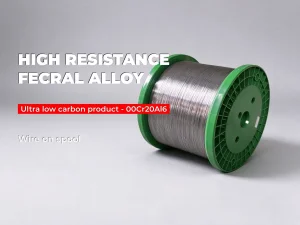
FeCrAl alloys (such as 0Cr25Al5, 0Cr23Al5, SGHYZ 1400°C, and SGHT 1425°C) are characterized by their superior resistivity (1.25–1.45 μΩ·m) and exceptionally high maximum operating temperatures. Upon initial heating, FeCrAl alloys form a dense, adherent layer of alpha-alumina ($\alpha\text{-Al}_2\text{O}_3$), which acts as an impenetrable barrier against further atmospheric oxidation and chemical attack.
- High Resistivity: Lower material weight required per kilowatt output.
- Powder Metallurgy (SGHT): Exceptional creep strength and resistance to hot bending.
- TIG Processing: Requires controlled shielding gas (Ar/He) to prevent aluminium oxidation during joint fusion.
NiCr (Nickel-Chromium) Series
NiCr alloys (including Cr20Ni80 and Cr30Ni70) provide unexcelled mechanical ductility after prolonged thermal exposure. Unlike FeCrAl alloys, which undergo grain growth and become embrittled at room temperature after heating, NiCr alloys retain superior room-temperature toughness and hot strength, making them ideal for high-vibration environments and frequent thermal cycling.
- Post-Service Ductility: Easily repaired or re-wound without brittle fracture.
- Non-Magnetic: Preferred in precision electronic and high-frequency induction applications.
- TIG Weldability: Outstanding molten pool fluidity and high tolerance to standard TIG filler techniques.
| Alloy Grade | Material Family | Max Temp (°C) | Resistivity (μΩ·m, 20°C) | Density (g/cm³) | TIG Compatibility Index |
|---|---|---|---|---|---|
| SGHT | FeCrAl (Powder Metallurgy) | 1425°C | 1.45 | 7.10 | Very High (Specialized Flow) |
| SGHYZ | FeCrAl (Rare Earth Enhanced) | 1400°C | 1.42 | 7.15 | High |
| 0Cr25Al5 | FeCrAl Standard Industrial | 1250°C | 1.42 | 7.10 | High |
| Cr30Ni70 | NiCr High-Temp Ductile | 1250°C | 1.18 | 8.10 | Excellent |
| Cr20Ni80 | NiCr Standard Nichrome | 1200°C | 1.09 | 8.40 | Superior |
China Factory Supply Chain & Scale Advantage
Leveraging full-spectrum metallurgical manufacturing, from vacuum induction melting (VIM) to fine wire drawing and automated spooling.
End-to-End Vertical Integration
By controlling every stage of production—from raw iron ore refining and alloying within the Shougang Group ecosystem to precision cold rolling and hydrogen atmosphere bright annealing—SPARK eliminates supply chain fragmentation. This guarantees absolute chemical homogeneity across bulk wholesale orders.
Massive Scalability & Cost Efficiency
Occupying over 39,268 square meters of specialized workshop space, our plant produces thousands of metric tons of fine resistance wire, strip, ribbon, and heavy furnace elements annually. Scale economics directly translate into highly competitive wholesale factory pricing for global OEMs.
Advanced Metallurgical Research
Over 30% of our 500-strong workforce comprises specialized metallurgists and senior materials engineers. Our proprietary powder metallurgy techniques (SGHT series) rival premium global brands, achieving enhanced hot strength without sacrificing processing economy.
Localized Support, Quality Assurance & Compliance Standards
Ensuring frictionless global import, certified traceability, and regulatory compliance across North American, European, and Asia-Pacific markets.
Quality Assurance & Testing Framework
Every shipment leaving our Beijing factory undergoes rigorous quality control under our ISO 9001:2015 certified management system. We adhere strictly to national standards GB/T 1234-2012 while providing complete cross-reference compliance with international equivalents (ASTM B603, DIN 17470, JIS C2520).
- Mill Test Reports (MTR): Complete chemical analysis via optical emission spectrometry (OES).
- Electrical Resistance Tolerances: Wire resistance controlled within standard ±3% (precision ±1% available).
- Mechanical Inspection: Tensile strength, elongation, and surface defect eddy-current testing.
- Environmental Compliance: Fully compliant with EU RoHS 3 (Directive 2015/863) and REACH regulations.
Localized Support & Custom Fabrication
To streamline global procurement, SPARK provides dedicated engineering consultation for multinational equipment manufacturers. Whether you require custom spooled TIG wire diameters, flattened heating ribbons, pre-wound furnace coils, or complete ceramic-supported assembly modules, our local technical support channels ensure seamless project delivery.
Global Logistics Integration: Expedited air freight, LCL, and full-container sea logistics with custom clearance documentation, dual-language invoicing, and dedicated account handling for tier-1 industrial clients.
Industrial Application Scenarios for Compatible TIG Alloys
Engineered for high-stress operational environments across key global technology sectors.
Semiconductor & Photovoltaics
Diffusion furnaces, polysilicon crystal growth reactors, and CVD equipment utilizing ultraclean SGHT powder metallurgy wire to eliminate ionic contamination.
Automotive Heat Treating
Continuous carburizing furnaces, roller hearth kilns, and controlled-atmosphere brazing lines using heavy-gauge TIG-welded FeCrAl strip elements.
Advanced Technical Ceramics
High-temperature shuttle kilns and ceramic sintering furnaces operating continuously up to 1400°C with SGHYZ ultra-high performance wire.
Petrochemical Industry
Heavy-duty heat exchanger tubes, catalyst heating arrays, and immersion heaters relying on high-nickel Cr30Ni70 TIG compatible alloys.
Future Trends in Electrothermal Alloy Manufacturing
Emerging innovations reshaping high-temperature material engineering and industrial heating infrastructure.
1. Decarbonization via Electrification
Global heavy industries are replacing fossil-fuel combustion burners with electric heating element arrays. This shift demands larger-diameter resistance alloys capable of carrying high currents without creep deformation, making advanced powder metallurgy alloys (like SGHT) the primary choice for green steel and glass manufacturing.
2. Nanoscale Rare Earth Micro-Alloying
Adding micro-quantities of Yttrium (Y), Zirconium (Zr), and Hafnium (Hf) to FeCrAl matrices dramatically enhances oxide scale adhesion. Future alloy generations focus on eliminating oxide spallation under high-frequency thermal cycling conditions.
3. Additive Manufacturing & TIG Hybridization
The integration of 3D-printed ceramic formers with precise TIG-welded alloy wire mesh allows complex, custom-shaped heating modules that reduce furnace startup times and optimize thermal uniformity.
Frequently Asked Questions (Procurement & Engineering FAQ)
Expert insights regarding technical specifications, TIG processing, order minimums, and alloy life optimization.
What makes resistance wire "compatible with TIG" manufacturing processes?
TIG compatibility refers to an alloy's ability to undergo localized melting and fusion without forming brittle intermetallic phases, micro-cracks, or gas porosity. Our SPARK FeCrAl and NiCr alloys feature controlled chemical purities and minimal tramp elements (such as sulfur and phosphorus), allowing smooth molten pool behavior, excellent wetability, and superior mechanical strength across welded joints.
How do I select between FeCrAl (e.g., 0Cr25Al5, SGHT) and NiCr (e.g., Cr20Ni80) for my furnace build?
Choose FeCrAl if your application requires higher operating temperatures (up to 1425°C), high electrical resistivity, lower density (saving up to 15% material weight), and cost-effective continuous operation in oxidizing or sulfur-containing atmospheres. Choose NiCr if your equipment undergoes frequent thermal cycling, requires high ductility after aging, operates in nitrogenous atmospheres, or needs non-magnetic material characteristics.
What is the advantage of SGHT powder metallurgy alloy over conventional FeCrAl?
SGHT is produced via advanced powder metallurgy techniques that create an ultra-fine grain structure with uniform rare-earth oxide dispersion. This provides superior high-temperature creep strength, vastly reduced elongation/sagging over time, and an extended service life near its 1425°C maximum rating—outperforming traditional ingot-melted alloys in demanding industrial applications.
What parameters affect the service life of electric heating elements?
Key factors include element surface load ($\text{W/cm}^2$), furnace atmosphere (oxidizing, reducing, vacuum, or carburizing), operating temperature, thermal cycling frequency, element design (wire diameter to coil pitch ratio), and mechanical support structures. Our technical engineering team can review your furnace blueprints to optimize surface load calculations.
Are mill test certificates and regulatory compliance documents provided with wholesale orders?
Yes. Every wholesale delivery includes certified Mill Test Reports (MTR) detailing exact heat number chemical composition, mechanical test results, and electrical resistance measurements. Complete compliance declarations for RoHS, REACH, and ISO 9001 quality standards are supplied with export documentation.
What delivery forms are available for wholesale procurement?
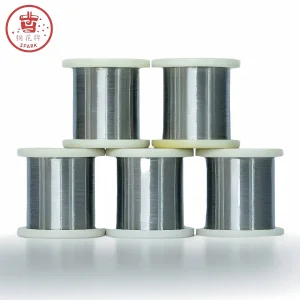
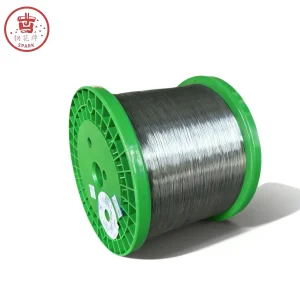
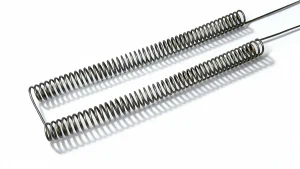
SPARK provides resistance materials in round wire (0.05mm to 12.0mm diameter), flat ribbon/strip (thickness 0.1mm to 4.0mm, width 1.0mm to 200mm), pre-wound spiral elements, straight rods, and complete custom-fabricated furnace element modules.
Additional High-Temperature & Resistance Products
Explore our complete range of specialized high-temperature resistance wire, alloy foils, and customized industrial thermal equipment.