Featured Sintering Heating Elements & Alloys
Direct factory sourcing of premium-grade electrical resistance heating wires engineered for extreme atmosphere resistance, low creep, and extended thermal cycling life in ceramic sintering applications.





Executive Technical Whitepaper: Ceramic Sintering Heating Wire Metallurgy
Understanding the thermodynamic, mechanical, and microstructural demands on electrical resistance alloys during continuous high-temperature ceramic densification.
Modern advanced ceramic manufacturing—encompassing technical ceramics like Alumina (Al₂O₃), Zirconia (ZrO₂), Silicon Nitride (Si₃N₄), Multi-layer Ceramic Capacitors (MLCC), and Low-Temperature Co-fired Ceramics (LTCC)—relies fundamentally on ultra-precise thermal profile execution. Sintering is the thermodynamic driving force that transforms green ceramic compacts into dense, polycrystalline structural and functional bodies. During this process, temperatures typically fluctuate between 1100°C and 1425°C inside industrial tunnel kilns, roller hearth furnaces, and periodic shuttle kilns.
At the heart of these high-temperature thermal systems is the ceramic sintering heater wire. Selecting the correct metallic heating alloy requires an in-depth understanding of high-temperature corrosion mechanisms, phase transformations, oxide scale adherence, and grain-boundary creep deformation. As a leading manufacturer and global wholesale supplier, our metallurgical engineering teams specialize in formulating high-purity **FeCrAl (Iron-Chromium-Aluminum)** and **NiCr (Nickel-Chromium)** alloys designed to optimize thermal efficiency and extend element service life.
1. The Chemistry of Resistance Alloys: Passivation & Oxide Scale Kinetics
When electric heating wire operates at elevated temperatures, its survival depends on its ability to form a self-healing, adherent, protective surface oxide film. Without this passive layer, rapid oxidation, spallation, and localized hotspots lead to catastrophic wire burnout.
A. FeCrAl Alloys (Iron-Chromium-Aluminum): The Alpha-Alumina Advantage
FeCrAl alloys (such as 0Cr25Al5, 0Cr23Al5, HRE, SGHYZ, and PM-grade SGHT) derive their exceptional temperature resistance from the formation of a dense, thermodynamically stable Alpha-Alumina (α-Al₂O₃) scale at temperatures above 1000°C. This oxide layer features an extremely low parabolic oxidation rate constant, providing an effective barrier against further oxygen diffusion into the bulk metal.
To maximize the adhesion of the α-Al₂O₃ layer, advanced micro-alloying techniques are applied. The addition of reactive rare-earth elements (RE) such as Yttrium (Y), Zirconium (Zr), Lanthanum (La), and Cerium (Ce) eliminates grain-boundary vacancy coalescing at the metal-oxide interface. This prevents oxide spallation during rapid thermal cycling in continuous ceramic sintering furnaces.
B. NiCr Alloys (Nickel-Chromium): Superior Hot Strength & Cycling Resistance
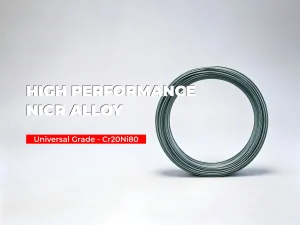
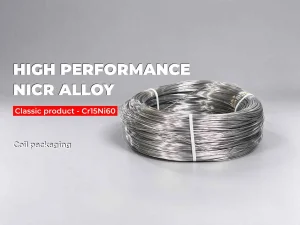
NiCr alloys (including Cr20Ni80, Cr30Ni70, and Cr15Ni60) rely on a Chromium Oxide (Cr₂O₃) protective scale. While NiCr has a lower maximum operating temperature compared to top-grade FeCrAl (1200°C–1250°C vs. 1425°C), NiCr possesses superior mechanical hot strength (yield strength at temperature) and maintains exceptional ductility after prolonged exposure. This ductility allows NiCr elements to be easily re-formed or serviced after cooling down, whereas FeCrAl develops a coarse grain structure upon heating that makes it brittle at room temperature.
High Surface Watt-Density Allowance
Engineered FeCrAl grades allow higher surface watt-loading (W/cm²), enabling compact furnace design, faster ramp-up rates, and significant electrical energy savings.
Atmospheric Corrosion Resistance
Optimized against outgassing compounds, volatile organic binders (binder burnout phase), sulfur traces, and fluctuating oxidizing/reducing ceramic firing environments.
Creep & Sag Resistance
Powder metallurgy (PM) and dispersion-strengthened alloy structures prevent wire stretching and inter-turn short circuits in suspended or ceramic tube-mounted coils.
Global Market Status & Industrial Trends in Ceramic Sintering
Key structural shifts in thermal processing technology driving the demand for specialized resistance alloys across Europe, North America, and Asia-Pacific.
The global ceramic sintering equipment market is undergoing a rapid transition toward **decarbonization, electrification, and Industry 4.0 digitisation**. Flame-fired gas kilns are increasingly being replaced by clean electric heating technology to satisfy stringent carbon footprint regulations and meet zero-defect thermal uniformity targets for advanced technological components.
1. Electrification & Decarbonization of High-Temperature Thermal Processing
As industrial manufacturing aligns with global net-zero emissions mandates, industrial ceramic producers are electrifying thermal lines. High-purity electric heating wire solutions provide direct zero-emission operation, eliminating combustion by-products ($NO_x, SO_x, CO_2$) from the furnace environment. This zero-contamination firing zone is vital for optical ceramics, bio-compatible dental zirconia implants, and advanced semiconductor substrates.
2. Rise of High-Throughput Continuous Sintering
The explosive growth of New Energy Vehicles (NEVs), 5G telecommunication hardware, and energy storage systems has accelerated demand for mass-produced ceramics. Modern production lines utilize high-speed continuous roller hearth kilns and automated push-rod furnaces operating 24/7. These continuous systems require resistance heating wires with extraordinary oxidation fatigue resistance, low thermal expansion mismatch, and long continuous operating lifetimes to prevent costly unscheduled shutdown events.
3. Micro-Sintering & Rapid Thermal Processing (RTP)
Precision micro-electronics require accelerated ramp rates (up to 50°C/min) and rapid cooling curves to control ceramic grain size growth and prevent cross-phase segregation. High-performance resistance alloys like **SGHT and HRE 1350°C** are engineered to withstand rapid dynamic thermal shocks without scale spallation or resistance drifting.
Metallurgical Data Comparison & Selection Matrix
Engineered performance metrics to assist procurement managers and furnace design engineers in selecting optimal alloy grades per GB/T 1234-2012 and international standards.
| Alloy Grade | Alloy Type | Max Temp (°C) | Resistivity @ 20°C (μΩ·m) | Density (g/cm³) | Primary Sintering Atmosphere & Application |
|---|---|---|---|---|---|
| SGHT (PM Grade) | FeCrAl (Powder Met) | 1425°C | 1.45 | 7.10 | Air, Inert, Vacuum. High-end Technical Ceramics, MLCC Sintering. |
| SGHYZ | FeCrAl + RE Micro-alloy | 1400°C | 1.42 | 7.10 | Air, Oxidizing atmospheres. Heavy-duty Ceramic Sintering Kilns. |
| HRE 1350 | FeCrAl Rare-Earth | 1350°C | 1.40 | 7.15 | Air, Nitrogen, Hydrogen. Powder Metallurgy & Structural Ceramics. |
| 0Cr25Al5 | Standard FeCrAl | 1250°C | 1.42 | 7.10 | Air, Inert. Cost-effective Industrial Kilns & Radiant Heating Elements. |
| Cr30Ni70 | NiCr High-Chrome | 1250°C | 1.18 | 8.10 | Reducing, Carburizing, Nitrogen. Precision Sintering & Appliances. |
| Cr20Ni80 | Standard Nichrome | 1200°C | 1.09 | 8.40 | Cyclic Air, Nitrogen. High Hot-Strength, Precision Dental Sintering. |
Detailed Life-Cycle Cost (LCC) & Energy Efficiency Analysis
When procuring ceramic sintering heater wires in wholesale volumes, evaluating the **Total Cost of Ownership (TCO)** is significantly more crucial than comparing initial per-kilogram material costs. FeCrAl alloys offer a key physical advantage: a density approximately **15% lower than NiCr alloys** (7.10 g/cm³ vs 8.40 g/cm³). This density differential translates directly into lower weight requirements per linear meter for equivalent element resistance and surface area, reducing overall raw material transport costs and element installation mass.
Furthermore, because FeCrAl operates at higher electrical resistivity (up to 1.45 μΩ·m), engineers can select thicker wire gauges without reducing electrical resistance. Thicker wire cross-sections dramatically extend service life by offering greater resistance to oxidation degradation, reducing furnace maintenance cycles and downtime penalties by up to 40% over multi-year operations.
China Industry 4.0: Supply Chain Resilience & Manufacturing Efficiency
How integrated metallurgy, automated wire drawing, and strategic quality control ensure reliable global B2B procurement.
As a specialized manufacturer originating from China's premier metallurgical enterprise system, our manufacturing infrastructure combines decades of heavy metallurgical research with **Industry 4.0 smart manufacturing technologies**. Our sprawling 88,000 m² industrial base integrates every phase of production—from raw element melting to final spiral coil fabrication.
Vertical Upstream Control (VIM/ESR)
Utilizing Vacuum Induction Melting (VIM) and Electroslag Remelting (ESR) to eliminate non-metallic inclusions, controlling gas impurities ($O_2, N_2, H_2$) to parts-per-million (PPM) levels.
Automated Precision Cold Drawing
Continuous multi-pass drawing dies monitored by inline real-time laser micrometer profiling guarantee outer diameter tolerances as tight as ±0.01 mm across multi-ton orders.
Hydrogen Bright Annealing
Atmosphere-controlled continuous annealing furnaces ensure complete stress relief, pristine oxide-free golden surface finishing, and uniform grain microstructure for optimal coil winding.
This vertical integration insulates global buyers from raw material volatility and supply chain disruptions. Whether supplying standard 0Cr25Al5 heating wire coils, pre-formed heavy rod elements, or complete alumina ceramic fiber heating plates, our factory guarantees short lead times, full traceabilities, and Mill Test Certificates (MTC) conforming strictly to **ISO 9001:2015** quality systems.
Localized High-Temperature Application Scenarios
Engineered alloy solutions optimized for dedicated ceramic firing profiles across industrial sectors.
1. Electronic Ceramics & MLCC Co-firing
Challenge: Sintering multi-layer ceramic capacitors requires precise atmosphere control (protective $N_2/H_2$ or air) and zero particulate contamination.
Solution: High-purity Cr30Ni70 and SGHT PM alloys prevent oxide flaking and maintain stable resistance during high-frequency thermal cycling.
2. Dental Zirconia Prosthetics Sintering
Challenge: Dental restoration blocks require rapid heating up to 1550°C (with local wire temps reaching 1350°C–1400°C) without staining translucent zirconia white bodies.
Solution: Rare-earth enhanced SGHYZ / HRE 1350°C wires feature a pure, non-coloring α-Al₂O₃ protective film that eliminates chemical cross-contamination.
3. Industrial Structural Ceramics & Wear Parts
Challenge: Sintering dense alumina grinding media, seal rings, and ceramic armor plates in continuous pusher kilns operating above 1300°C for months.
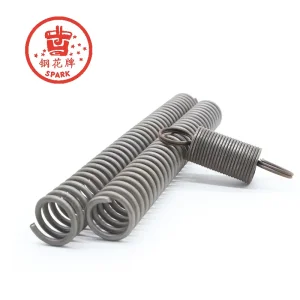
Solution: Heavy-gauge coiled or wave-shaped 0Cr25Al5 and SGHT heating elements with superior hot-creep resistance prevent sag and turn-to-turn shorting.
4. Lithium-Ion Battery Cathode Material Kilns
Challenge: High concentrations of alkaline outgassing ($LiOH, Li_2CO_3$) create extreme high-temperature chemical corrosion.
Solution: Specially formulated high-chromium FeCrAl elements engineered to resist alkali vapor attack and prolong roller hearth furnace element life.
Frequently Asked Questions (FAQ)
In-depth technical answers for buyers, ceramic kiln builders, and thermal process engineers.
How do I choose between FeCrAl and NiCr heating wire for my ceramic sintering kiln? +
What is the maximum surface watt loading (W/cm²) allowed for ceramic sintering wires? +
How does organic binder burnout in green ceramics affect heater wire life? +
Why do FeCrAl heating wires become brittle after initial heating cycles? +
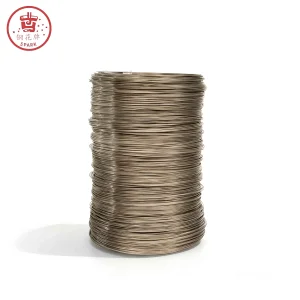
What delivery forms and custom manufacturing capabilities are available for wholesale orders? +
Complete Resistance Wire & Alloy Portfolio
Explore our complete range of specialized nickel-chrome, iron-chromium-aluminum, and high-performance furnace elements manufactured directly in China.