
Featured Industrial Heating Wire Coils & Elements
Factory-direct supply of premium grade FeCrAl and NiCr heating alloys engineered for extreme thermal endurance up to 1425°C.
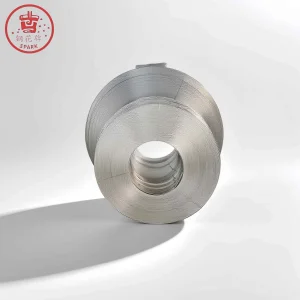
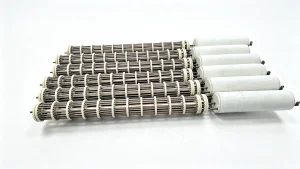
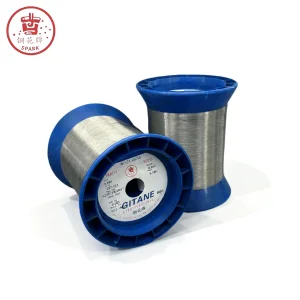


Technical Whitepaper: Metallurgical Dynamics of Alloy 875 FeCrAl Heating Coils
An engineering analysis of iron-chromium-aluminium electrical resistance alloys, passivating oxide scale kinetics, and structural lifespan optimization in ultra-high temperature industrial environments.
In modern industrial thermal processing, selecting the optimum resistance element material dictates process stability, energy efficiency, and total cost of operation. Alloy 875 FeCrAl (Iron-Chromium-Aluminium) represents a premier engineering alloy within the ferritic high-resistance thermal alloy spectrum, engineered specifically to withstand continuous service temperatures up to 1400°C (2550°F). Designed as a direct equivalent to top-tier international standards such as Kanthal A1 and UNS K92500, Alloy 875 provides exceptional thermal stability, elevated electrical resistivity, and superior oxidation resistance compared to traditional Nickel-Chromium (NiCr) alloys.
The primary operational mechanism enabling Alloy 875's extreme temperature tolerance is the controlled formation of a highly dense, non-porous alpha-alumina ($\alpha\text{-Al}_2\text{O}_3$) oxide layer. When exposed to oxidizing environments above 900°C, the aluminium content (~5.8%) within the ferritic matrix selectively diffuses to the wire surface, forming a self-healing dielectric scale. This layer acts as a impermeable barrier against atmospheric oxygen, sulfur vapor, and carbon ingress, significantly retarding internal oxidation degradation.
Comprehensive Chemical & Metallurgical Parameter Comparison
To understand the economic and technical trade-offs during B2B OEM procurement, thermal engineers must evaluate chemical stoichiometry, specific resistance, and creep strength. Below is a engineering comparison matrix evaluating Alloy 875 against competing market standards:
| Alloy Grade | Composition Breakdown | Max Temp (°C) | Resistivity at 20°C ($\mu\Omega\cdot\text{m}$) | Density ($\text{g/cm}^3$) | Creep Strength |
|---|---|---|---|---|---|
| Alloy 875 (FeCrAl) | Cr: 21.0-23.0% | Al: 5.3-6.2% | Fe: Bal. + RE | 1400°C | 1.45 | 7.10 | Moderate (Enhanced with Y/Zr) |
| 0Cr25Al5 (FeCrAl) | Cr: 23.0-26.0% | Al: 4.5-5.5% | Fe: Bal. | 1250°C | 1.42 | 7.10 | Standard Ferritic |
| 0Cr21Al6Nb (FeCrAl) | Cr: 21.0-23.0% | Al: 5.5-6.5% | Nb: 0.5% | Fe: Bal. | 1350°C | 1.45 | 7.10 | High (Niobium Stabilized) |
| Ni80Cr20 (Nichrome) | Ni: 78.0-80.0% | Cr: 19.0-21.0% | Fe: <1.0% | 1200°C | 1.09 | 8.40 | Very High (Austenitic) |
| HRE / SGHYZ Grade | Ultra-Pure FeCrAl + Rare Earth Dopants | 1425°C | 1.45 | 7.10 | Maximized Grain-Boundary Stability |
Wholesale Manufacturing Advantages: The China Supply Chain Imperative
Why leading global furnace manufacturers and thermal system integrators source OEM Alloy 875 FeCrAl heating coils from specialized Chinese production hubs.
Cost-Efficiency & Material Savings
FeCrAl alloys possess a lower density ($7.10\text{ g/cm}^3$) compared to NiCr ($8.40\text{ g/cm}^3$). Sourcing from wholesale Chinese factories reduces raw material tonnage requirements by approximately 15-18% for identical electrical power ratings, delivering massive capital efficiency for high-volume B2B orders.
Advanced VIM & ESR Metallurgy
Tier-1 Chinese factories utilize Vacuum Induction Melting (VIM) followed by Electroslag Remelting (ESR). This double-vacuum refinement process eliminates non-metallic inclusions, stabilizes chemical micro-homogeneity, and guarantees precise rare earth dopant additions (Yttrium, Zirconium, Cerium).
Custom CNC Coiling & Annealing
Chinese industrial mills offer fully automated CNC coiling, tension-controlled wire drawing (from $\Phi 0.1\text{mm}$ fine wire to $\Phi 12\text{mm}$ heavy rod), and bright hydrogen annealing. Coils arrive pre-formed, stress-relieved, and ready for immediate furnace insulation mounting.
Macro-Industry Solutions & Localized Application Scenarios
Tailored technical heating solutions powered by Alloy 875 FeCrAl coiling across high-tech manufacturing, green energy, and metallurgical processing.
1. Semiconductor & Photovoltaic Crystal Growing
In monocrystalline silicon ingot production (Czochralski process) and diffusion furnaces, temperature uniformity is vital. Alloy 875 heating coils provide zero-contamination heat profiles up to 1350°C, maintaining stable thermal zones required for high-purity silicon growth.
2. Automotive Heat Treatment & Carburizing
For roller hearth furnaces, batch tempering equipment, and automotive gear carburizing lines, Alloy 875 coils resist carbon pickup when properly pre-oxidized. The stable $\alpha\text{-Al}_2\text{O}_3$ film protects the internal ferritic structure against soot and hydrocarbon degradation.
3. Advanced Structural Ceramic Sintering
Sintering zirconia, alumina, and technical ceramic components requires rapid thermal cycling and extreme temperatures. Alloy 875 coils deliver rapid heat transfer rates without melting or flaking oxide debris onto delicate ceramic workpieces.
Global B2B Wholesale Procurement Guide & Pricelist Structure
Understanding price calculation variables, minimum order quantities (MOQ), and surface loading formulas to optimize procurement budgets.
When evaluating wholesale pricelists for Alloy 875 FeCrAl heating coils, procurement officers must look beyond simple raw material weight charges ($\text{USD/kg}$). Wholesale pricing models are governed by four fundamental engineering parameters:
- Wire Diameter Tolerance ($\pm\text{mm}$): Precision-drawn fine wires ($\Phi < 0.5\text{mm}$) require multi-pass diamond dies and intermediate bright annealing, yielding higher fabrication costs per kilogram than heavy industrial coil stock ($\Phi 3.0\text{mm} - 8.0\text{mm}$).
- Micro-Alloying Dopants: Premium Alloy 875 grades containing controlled Yttrium ($\text{Y}$) and Hafnium ($\text{Hf}$) additions demand elevated raw ingot costs but extend cyclic furnace service life by over 30%.
- Surface Loading ($\text{W/cm}^2$): Properly designed heating elements keep surface loading within $1.5 - 3.2 \text{ W/cm}^2$ for furnace air operating temperatures above 1100°C. Exceeding recommended loading reduces element life exponentially.
- Packaging & Oxidation Protection: Wholesale shipments require spooled plastic wrapping, desiccant sealing, and reinforced export wooden crate packaging to eliminate humidity oxidation during ocean transit.
Engineering Formula: Surface Load & Resistance Calculation
To calculate the total required wire length ($L$) and surface load ($W$) for an Alloy 875 heating coil:
Complete Factory Catalog & Custom Resistance Solutions
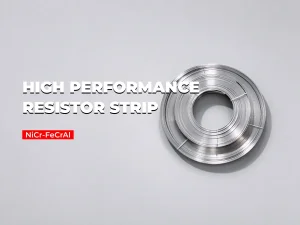
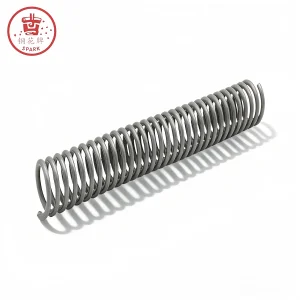
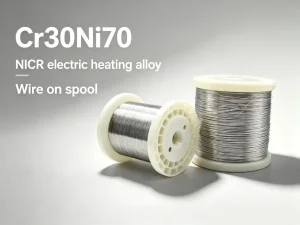
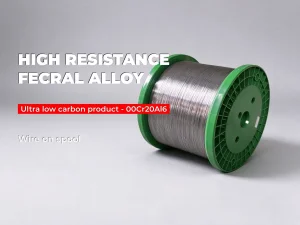
Explore our full line of resistance strips, heating ribbons, low-carbon alloys, and custom furnace element configurations.


Frequently Asked Questions (FAQ) for Engineering & Procurement Teams
Detailed technical insights regarding installation, alloy selection, lifespan optimization, and wholesale logistics.