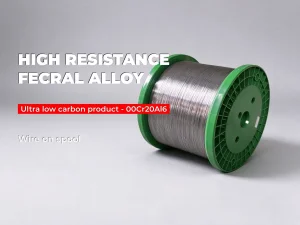
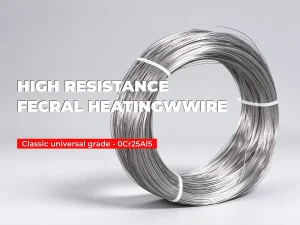
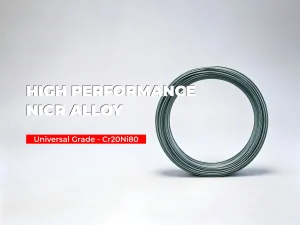
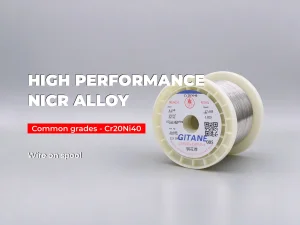
High-Performance Heating Alloy Products
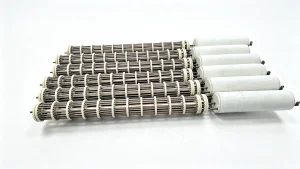
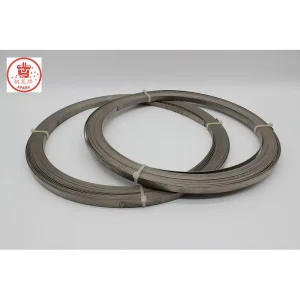
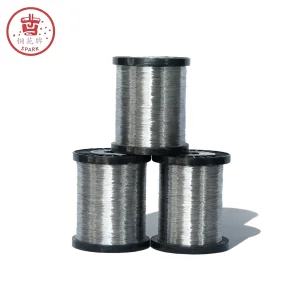
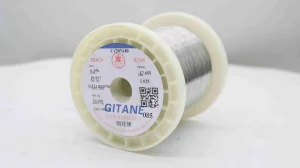
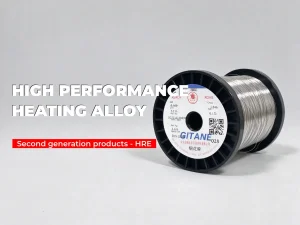
Direct factory-grade resistance heating elements, ribbons, and specialized 1420°C FeCrAl alloy wires manufactured under certified quality control systems.

Metallurgical Dynamics of 1420°C FeCrAl Heating Alloys
In high-temperature thermal processing industries, selecting an element capable of continuous operations at temperatures exceeding 1400°C requires a deep understanding of solid-state phase stability, micro-alloying chemistry, and oxidation kinetics. The standard grade iron-chromium-aluminium (FeCrAl) family—such as standard 0Cr25Al5 or 0Cr23Al5—faces physical constraints near 1250°C–1300°C due to accelerated grain growth, creep deformation, and mechanical breakdown of the surface oxide layer. To achieve a reliable continuous operating rating of 1420°C (2588°F), specialized Chinese manufacturing facilities employ advanced metallurgical synthesis, such as Rapid Powder Metallurgy (PM) processing, Dispersion Strengthening (ODS), and Reactive Element Addition (REA).
Micro-Alloying & REA Mechanism
By incorporating precisely controlled micro-additions of Reactive Elements—specifically Yttrium (Y), Zirconium (Zr), Hafnium (Hf), and Cerium (Ce)—the 1420°C FeCrAl alloy inhibits grain border sliding. The ionic radii of these rare-earth dopants segregate to internal grain boundaries, preventing rapid thermal coarsening above 1300°C.
Self-Healing α-Al₂O₃ Oxide Scale
At elevated operating temperatures up to 1420°C, high-purity aluminium (typically 5.8% to 6.5% wt.) diffuses outward to form a dense, thermodynamically stable Alpha-Alumina ($\alpha$-Al₂O₃) protective film. This ceramic boundary layer features an extremely low oxygen diffusion coefficient, insulating the inner alloy matrix against thermal degradation.
High Temperature Sag & Creep Resistance
Conventional rolled FeCrAl wires suffer from thermal elongation and sagging when suspended in furnace chambers. The 1420 heating wire utilizes specialized grain-boundary engineering (high aspect ratio elongated grain structures) to maintain high hot-yield strength, drastically extending element lifespan in heavy industrial kilns.
1420°C FeCrAl Wire vs Standard Industrial Heating Alloys
Review physical, thermal, and electrical metrics comparing 1420-rated high-temperature wire (such as SPARK SGHT/SGHYZ series) against standard NiCr, standard FeCrAl, and ceramic elements.
| Material Specification | Wholesale 1420 FeCrAl Wire | Standard 0Cr25Al5 Wire | Cr20Ni80 Nichrome Wire | Silicon Carbide (SiC) Rods |
|---|---|---|---|---|
| Max Atmosphere Temp | 1420°C (2588°F) | 1250°C (2282°F) | 1200°C (2192°F) | 1450°C (2642°F) |
| Resistivity at 20°C (μΩ·m) | 1.45 ± 0.05 | 1.42 ± 0.05 | 1.09 ± 0.04 | 800.0 – 1200.0 |
| Density (g/cm³) | 7.10 | 7.10 | 8.40 | 3.18 |
| Formability / Ductility | High (Cold Wound easily) | Medium | Very High | Zero (Brittle Ceramic) |
| Oxidation Film Characteristics | Dense, non-spalling α-Al₂O₃ | Standard Al₂O₃ scale | Cr₂O₃ protective layer | SiO₂ (Aging resistance increase) |
| Resistance to Sulfur Atmospheres | Excellent Resistance | Good Resistance | Poor (Prone to Green Rot) | Moderate |
| Cost / Performance Ratio | Optimal B2B High-Temp Choice | Standard Cost / Medium Temp | High Raw Nickel Cost | High Fragility & Component Cost |
China Manufacturing Superiority for 1420 Heating Wire
China has evolved into the global epicenter for electrical resistance alloy manufacturing, driven by robust industrial infrastructure, complete rare-earth supply chains, and advanced metallurgical research institutes (such as Shougang Gitane New Materials Co., Ltd.). Wholesale buyers purchasing direct from top-tier Chinese factories gain unmatched commercial and technical advantages.
Vertical Melting to Drawing Integration
Leading Chinese manufacturers oversee the entire production chain: Vacuum Induction Melting (VIM), Electroslag Remelting (ESR), continuous hot rolling, multi-pass precision wire drawing, and bright hydrogen annealing. This vertical integration guarantees batch-to-batch chemical homogeneity and tight dimensional tolerances ($\pm 0.01\text{ mm}$).
Integrated Rare Earth Supply Security
Because 1420°C rated FeCrAl relies heavily on ultra-pure Yttrium, Zirconium, and Lanthanum additives, Chinese factories leverage direct domestic access to high-purity rare-earth refining facilities. This eliminates supply chain bottlenecks and ensures lower raw material procurement overhead.
Wholesale Pricing & Customized Delivery
OEM customers benefit from scalable manufacturing capacity—whether ordering 1.0mm fine resistance wire spools, 6.0mm heavy-gauge furnace coils, or corrugated ribbons. Direct factory sourcing provides custom packaging, precise spooling, and mill test certificates (ISO 9001, GB/T 1234-2012) at competitive price points.
1420 Heating Wire Macro Solutions & Application Scenarios
Photovoltaic & Solar Ingot Kilns
In single-crystal silicon pulling furnaces and polysilicon directional solidification systems, 1420 heating wire provides uniform radiation without releasing volatile contaminants, maintaining high thermal efficiency in cleanroom environments.
Semiconductor Wafer Processing
Used in horizontal and vertical diffusion furnaces, LPCVD thermal processing, and wafer annealing chambers. The high alumina stability prevents particulate flaking that could destroy micro-electronic yields.
Advanced Technical Ceramics
Essential for sintering zirconia dental blanks, alumina substrates, and silicon nitride components where process temperatures must sit steadily between 1350°C and 1400°C over multi-day firing schedules.
Aerospace Heat Treatment
Integrated into vacuum furnace radiant tube heating cores and high-temp stress-relieving systems for titanium alloys and nickel superalloy aerospace turbine components.
Designing Elements with 1420 Heating Wire: Calculations & Limits
Surface Load Factor ($W/cm^2$) Selection Guidelines
When constructing industrial elements operating at 1420°C, selecting the correct surface load ($p, \text{W/cm}^2$) is critical to avoiding element overheating and early burn-out. As furnace operating temperatures increase, the allowable surface loading must be downgraded.
| Furnace Atmosphere Temp (°C) | Wire Diameter (d < 3.0mm) | Wire Diameter (d ≥ 5.0mm) | Ribbon Element (Thickness ≥ 2.0mm) |
|---|---|---|---|
| 1000°C | 2.5 – 3.2 W/cm² | 3.5 – 4.5 W/cm² | 3.8 – 5.0 W/cm² |
| 1200°C | 1.6 – 2.2 W/cm² | 2.2 – 2.8 W/cm² | 2.5 – 3.2 W/cm² |
| 1350°C | 0.9 – 1.3 W/cm² | 1.3 – 1.8 W/cm² | 1.5 – 2.0 W/cm² |
| 1420°C (Limit) | 0.5 – 0.8 W/cm² | 0.8 – 1.2 W/cm² | 1.0 – 1.4 W/cm² |
Thermal Expansion & Atmospheric Compatibility
1420°C FeCrAl alloy exhibits a coefficient of thermal expansion of approximately $15.0 \times 10^{-6}/\text{K}$ between 20°C and 1000°C. Designers must allow ample space for thermal expansion within ceramic support tubes or furnace brick grooves to prevent mechanical buckling. In terms of furnace atmosphere compatibility:
- Air / Oxidizing Atmosphere: Ideal environment. Promotes continuous renewal of the protective $\alpha$-Al₂O₃ scale.
- Pure Hydrogen ($H_2$): Reduces oxide film; element temperature rating should be reduced by 50°C to 100°C.
- Nitrogen ($N_2$): Susceptible to nitriding above 1100°C if the oxide scale is disrupted; surface loading should be kept conservative.
- Carburizing Atmospheres: High carbon potential forms chromium and aluminium carbides, embrittling the alloy. Pre-oxidation treatment is strongly advised.
Explore Additional Resistance Alloy Lines
Select from customized industrial furnaces, ultra-low carbon alloys, high-temp ribbons, and specialized nickel-chromium formulations.