
High-Temperature Electric Heating Wires & Resistance Alloys
Featured specialized resistance alloys engineered for semiconductor equipment manufacturing, industrial furnaces, and precise thermal processing environments.



The Critical Role of China Semiconductor Heating Wire Manufacturers
Navigating thermal budget constraints, sub-nanometer processing precision, and micro-contamination controls in modern semiconductor fab equipment.
In contemporary semiconductor wafer fabrication, thermal management serves as a fundamental pillar governing process repeatability, film thickness uniformity, dopant activation, and defect density mitigation. As advanced node architectures scale down to 3nm and below, and as 3D NAND flash memory structures surpass 200+ vertical layers, the operational demands placed on thermal equipment—such as vertical diffusion furnaces, Chemical Vapor Deposition (CVD) tools, Atomic Layer Deposition (ALD) reactors, Epitaxial (EPI) chambers, and Molecular Beam Epitaxy (MBE) systems—have intensified exponentially.
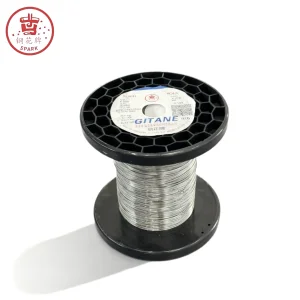
At the center of these thermal processing reactors is the specialized electrical resistance heating element. The global semiconductor industry relies heavily on trusted China semiconductor heating wire manufacturers capable of synthesizing ultra-pure iron-chromium-aluminum (FeCrAl), nickel-chromium (NiCr), and powder metallurgy (PM) dispersion-strengthened alloys. Beijing Shougang Gitane New Materials Co., Ltd. (SPARK brand), with over 60 years of metallurgical heritage within the Shougang Group, stands at the forefront of this critical supply chain.
This industry whitepaper provides an exhaustive technical analysis of semiconductor heating wire manufacturing in China. It explores global procurement dynamics, metallurgical technological roadmaps, micro-impurity control, protective oxide scale passivation, macro-industry solutions, and regulatory compliance standards necessary to supply Tier-1 OEM semiconductor equipment builders worldwide.
Thermal Uniformity ±0.5°C
Strict resistance tolerance matching (±1.5%) across full wire coils eliminates hot spots and ensures flat thermal zones across 300mm wafer stages.
Zero-Particle Passivation
Proprietary golden pre-oxidation treatment forms a dense, non-flaking α-Al₂O₃ layer preventing metal vapor drift and airborne particulate contamination.
PM Alloy Rating to 1425°C
Powder metallurgy FeCrAl (SGHT & SGHYZ) prevents grain growth and sag under prolonged extreme temperature operational cycles.
Global Procurement Intent & Sourcing Requirements
Analyzing key metrics, risk mitigation factors, and qualification criteria specified by semiconductor OEM procurement directors.
When procurement managers and chief thermal engineers from global fab equipment suppliers source electric heating wires, their purchasing intent revolves around four non-negotiable pillars: Resistance Stability, Impurity Purity (GDMS Analysis), Mechanical Sagging Resistance, and Thermal Cycle Lifespan.
1. Micro-Impurity Mitigation and Particle Generation
In sub-micron wafer manufacturing, heavy metals such as Copper (Cu), Iron (Fe), Nickel (Ni), and Cobalt (Co) are severe killer contaminants if vaporized into the process atmosphere. When traditional heating alloys operate above 1000°C, trace element volatility can cause metallic ions to migrate through quartz tubes or ceramic insulation into the wafer active layer. China high-purity semiconductor heating wire manufacturers utilize vacuum induction melting (VIM) combined with electroslag remelting (ESR) to maintain trace element impurities below strict parts-per-million (ppm) thresholds.
2. Resistance Drift and Temperature Coefficient Control
Process repeatability in ALD and rapid thermal annealing (RTA) hinges on constant electrical resistance. Standard commercial heating wires exhibit resistance drift over extended thermal cycles due to selective aluminum depletion or grain boundary oxidation. SPARK brand semiconductor heating wires (such as 0Cr25Al5, SGHYZ, and SGHT) are engineered to keep electrical resistance drift below <0.5% over 5,000 thermal cycles, preventing driver power supply recalibration overhead.
3. Sagging Coefficient and Creep Resistance at Elevated Temperatures
Vertical diffusion furnaces utilize long helical wire coils suspended inside ceramic fiber or quartz support structures. Under continuous operation at 1100°C–1350°C, gravity induces creep and sagging in standard FeCrAl wires, causing adjacent coils to short-circuit or disrupt heat flux distribution. By incorporating micro-alloyed rare earth elements (Yttrium, Zirconium, Hafnium) and adopting powder metallurgy routes, SPARK heating wires feature elevated hot yield strength and high sag resistance.
Macro-Industry Thermal Solutions Architecture
Tailored heating alloy configurations across key front-end and back-end semiconductor equipment modules.
Vertical Diffusion & Oxidation Furnaces
Heavy-gauge FeCrAl coils (0Cr25Al5, SGHYZ) designed for multi-zone vertical thermal chambers. Provides tight temperature gradient control up to 1350°C across 300mm wafer boats.
Atomic Layer Deposition (ALD) & Gas Lines
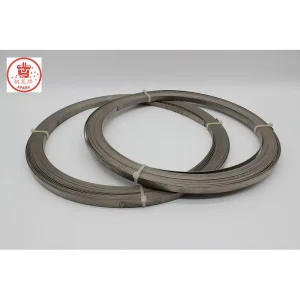
Ultra-flexible Cr20Ni80 Nichrome flat ribbons and coiled heating jackets for delivery lines. Prevents organometallic precursor condensation between 150°C and 450°C without hot-spot burnouts.
MOCVD & Epitaxy (EPI) Susceptor Heating
Powder metallurgy SGHT alloy elements constructed for rapid high-temperature ramp rates up to 1425°C in hydrogen and vacuum environments during GaN and SiC wafer growth.
Exhaust Line Gas Abatement / Scrubbers
Corrosion-resistant Cr20Ni40 and golden-finished FeCrAl resistance heaters operating inside thermal scrubbers to decompose fluorinated compounds (PFCs) and toxic process gases.
Rapid Thermal Processing (RTP) Reflectors
High-emissivity ceramic-sheathed heating element assemblies providing microsecond response times and thermal uniformity for wafer rapid annealing and silicide formation.
Wafer Bake Out & Advanced Packaging
Precision electric heating tubes and modular resistance ribbons designed for photoresist bake ovens, flip-chip reflow lines, and vacuum degas chambers.
Metallurgical Comparison: FeCrAl vs. NiCr vs. PM Alloys
In-depth chemical and physical matrix outlining performance trade-offs for thermal process design engineers.
Selecting the correct heating alloy chemistry determines not only heater efficiency but also furnace sheath lifetime and maintenance intervals. The table below outlines the key metallurgical characteristics of SPARK resistance heating alloys manufactured by Beijing Shougang Gitane New Materials Co., Ltd. in accordance with GB/T 1234-2012 and international standards.
| Alloy Grade | Material Family | Max Operating Temp (°C) | Resistivity at 20°C (μΩ·m) | Protective Scale Type | Primary Semiconductor Application |
|---|---|---|---|---|---|
| SGHT | Powder Metallurgy FeCrAl | 1425°C | 1.45 ±0.05 | Pure α-Al₂O₃ Oxide Film | SiC / GaN Epitaxy, Ultra-High Temp Diffusion |
| SGHYZ | Rare-Earth Refined FeCrAl | 1400°C | 1.42 ±0.05 | Adherent Al₂O₃ Scale | Vertical Furnace Modules, Ceramic Sintering |
| 0Cr20Al6 | High-Performance FeCrAl | 1350°C | 1.38 ±0.04 | Self-Healing Al₂O₃ | Diffusion Furnaces, Quartz Tube Heaters |
| 0Cr25Al5 | Standard High-Temp FeCrAl | 1250°C | 1.42 ±0.04 | Continuous Al₂O₃ Layer | Wafer Bake Out, Industrial Thermal Process |
| Cr20Ni80 | 80/20 Nichrome Alloy | 1200°C | 1.09 ±0.03 | Cr₂O₃ Oxide Layer | ALD Gas Lines, Vacuum Degas Chambers |
| Cr20Ni40 | Nickel-Chrome-Iron | 1100°C | 1.04 ±0.03 | Cr₂O₃ / Fe₂O₃ Complex | Exhaust Scrubbers, General Heating Cables |
The Science of Oxide Passivation: Golden Finished Wires
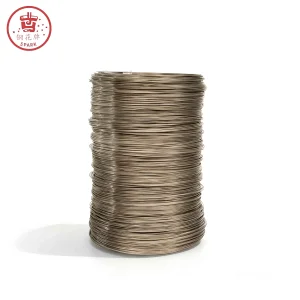
A critical innovation in SPARK semiconductor-grade heating wires is the specialized Golden Pre-Oxidation Surface Finishing. Through a controlled thermal oxidation process in an ultra-clean atmosphere, a uniform, continuous, micro-thin alpha-alumina (α-Al₂O₃) ceramic layer is grown on the wire surface prior to installation. This golden surface finish provides three key advantages:
- Preventing Thermal Spallation: Eliminates scale flaking and particle shedding that could pollute silicon wafers inside cleanrooms.
- Suppressing Metal Outgassing: Seals trace volatile metallic species inside the alloy matrix, keeping process atmospheres ultra-pure.
- Extending Service Life: Reduces ongoing oxidation rates by acting as an immediate kinetic barrier against reactive gases.
Manufacturing Excellence & Global Fab Standards
Comprehensive compliance, ISO quality systems, and state-backed metallurgical consistency.
As a key subsidiary of the state-owned Shougang Group, Beijing Shougang Gitane New Materials Co., Ltd. operates state-of-the-art manufacturing workshops covering 39,268 m² in Changping, Beijing. Out of 500+ employees, more than 30% comprise senior metallurgical scientists, process engineers, and semiconductor thermal consultants.
Certifications and Quality Systems
Shougang Gitane achieved ISO 9002 certification in 1996 and upgraded to ISO 9001 quality management in 2003, alongside ISO 14001 environmental management certification. Every production batch of SPARK heating wire undergoes rigorous quality verification:
- GDMS Trace Element Analysis: Glow Discharge Mass Spectrometry auditing to verify non-ferrous trace impurity limits.
- 100% Eddy Current Testing: Non-destructive crack detection across 100% of wire lengths to prevent structural failure under thermal stress.
- Laser Diameter Calibration: Continuous dual-axis laser measurement ensuring dimensional tolerance within ±0.01mm.
- Accelerated Life Testing: Compliance with GB/T 1234-2012 automated high-temperature life cycling tests (50-hour accelerated rating).
- RoHS & REACH Compliance: Full compliance with EU directives for heavy metals and chemical substance safety.
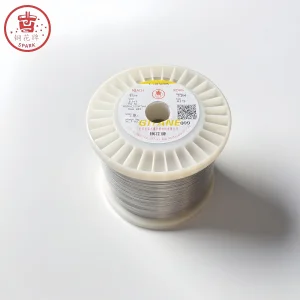
For international buyers and fab tool OEMs, Shougang Gitane provides full Mill Test Certificates (MTC), heat-lot traceability documents, customized coil winding, specialized spools, and customized localized engineering design assistance.
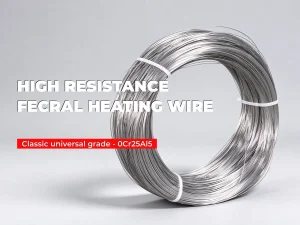
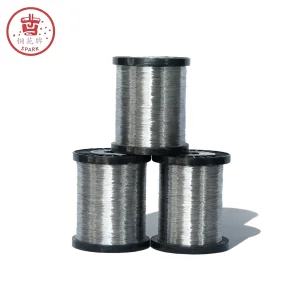
Wholesale Resistance Heating Wires & Alloy Tubes
Explore our full line of golden finished, FeCrAl, and NiCr alloys delivered in wire, strip, tube, and custom element formats.


Frequently Asked Questions by Thermal Engineers & Buyers
Structured semantic search insights answering technical queries regarding semiconductor heating wire selection and operation.
Why choose FeCrAl over Nichrome (NiCr) for semiconductor diffusion furnaces?
FeCrAl alloys (such as 0Cr25Al5, SGHYZ, and SGHT) offer higher maximum operating temperatures (up to 1425°C) compared to NiCr alloys (typically capped at 1200°C). Crucially, FeCrAl forms a self-healing alpha-alumina (α-Al₂O₃) surface scale that acts as a tight barrier against micro-particle generation and outgassing, whereas NiCr forms chromia scale which can volatilize into Cr-bearing vapors above 1050°C under vacuum or reducing atmospheres.
What is the advantage of Golden Finished Electric Heating Wire?
The "Golden Finish" represents a factory-controlled pre-oxidation conditioning process. By thermal-passivating the wire under precise atmosphere parameters, a uniform α-Al₂O₃ layer is established before the wire is coiled or installed. This avoids initial particle spallation inside cleanroom diffusion chambers and minimizes initial electrical resistance fluctuations.
How does Powder Metallurgy (PM) SGHT wire prevent creep sagging in long vertical furnace coils?
Powder metallurgy synthesis creates fine, uniformly dispersed rare-earth oxide particulates throughout the FeCrAl alloy matrix. These dispersed oxides pin grain boundaries and prevent coarse grain growth at extreme temperatures (1300°C–1425°C), dramatically raising the high-temperature creep strength and preventing horizontal sag in suspended heater elements.
Can SPARK heating wires be used in hydrogen or ammonia reducing atmospheres?
Yes. However, in dry hydrogen or reducing gases, the protective oxide scale on standard FeCrAl can be gradually reduced. To maintain maximum lifespan, we recommend periodic pre-oxidation in air to regenerate the α-Al₂O₃ layer, or utilizing our specialized NiCr / PM FeCrAl grades engineered for controlled atmosphere compatibility.
What delivery forms and dimensional tolerances are available for wholesale orders?
Beijing Shougang Gitane supplies resistance heating materials as fine round wire (0.05mm to 12mm diameter), flat ribbon/strip (thickness 0.1mm–6mm, width 1mm–200mm), wound helical spirals, and pre-fabricated heating element tubes. Diameter tolerances are held tightly within ±0.01mm via continuous laser gauge feedback.
How does Shougang Gitane control trace element contaminants like Cu, Fe, and Ni?
Through state-backed metallurgical facilities utilizing Vacuum Induction Melting (VIM) and Electroslag Remelting (ESR), raw virgin elements are refined under strict vacuum. Batch samples undergo Glow Discharge Mass Spectrometry (GDMS) testing to confirm heavy metal impurities remain well within Tier-1 semiconductor fab limits.