Featured Photovoltaic & Industrial Electrothermal Products
High-performance FeCrAl and NiCr heating alloys engineered for monocrystalline silicon growth, solar cell diffusion furnaces, and thermal module assembly.




1. Global Photovoltaic Heating Ribbon Industrial Landscape & Market Dynamics
Analyzing the critical role of specialized resistance ribbons and electrothermal strips in modern solar cell manufacturing and crystal growth technologies.
The accelerated global transition toward green energy has catapulted the photovoltaic (PV) manufacturing industry into an unprecedented phase of technology iteration. As solar cell architectures rapidly evolve from standard P-type PERC (Passivated Emitter and Rear Cell) to N-type TOPCon (Tunnel Oxide Passivated Contact), HJT (Heterojunction Technology), and Perovskite-Silicon Tandem cells, the thermal processing requirements across the entire PV supply chain have become rigorously stringent.
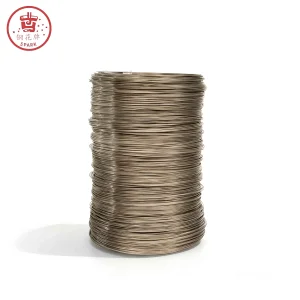
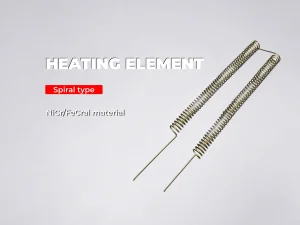
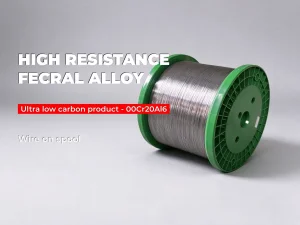
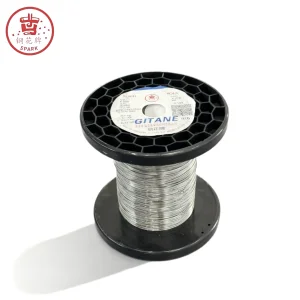
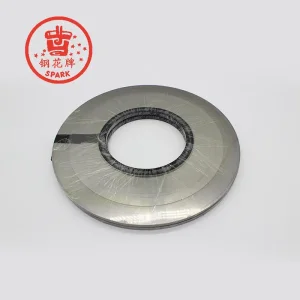
At the center of this thermal processing revolution is Photovoltaic Heating Ribbon (Electrothermal Resistance Ribbon). Manufactured primarily from advanced Iron-Chromium-Aluminum (FeCrAl) and Nickel-Chromium (NiCr) superalloys, precision heating ribbons are the essential core heating elements used in:
- Czochralski (CZ) Monocrystalline Silicon Ingot Pullers: Creating high-purity uniform thermal zones operating continuously at 1300°C–1425°C.
- Diffusion & Oxidation Furnaces: Delivering ultra-precise temperature control ($\pm 0.5^\circ\text{C}$) during POCl3 doping and oxide growth.
- PECVD & ALD Passivation Tools: Maintaining uniform substrate pre-heating for high-efficiency thin-film deposition.
- Solar Cell Ribbon Soldering & Module Lamination: Rapid thermal response contact heating strips for fast, non-destructive tabbing and stringing.
- Utility-Scale Thermal Management & De-icing Systems: Integrated low-voltage resistive heating ribbons for PV panels deployed in arctic and high-altitude alpine solar parks.
China's Manufacturing Dominance in Resistance Alloys
China currently supplies over 80% of the world's electrothermal alloy ribbon products. By integrating upstream raw metal refining (high-purity electrolytic nickel, chromium, and refined iron) with vacuum induction melting (VIM), electro-slag remelting (ESR), precision flat rolling, and continuous bright annealing, Chinese manufacturers provide the global photovoltaic sector with unparalleled cost-efficiencies, rapid OEM scalability, and exceptional batch-to-batch consistency.
2. Metallurgy, Material Science & Technical Specifications
Understanding the physical, electrical, and thermal mechanics of FeCrAl vs. NiCr heating ribbons in photovoltaic equipment.
Photovoltaic heating ribbons differ significantly from ordinary resistance wire. They are manufactured with high aspect ratios (width-to-thickness ratios ranging from 5:1 up to 25:1) to maximize radiative thermal surface area while minimizing mass. Choosing the optimal alloy chemistry depends directly on the operating environment, maximum temperature, atmosphere, and mechanical stress.
FeCrAl Alloys vs. NiCr Alloys in Photovoltaic Applications
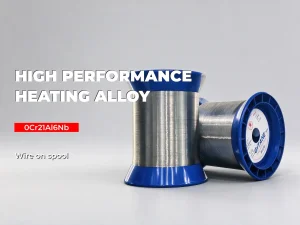
Iron-Chromium-Aluminum (FeCrAl) Alloys (e.g., 0Cr25Al5, 0Cr21Al6Nb, SGHYZ, SGHT):
FeCrAl alloys are the premier choice for high-temperature furnace chambers (1100°C–1425°C). When exposed to high temperatures, FeCrAl forms a dense, adherent outer protective film of alpha-alumina ($\alpha\text{-Al}_2\text{O}_3$). This oxide film possesses high electrical resistivity and superior chemical inertness against silicon vapor and corrosive gases.
- Higher Maximum Operating Temperature: Operates reliably up to 1425°C (powder metallurgy SGHT grade).
- Higher Electrical Resistivity: Typically $1.35 - 1.45\,\mu\Omega\cdot\text{m}$, allowing compact element design.
- Lower Specific Density: Approximately $7.10\,\text{g/cm}^3$ (15% lighter than NiCr), reducing raw material weight and cost.
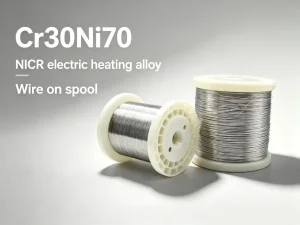
Nickel-Chromium (NiCr) Alloys (e.g., Cr20Ni80, Cr30Ni70, Cr15Ni60):
NiCr ribbons excel in low-to-medium temperature applications (<1200°C) requiring high mechanical ductility, frequent heating/cooling cycling, and non-magnetic performance.
- Post-Use Ductility: NiCr alloys do not embrittle after prolonged high-temperature exposure, enabling easy coil repair and reconfiguration.
- Superior Hot Strength: Excellent resistance to sag and deformation under high mechanical strain or vertical mounting.
- Protective Oxide: Forms a chromic oxide ($\text{Cr}_2\text{O}_3$) layer suited for neutral or reducing atmospheres.
| Alloy Grade | Alloy Type | Max Temp (°C) | Resistivity ($\mu\Omega\cdot\text{m}$, 20°C) | Density ($\text{g/cm}^3$) | Primary PV Application Scenario |
|---|---|---|---|---|---|
| SGHT (Powder Met) | FeCrAl + Rare Earth | 1425°C | 1.45 | 7.10 | CZ Monocrystalline Silicon Ingot Thermal Zones |
| SGHYZ / HRE | FeCrAl + Yttrium | 1400°C / 1350°C | 1.42 | 7.15 | Solar Diffusion & Oxidation Furnace Core Tubes |
| 0Cr25Al5 | FeCrAl Standard | 1250°C | 1.42 | 7.20 | General Industrial Heat Treatment & Annealing Kilns |
| 0Cr21Al6Nb | FeCrAl + Niobium | 1350°C | 1.40 | 7.10 | High-Stress Solar Cell Sintering Heaters |
| Cr20Ni80 | 80/20 Nichrome | 1200°C | 1.09 | 8.40 | Tabbing/Stringing Soldering Plates & Module Lamination |
| Cr30Ni70 | 70/30 Nichrome | 1250°C | 1.18 | 8.10 | Rapid Thermal Processing (RTP) & PECVD Pre-heaters |
3. Comprehensive Industry Application Scenarios
From silicon ingot synthesis to end-user module protection in extreme climates.
4. Macro Industry Solutions & Quality Engineering Standards
End-to-end manufacturing oversight from metallurgical refining to final ribbon spooling under ISO 9001 and GB/T 1234-2012.
To guarantee zero production line downtime for global solar manufacturers, China's tier-1 electrothermal alloy manufacturers implement a multi-stage quality control framework:
5. Commercial Pricing Drivers & B2B Wholesale Pricelist Matrix
A transparent guide to procurement costs, raw material surcharges, quantity discounting, and OEM customization.
Photovoltaic heating ribbon pricing is dictated by four core metallurgical cost drivers:
- Raw Material LME/SMM Index: Nickel (LME Ni) and Chromium prices heavily influence NiCr alloys, whereas FeCrAl is significantly less sensitive to nickel volatility.
- Ribbon Aspect Ratio & Thickness: Ultra-thin ribbons (<0.10mm thickness) require additional cold-rolling passes and bright annealing cycles, carrying a higher fabrication premium per kilogram.
- Rare Earth Micro-Alloying: Additions of Yttrium (Y), Zirconium (Zr), or Niobium (Nb) for ultra-high temperature grades (SGHYZ, SGHT) increase raw material costs by 15%–25% but extend service lifespan twofold.
- Delivery Form & Spooling: Precision DIN160/DIN200 spooling, cut-to-length flat strips, or custom-bent zigzag coils for solar furnaces.
Below is an indicative B2B Factory Wholesale Pricelist Matrix for standard China Photovoltaic Heating Ribbons and Electrothermal Wires (FOB Tianjin/Shanghai Port):
| Material Grade | Standard Dimensions | MOQ (Kilograms) | Estimated Wholesale Price (USD/kg) | Lead Time |
|---|---|---|---|---|
| 0Cr25Al5 FeCrAl Ribbon | 0.2mm – 2.0mm Thick x 3mm – 30mm Wide | 100 kg | $8.50 – $12.80 / kg | 7 – 10 Days |
| 0Cr21Al6Nb Heating Strip | 0.3mm – 3.0mm Thick x 10mm – 50mm Wide | 100 kg | $11.20 – $15.50 / kg | 10 – 12 Days |
| SGHYZ / HRE 1400°C Ribbon | 0.5mm – 4.0mm Thick x 5mm – 40mm Wide | 50 kg | $16.80 – $24.00 / kg | 12 – 15 Days |
| SGHT Powder Met Ribbon | 1.0mm – 5.0mm Thick x 10mm – 60mm Wide | 20 kg | $35.00 – $52.00 / kg | 15 – 20 Days |
| Cr20Ni80 Nichrome Ribbon | 0.1mm – 1.5mm Thick x 2mm – 25mm Wide | 50 kg | $28.50 – $38.00 / kg | 7 – 10 Days |
| Cr30Ni70 Alloy Ribbon | 0.2mm – 2.0mm Thick x 4mm – 30mm Wide | 50 kg | $32.00 – $44.00 / kg | 10 – 14 Days |
*Note: Prices are subject to raw material market fluctuations. Contact sales for precise, customized quotes to exact drawing specifications.
6. Frequently Asked Questions (FAQ)
Expert engineering answers regarding selection, installation, and optimization of photovoltaic heating ribbons.
Q1: Why is flat heating ribbon preferred over round resistance wire in solar cell furnaces?
Q2: What causes premature failure of heating ribbons in PV diffusion furnaces?
Q3: How does rare-earth addition (Y, Ce, La) improve FeCrAl ribbon performance?
Q4: Can FeCrAl heating ribbon be welded or spliced after high-temperature use?
Q5: What quality certifications should I verify when importing heating ribbons from China?
Complete Resistance Alloys & Custom Heating Elements Solutions
Explore our extended catalog of high-purity electrothermal tubes, alloy wires, spectrometer components, and custom furnace heating assemblies.