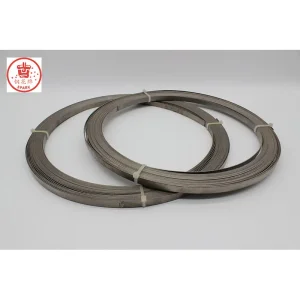
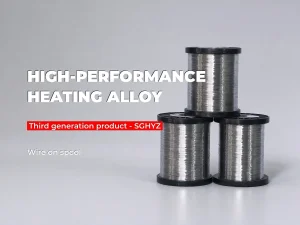
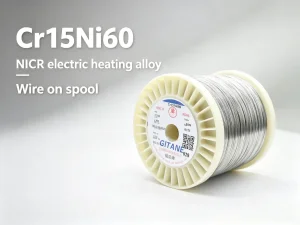
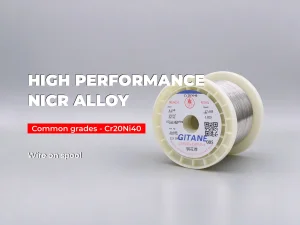
Featured Semiconductor Grade Heating Alloy Products
Precision resistance wires, strips, and engineered thermal cores tailored for semiconductor wafer processing equipment.

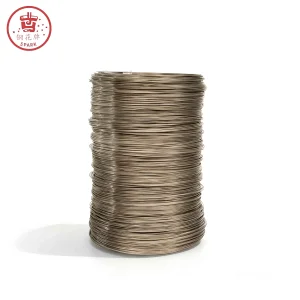

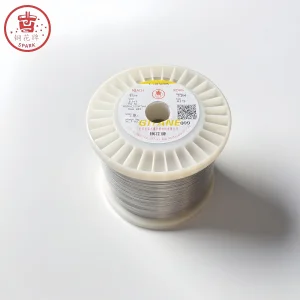
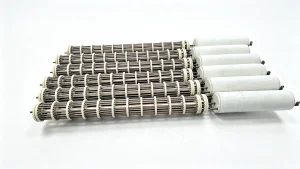
Global Industry Landscape: Nichrome Wire in Semiconductor Fabrication
In the ultra-precise domain of semiconductor manufacturing, sub-micron wafer processing demands absolute thermal control, zero particulate contamination, and exceptional high-temperature resistance alloy longevity. As global fabrication facilities transition to advanced sub-7nm node architectures, 3D NAND vertical stacking (>300 layers), and wide-bandgap compound semiconductors (SiC/GaN), thermal equipment OEMs face unprecedented requirements for heater element purity, structural integrity, and thermal stability.
China Nichrome Wire Manufacturers and Specialized Metallurgy Factories have emerged as pivotal global leaders in providing ultra-high-grade Nickel-Chromium (NiCr) and Iron-Chromium-Aluminium (FeCrAl) resistance wires. Through decades of metallurgical innovation, proprietary Vacuum Induction Melting (VIM), Electroslag Remelting (ESR), and micro-alloying techniques involving Rare Earth (RE) elements, Chinese suppliers are delivering resistance heating alloys that match or exceed international standards (such as ASTM B344 and DIN 17470) at scalable economics.
The Strategic Importance of High-Purity NiCr Alloys
Unlike standard industrial heating elements, semiconductor-grade Nichrome wire (specifically high-purity Cr20Ni80, Cr30Ni70, and specialized Cr20Ni80S) operates inside critical reaction zones including Chemical Vapor Deposition (CVD), Atomic Layer Deposition (ALD), Rapid Thermal Processing (RTP), and Oxidation/Diffusion Quartz Tubes. At elevated temperatures ($800^\circ\text{C}$ to $1250^\circ\text{C}$), trace metal outgassing (e.g., Cu, Fe, Zn, Pb) can ruin entire silicon wafer lots by causing severe micro-defect contamination. Chinese specialized factories have mastered ultra-clean melting routes to ensure zero heavy metal volatile emissions.
Localized Application Scenarios in Semiconductor Fabrication
Semiconductor fabrication relies on precise thermal budgets. Nichrome and FeCrAl resistance alloys engineered by top China factories serve as the fundamental heating engine across multiple high-vacuum and atmospheric wafer processing modules:
1. Horizontal & Vertical Diffusion Tubes
Diffusion and thermal oxidation processes require ultra-uniform multi-zone heating coils. Precision wire wound with uniform pitch ensures that temperature gradients across 200mm and 300mm silicon wafers remain within fractions of a degree, promoting uniform oxide film growth ($SiO_2$) and precise dopant drive-in profiles.
2. Low-Pressure CVD & ALD Reactors
LPCVD and ALD modules deposit ultra-thin dielectric and metallic films. Nichrome heater coils encased in ceramic or quartz jackets provide rapid thermal response without magnetic disturbance or surface spallation, preventing killer particles from alighting on delicate wafer surfaces.
3. Rapid Thermal Processing (RTP) & Annealing
RTP requires heater elements capable of undergoing extreme thermal ramp rates ($>100^\circ\text{C}/\text{sec}$) without sagging, distortion, or hot-spot formation. Customized Cr30Ni70 and micro-alloyed FeCrAl strip elements deliver exceptional thermal fatigue resistance during millions of high-frequency thermal cycles.
4. Wafer Bakeout & Photolithography Track Units
Precision hot plates used for soft-bake and hard-bake photoresist processes integrate fine-gauge Nichrome ribbon wire embedded in aluminum or nitride ceramic substrates, delivering precise surface thermal planarity.
Technical Comparison: NiCr vs FeCrAl Alloys in Semiconductor Duty
Selecting the correct electrothermal alloy composition is crucial for optimizing equipment mean time between failures (MTBF). Below is the authoritative engineering breakdown of primary China-manufactured resistance alloys:
| Alloy Grade | Alloy Family | Max Continuous Temp (°C) | Resistivity at 20°C (μΩ·m) | Oxide Scale Characteristics | Primary Semiconductor Application |
|---|---|---|---|---|---|
| Cr20Ni80 / Cr20Ni80S | Nichrome (80/20) | 1200°C | 1.09 ± 0.05 | Tenacious $Cr_2O_3$ scale; non-spalling, high hot strength | CVD reaction chambers, RTP, Diffusion furnaces, Cleanroom heaters |
| Cr30Ni70 | Nichrome (70/30) | 1250°C | 1.18 ± 0.05 | Superior green-rot & corrosion resistance in reducing atmospheres | High-temperature annealing, epitaxy susceptor pre-heaters |
| Cr15Ni60 | Nichrome (60/15) | 1150°C | 1.11 ± 0.05 | Adherent oxide film; excellent cold ductility | Exhaust line bakeout jackets, gas line heating tapes |
| SPARK SGHT | Powder Metallurgy FeCrAl | 1425°C | 1.45 ± 0.07 | Ultra-dense $Al_2O_3$ scale; zero particle shed | SiC/GaN high-temp crystal growth, ceramic sintering furnaces |
| SPARK SGHYZ / HRE | Rare Earth FeCrAl | 1350°C - 1400°C | 1.42 ± 0.05 | Self-healing alumina layer; extreme thermal resistance | High-temperature diffusion tubes, heavy-duty radiant tube cores |
Metallurgical Deep-Dive: Oxide Scale Dynamics and Grain Structure
The performance of China Nichrome Wire in semiconductor equipment hinges on the formation of a self-passivating, non-spalling protective oxide oxide scale. When heated in oxidizing environments, Cr20Ni80 forms an inner layer of chromic oxide ($Cr_2O_3$) bonded with nickel chromate spinel ($NiCr_2O_4$). This crystalline barrier prevents further oxygen inward diffusion.
Furthermore, leading Chinese suppliers micro-alloy Nichrome wire with active rare-earth elements such as Yttrium (Y), Cerium (Ce), and Zirconium (Zr). Rare earth atoms segregate to grain boundaries, keying the oxide scale tightly to the metal matrix. This prevents oxide flaking—a mandatory requirement for ISO Class 1 to Class 5 cleanrooms where airborne particle contamination causes severe wafer patterning yield losses.
Technology Roadmap & Next-Generation Metallurgical Trends
As wafer fabs scale up to 300mm wafer formats and push toward advanced packaging (2.5D/3D ICs, Chiplets), thermal equipment must evolve. Chinese resistance wire manufacturers are actively executing a multi-faceted technology roadmap to meet tomorrow's semiconductor challenges:
Traditional ingot melting can introduce microscopic non-metallic inclusions. China’s advanced suppliers are expanding gas atomization and hot isostatic pressing (HIP) powder metallurgy lines (e.g., SPARK SGHT grade). PM processing ensures absolute chemical homogeneity, ultrafine grain structure, and zero structural voiding.
To eliminate surface carbon residues and drawing lubricants, wire production lines employ inline vacuum hydrogen bright annealing. Wires emerge with mirror-like surface finishes ($Ra < 0.2\mu m$), guaranteeing immediate cleanroom readiness without requiring lengthy customer bakeout cycles.
At temperatures exceeding $1100^\circ\text{C}$, wire sag caused by grain boundary sliding can cause heater coil turns to short-circuit. By controlling grain growth direction during drawing and stress-relieving, China factories produce wires with interlocking elongated grain structures that dramatically increase high-temperature creep resistance.
Moving beyond bare wire supply, Chinese manufacturers are partnering with fab OEMs to supply pre-formed, pre-oxidized, ceramic-embedded modular radiant heating cores equipped with integrated thermocouple channels for real-time digital closed-loop thermal control.
Macro Industry Solutions for Semiconductor OEMs & Fabs
China’s leading electrothermal alloy factories do not merely deliver spools of wire; they engineer comprehensive, system-level solutions that optimize energy efficiency, lower power consumption, and extend equipment operating cycles:
Custom Wire Drawing & Ribbon Flattening to Nanometer Tolerances
Semiconductor heating element coils require extreme cross-sectional precision. Diameter variations along a 1,000-meter wire spool must not exceed ±0.002 mm to prevent local resistance hot-spots. China’s leading drawing mills utilize synthetic diamond wire dies, laser micrometers, and automatic tension control systems to guarantee perfectly uniform linear resistance across entire production runs.
Turnkey Furnace Element Fabrication & Pre-Passivation
For rapid deployment during fab maintenance turnarounds, China factories supply fully fabricated spiral coils, wave-shaped ribbon elements, and ceramic-supported bundle rod radiant elements. Elements undergo factory pre-oxidation in specialized clean atmospheres, creating a pre-formed $Cr_2O_3$ or $Al_2O_3$ protective layer that shortens end-user commissioning time from days to hours.
Stringent Quality Assurance & ISO/SEMI Compliance Protocols
Procurement directors and quality engineers sourcing from China benefit from rigorous testing infrastructure compliant with ISO 9001, ISO 14001, GB/T 1234-2012, and international SEMI guidelines:
ICP-MS Trace Element Analysis
Inductively Coupled Plasma Mass Spectrometry verifies trace impurity levels down to parts-per-million (ppm), ensuring hazardous contaminants like Lead, Cadmium, Mercury, and Zinc are strictly contained below fab limits.
Accelerated Thermal Life Testing
Per GB/T 1234-2012 and ASTM B78 standards, wire samples undergo rigorous cyclic rapid burn-in testing at elevated voltage and temperature to guarantee high-temperature life expectation prior to batch dispatch.
100% Eddy-Current Surface Defect Inspection
In-line non-destructive eddy-current testing scans the full length of drawn wire for micro-cracks, inclusions, or surface laps, eliminating structural failure points prior to coiling.
Frequently Asked Questions (FAQ)
Direct technical insights for process engineers, thermal equipment designers, and sourcing managers.
While FeCrAl alloys offer higher operating temperatures, high-purity Nichrome (especially Cr20Ni80 and Cr30Ni70) maintains superior mechanical ductility after prolonged thermal exposure. It does not become brittle upon cooling, resisting vibration and thermal shock during wafer loading. Additionally, NiCr forms a tightly adherent chromia ($Cr_2O_3$) film that does not spall off in cycling thermal operations, safeguarding wafer cleanliness.
Top China manufacturers utilize Vacuum Induction Melting (VIM) followed by Electroslag Remelting (ESR) to strip out volatile trace elements. Wires undergo final bright annealing in high-purity dry Hydrogen ($H_2$) gas or high vacuum atmospheres to remove drawing oil residues, producing a pristine surface ready for semiconductor cleanroom integration.
Suppliers offer round wire (diameters from 0.05 mm up to 12.0 mm), flat wire/ribbon (thicknesses from 0.05 mm to 3.0 mm, widths up to 60 mm), rolled strip, wound spiral heating coils, and complete radiant cores. Wire diameter tolerances are tightly held within ±0.002 mm for micro-gauge wires.
Addition of micro-alloyed Rare Earth elements (Y, Ce, Zr) blocks grain boundary diffusion of oxygen, anchors the chromia/alumina scale to the alloy substrate (reactive element effect), and reduces high-temperature creep rate, effectively doubling operational life in demanding thermal cycling applications.
Yes. Advanced factories possess fully automated CNC coiling, bending, and welding machines capable of translating customer STEP/CAD files directly into precision spiral coils, wave elements, and ceramic-supported heating assemblies, complete with custom cold terminals (lead-outs).
Explore Complete Resistance Wire & Element Inventory
Direct factory quotes and engineered electrothermal alloys certified for semiconductor and demanding industrial heating.