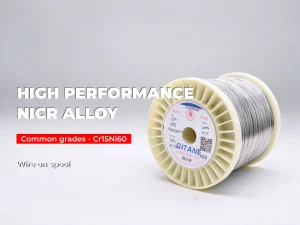
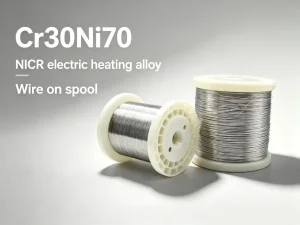
Explore primary high-temperature resistance wire, nickel-chrome strip, and FeCrAl elements manufactured in China under strict metallographic phase control standards.
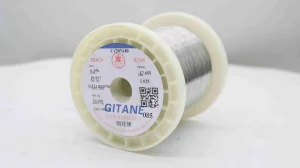
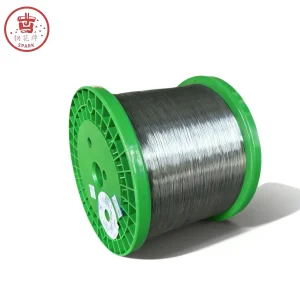





In modern industrial thermal processing, the operational lifespan of electrical heating elements and structural furnace components hinges upon a singular metallurgical phenomenon: maintaining a homogeneous metallographic micro-structure after prolonged exposure to elevated temperatures (1100°C to 1425°C). Standard commercial alloys frequently suffer from rapid grain coarsening, precipitation of brittle secondary phases along grain boundaries, and localized elemental segregation during continuous thermal cycles. This leads to early embrittlement, catastrophic creep sagging, and non-uniform electrical resistivity distribution.
Leading Chinese alloy manufacturers and specialized factories have revolutionized high-temperature resistance wire and structural tube manufacturing through advanced thermodynamics and micro-alloying engineering. By controlling grain boundary dynamics, refining trace element addition, and implementing state-of-the-art melting processes, these materials achieve exceptional structural thermal stability.
In Iron-Chromium-Aluminum (FeCrAl) and Nickel-Chromium (NiCr) matrix alloys, thermal energy induces atomic diffusion that expands grain boundaries (coarsening). Premium Chinese factories introduce controlled nano-scale dispersoids such as Yttrium ($Y_2O_3$), Zirconium ($Zr$), and Niobium ($Nb$). These precipitates cluster along grain boundaries, effectively pinning them through Zener drag mechanisms and preventing abnormal grain growth under high thermal stress.
Microstructural homogeneity guarantees the smooth, continuous outward diffusion of aluminum atoms to form a dense, protective alpha-alumina ($\alpha-Al_2O_3$) surface layer. Unlike inhomogeneous alloys where oxide spallation occurs due to localized stress gradients, homogeneous Chinese alloys maintain uniform thermal-expansion matching between the oxide film and the core metallic substrate.
By utilizing Vacuum Induction Melting (VIM) followed by Electroslag Remelting (ESR), Chinese mills eliminate tramp elements like Sulfur ($S$), Phosphorus ($P$), and dissolved Carbon ($C$). This eliminates internal micro-void nucleation sites and preserves a unified crystal lattice (bcc for FeCrAl, fcc for NiCr) across tens of thousands of thermal duty cycles.
The global industrial landscape is shifting toward decarbonization, high-efficiency electrical heating, and ultra-high-precision thermal processes. As industrial furnaces switch from fossil fuel burner systems to electric resistance heating, the performance demands placed on resistance wire, strip, and structural tubes have escalated dramatically.
Traditional ingot metallurgy faces limits in alloying extension due to segregation during slow cooling. Leading Chinese manufacturers are deploying Powder Metallurgy (PM) routes—such as gas atomization coupled with hot isostatic pressing (HIP)—to produce super-alloys like SGHT and SGHYZ. Powder metallurgy ensures zero macro-segregation, yielding a perfectly uniform microscopic distribution of alloying elements that survives temperatures up to 1425°C without softening.
The precise addition of rare earth elements (Yttrium, Cerium, Lanthanum) in fractional percentages (0.05% to 0.25%) has transformed Chinese resistance alloys. Reactive elements concentrate at oxide scale grain boundaries, preventing rapid oxygen ion ingress into the metal matrix while strengthening the interface adhesion. This micro-alloying breakthrough minimizes weight-loss via oxidation during intermittent operational stops.
Metallographical control is not only created during melting—it is preserved through mechanical processing. Advanced Chinese factories utilize multi-pass cold drawing with intermediate bright annealing in pure hydrogen atmospheres. This restores fine equiaxed grain structures before final shipment, providing end-users with heating wire that is exceptionally ductile for winding into tight coils without fracturing.
Compare how optimized Chinese resistance alloys maintain microstructural integrity versus standard grades under prolonged high-temperature exposure.
| Alloy Grade / Family | Max Working Temp (°C) | Metallographic Phase Type | Grain Boundary Dispersoids | Creep Deflection Rate | Primary Industrial Application |
|---|---|---|---|---|---|
| SGHT (Powder Metallurgy FeCrAl) | 1425°C | Ferritic Matrix (Homogeneous) | Nano-$Y_2O_3$ / $ZrO_2$ Pinning | Ultra-Low (< 0.05 mm/m) | Semiconductor, Photovoltaic Diffusion Furnaces |
| 0Cr21Al6Nb (FeCrAl + Nb) | 1350°C | Stabilized Ferrite | Niobium Carbides ($NbC$) | Very Low | High-Temp Ceramic Sintering & Kilns |
| 0Cr25Al5 / 0Cr23Al5 | 1250°C | Standard Ferrite | Controlled Trace RE | Moderate | Industrial Heat Treatment, Furnace Elements |
| Cr30Ni70 (High-Ni Nichrome) | 1250°C | Austenitic Matrix (Non-magnetic) | Chromium Carbides ($Cr_{23}C_6$) | Low (High Hot Tensile) | Chemical Petrochemical Tubes, Cyclic Furnaces |
| Cr20Ni80 (Classic Nichrome) | 1200°C | Stable Austenite | Rare Earth Additions | Low | Precision Heating Elements, Appliances |
International B2B procurement officers, furnace builders, and metallurgical engineers from Europe, North America, and East Asia require rigorous compliance documentation and total cost of ownership (TCO) justification when sourcing from Chinese manufacturers.
Top Chinese factories provide complete Mill Test Reports (MTR) accompanying every production heat. Testing protocols include ASTM E112 standard grain size determination, SEM-EDS micro-analysis for inclusions, high-temperature accelerated oxidation tests (GB/T 1234-2012 standards), and strict electrical resistance tolerances ($\pm 3\%$).
Products conform fully to international quality standards, including ISO 9001:2015 Quality Management Systems, ISO 14001 Environmental Standards, REACH, and RoHS compliance. This guarantees frictionless integration into global supply chains without regulatory delays.
While low-grade alloys have cheaper upfront unit costs, frequent replacement downtime, wire sag short-circuits, and thermal degradation dramatically increase operational expenditure. Choosing microstructurally homogeneous alloys from China delivers up to 300% longer element service life, drastically reducing maintenance labor and unscheduled shutdowns.
Microstructurally stable resistance wires, strips, and tubes power critical thermal machinery across diverse strategic industries:
Quartz tube furnaces and ingot crystal growth equipment require flawless temperature uniformity across long heating zones. SGHT powder-metallurgy tubes and heavy-gauge spiral elements maintain precise resistance stability without slumping or outgassing contaminants into ultra-clean semiconductor rooms.
Continuous mesh-belt furnaces operating under protective atmospheres (Hydrogen, Nitrogen, Endothermic gas) subject alloys to severe carburization and nitridation. Chromium-rich NiCr and Nb-stabilized FeCrAl wires prevent structural degradation and phase transformation in high-throughput lithium battery cathode sintering kilns.
High-performance SGHT steel tubes and heavy-wall alloy sleeves provide robust structural integrity inside petrochemical cracking furnaces. Their fine-grain metallographic matrix withstands extreme internal pressures and thermal shock during cyclic shutdown routines.
Sourcing directly from Chinese factories provides more than raw wire on spools—it delivers comprehensive engineering collaboration from alloy selection to element geometry design.
Factory engineers calculate precise surface load rates ($W/cm^2$) based on customer thermal chamber dimensions, supplying pre-coiled spirals, meander elements, or corrugated ribbon systems ready for instant installation.
Dedicated metallurgical teams assist global buyers in diagnosing element failures, transitioning from obsolete wire specifications, and optimizing atmosphere compatibility for maximum element longevity.
All spools, coils, and straight tubes are sealed in vacuum moisture-proof barriers, cushioned in reinforced wooden crates, and labeled with heat-number barcoding for seamless inventory tracking.
Chinese research institutes and top alloy manufacturers are pushing the envelope of microstructural thermal science. The future technical roadmap focuses on three key innovations:
Oxide Dispersion Strengthened (ODS) alloys utilizing mechanical alloying techniques to uniformly distribute nano-yttria dispersoids throughout a ferritic matrix, raising continuous operating limits toward 1450°C with near-zero creep.
Integrating machine learning predictive models during thermo-mechanical processing to tailor grain boundary character distribution (GBCD), maximizing low-angle coincidence site lattice (CSL) boundaries that naturally resist intergranular corrosion and creep.
Developing pre-oxidized, self-healing surface architectures that automatically regenerate alumina protection when micro-scratched during assembly, ensuring zero performance degradation in harsh chemical vapor environments.
What does "homogeneous metallographic structure after high-temperature heating" mean in practice?
It means that after the alloy wire or element is heated to elevated operating temperatures (e.g., 1100°C to 1400°C) for hundreds of hours, its microstructural grain size remains fine, uniform, and equiaxed without localized coarse grain explosion, phase precipitation segregation, or embrittlement. This ensures consistent electrical resistance and high mechanical strength throughout its operational lifespan.
Why is FeCrAl preferred over NiCr for extreme temperature applications above 1250°C?
FeCrAl alloys form a protective alpha-alumina ($\alpha-Al_2O_3$) oxide film that is chemically stable up to 1425°C and possesses a higher melting point than the chromia oxide film formed on NiCr alloys (which volatilizes above 1200°C). Furthermore, FeCrAl has higher resistivity and lower density, offering substantial material weight savings.
How do Chinese manufacturers prevent resistance wire sagging at high temperatures?
Sag resistance is enhanced by adding micro-alloying pinning agents such as Niobium ($Nb$), Zirconium ($Zr$), and Rare Earth ($RE$) elements, or by utilizing Powder Metallurgy (PM) routes (like SGHT). These dispersoids block dislocations and grain boundary sliding under thermal load, dramatically reducing creep sag.
What quality control reports are provided with Chinese high-temperature alloy shipments?
Standard quality documentation includes full Mill Test Reports (MTR) detailing chemical heat analysis, room-temperature tensile strength, electrical resistivity at 20°C, high-temperature resistance coefficient ($C_t$), ASTM grain size analysis, and dimension tolerance compliance certificates.
Can these alloys be used in reducing or vacuum furnace atmospheres?
Yes. However, for FeCrAl alloys operating in reducing or nitrogen atmospheres, pre-oxidation in clean air at 1050°C for several hours is recommended to establish a robust protective alumina scale prior to exposure to reducing gases.
Complete your procurement evaluation with additional specialized nickel-chromium wires, FeCrAl resistance alloys, and industrial inductors engineered in China.