
Core Heating Elements & Precision Alloy Wires
Engineered for high-temperature resistance, oxidation protection, and operational endurance in extreme thermal environments.


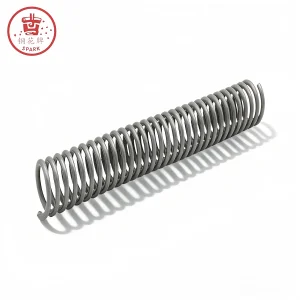
Metallurgical Foundations of High-Performance Electric Resistance Heating Alloys
In modern industrial thermo-processing, thermal efficiency, operational longevity, and precise temperature gradient control depend fundamentally on the physical and chemical behavior of core electrothermal alloys. As a global manufacturing benchmark in China, electric resistance alloys based on Nickel-Chromium (Ni-Cr) and Iron-Chromium-Aluminum (Fe-Cr-Al) systems represent the vital heat-generating core embedded inside modern industrial heating equipment, precision domestic civil appliances, and specialized ultra-high-temperature devices.
The fundamental operational principle of electrical resistance heating relies on Joule heating ($P = I^2 R$), where an electric current passing through a conductor generates thermal energy proportional to the material's electrical resistivity ($\rho$). However, engineered industrial alloys must balance high electrical resistivity with exceptional oxidation resistance, structural creep strength, microstructural phase stability, and resistance to thermal fatigue during rapid duty cycling.
1. The Nickel-Chromium (Ni-Cr) Alloy System: Ductility & Cyclic Stability
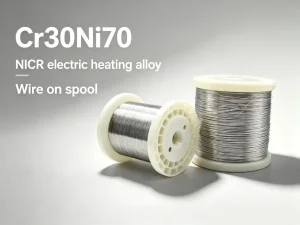
Nickel-Chromium alloys (such as classic Cr20Ni80, Cr15Ni60, and Cr30Ni70) possess outstanding hot strength, mechanical ductility after prolonged elevated-temperature exposure, and superior resistance to cyclic oxidation. The addition of Chromium (typically 15% to 30%) forms a tenacious, self-healing surface protective film dominated by Chromia ($\text{Cr}_2\text{O}_3$). When exposed to oxidizing environments, this scale prevents deeper oxygen ingress into the bulk matrix.
Ni-Cr alloys do not undergo severe embrittlement upon cooling, making them uniquely suitable for applications requiring frequent mechanical vibration, flexure, or aggressive thermal cycling (such as in precision domestic appliances, hot runner systems, and industrial batch furnaces).
2. The Iron-Chromium-Aluminum (Fe-Cr-Al) System: High Temp & High Resistivity
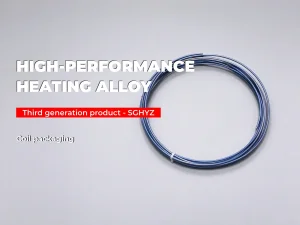
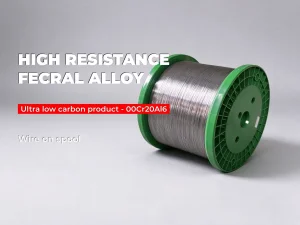
For operational temperatures exceeding 1200°C up to 1425°C, Iron-Chromium-Aluminum alloys (such as 0Cr25Al5, 0Cr23Al5, 0Cr21Al6Nb, and advanced powder metallurgy grades like SGHYZ and SGHT) deliver clear metallurgical advantages. At elevated temperatures, Aluminum dissolved within the ferritic matrix selectively oxidizes to form a dense, thermally stable alpha-alumina ($\alpha\text{-Al}_2\text{O}_3$) protective barrier.
This $\alpha\text{-Al}_2\text{O}_3$ scale features a lower vapor pressure and superior thermodynamic stability compared to chromia, enabling Fe-Cr-Al alloys to endure extreme thermal regimes while maintaining a higher electrical resistivity (up to $1.45 \ \mu\Omega\cdot\text{m}$) and approximately 15% lower density than Nickel-based counterparts, yielding substantial material mass savings for furnace designers.
Key Metallurgical Difference: Scale Mechanics
While Ni-Cr alloys rely on protective Chromia ($\text{Cr}_2\text{O}_3$) scales which exhibit superior resistance to thermal shock and cycling embrittlement, Fe-Cr-Al alloys leverage $\alpha\text{-Al}_2\text{O}_3$ scale formation to achieve higher maximum operating temperatures (up to 1425°C) and higher specific resistance, reducing overall component weight and electrical load demands in continuous industrial furnaces.
Global Industrial Heating Trends & Technological Paradigms
How global decarbonization, semiconductor manufacturing, and advanced thermal processing are reshaping demand for specialized resistance alloys.
Electrification of Heavy Industry
As global manufacturing shifts away from fossil-fuel combustion burners to meet strict ESG targets, electrical resistance heating is expanding into large-scale steel heat treatment, glass melting, and chemical calcination furnaces.
Semiconductor & Photovoltaic Growth
Precision crystal growing furnaces, silicon wafer diffusion tubes, and ceramic sintering lines require ultra-clean heating elements with near-zero chemical outgassing and extreme temperature uniformity ($\pm 1^\circ\text{C}$).
Powder Metallurgy & Micro-Alloying
Traditional ingot melting is supplemented by dispersion-strengthened powder metallurgy (PM). Micro-alloying with rare-earth elements (Reactive Elements: Yttrium, Zirconium, Cerium) enhances scale adhesion and prevents creep-induced sagging.
Industry 4.0 standards mandate that resistance wire manufacturers supply materials with tight dimensional tolerances, reproducible cold-to-hot resistance ratios ($R_t/R_{20}$), and predictable lifespans measured via standard accelerated life tests (such as ASTM B78 / GB/T 1234 standards). Thermal engineering procurement teams no longer buy simple commodity wire; they procure engineered heating systems with guaranteed thermodynamic reliability.
Global Enterprise Procurement Criteria for Resistance Alloys
A rigorous metallurgical benchmark used by international OEMs and EPC contractors when selecting China supply chain partners.
Resistivity Tolerances ($\pm 3\%$)
Uniform cross-sectional area and chemical homogeneity across thousands of meters of spooled wire guarantee identical heating output along the entire length of multi-zone industrial furnaces.
Creep Strength & Sag Resistance
In horizontally supported furnace elements or heavy-gage ceramic tube designs, low creep strength leads to element deformation, short-circuiting between coils, and catastrophic failure.
Surface Power Load Limit ($W/cm^2$)
Evaluating maximum allowable surface watt loading under specific furnace atmospheres (Air, $N_2$, $H_2$, Endothermic Gas, Vacuum) ensures safe operating temperatures without overheating the core metal.
Metallurgical Parameter Comparison Table
Below is a standardized technical matrix comparing major industrial grade resistance alloys manufactured according to international standards (ASTM, DIN, GB/T):
| Alloy Grade | Alloy Family | Max Temp (°C) | Resistivity ($\mu\Omega\cdot\text{m}$, 20°C) | Density ($\text{g/cm}^3$) | Primary Application Environment |
|---|---|---|---|---|---|
| SGHT / SGHYZ | Fe-Cr-Al (PM) | 1400 - 1425°C | 1.45 | 7.10 | Ultra-high-temp industrial kilns, semiconductor furnaces |
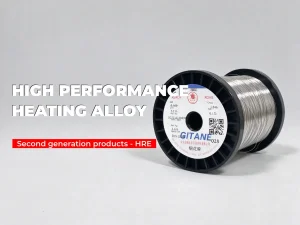
| 0Cr25Al5 / HRE | Fe-Cr-Al | 1250 - 1350°C | 1.42 | 7.10 | Heavy industrial heat treatment, radiant tubes |
| 0Cr23Al5 | Fe-Cr-Al | 1250°C | 1.35 | 7.25 | Industrial furnaces, ceramic heating plates |
| Cr20Ni80 (Nichrome) | Ni-Cr | 1200°C | 1.09 | 8.40 | Precision civil appliances, cycling heaters, medical equipment |
| Cr15Ni60 | Ni-Cr | 1150°C | 1.12 | 8.20 | Domestic heating elements, hot air guns, oil heaters |
| Cr30Ni70 | Ni-Cr | 1250°C | 1.18 | 8.10 | Specialized chemical synthesis, high-temp protective atmospheres |
China Industry 4.0: Metallurgical Precision & Global Supply Resilience
China's modern electrothermal material production has evolved from bulk steel manufacturing to high-value, ultra-clean precision alloy processing. Leading Chinese manufacturers leverage state-of-the-art fully integrated supply chains—from raw material melting to final element fabrication.
1. Vacuum Induction Melting (VIM) & Electroslag Remelting (ESR)
To eliminate tramp elements (such as Lead, Tin, Zinc, Sulfur, and Phosphorus) that degrade hot ductility and accelerate grain-boundary embrittlement, modern factories employ dual-stage VIM + ESR refining. Vacuum melting ensures precise control of volatile micro-alloying elements like Yttrium, Zirconium, and Rare Earth metals, establishing chemical homogeneity at the atomic scale.
2. Precision Cold Drawing & Continuous Bright Annealing
Achieving micron-level dimensional consistency across wire diameters ranging from 0.05 mm (ultra-fine wire for precision sensors) to 12.0 mm (heavy industrial furnace rod) requires multi-pass automated cold drawing dies with online laser micrometers. Continuous hydrogen-atmosphere bright annealing prevents surface oxidation, delivering clean, bright, stress-relieved wire with uniform mechanical elongation properties.
3. End-to-End Traceability & Digital Quality Control
From ingot master heats to individually barcoded wire spools, every step is logged within ERP and MES manufacturing execution systems. Automated eddy-current testing detects surface micro-cracks, while full-spectrum X-ray fluorescence (XRF) and ICP-OES spectroscopy guarantee strict chemical compliance with international procurement specifications.
Supply Chain Security & Cost Efficiency
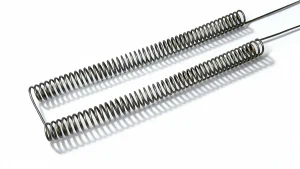
By controlling the entire production vertical—including master alloy formulation, hot rolling, cold drawing, strip rolling, and final spiral coiling—Chinese factories provide global OEMs with rapid lead times, competitive total cost of ownership (TCO), and complete insulation against upstream raw material volatility.
Localized Applications & Specialized Engineering Scenarios
From heavy industrial heat treatment to micro-electronics, resistance alloys power critical thermal processes across diverse sectors.
1. Industrial Thermal Processing & Kilns
Equipment: Mesh belt bright annealing furnaces, car-bottom forging heaters, pit carburizing furnaces, ceramic roller kilns.
Alloy Choice: 0Cr25Al5, HRE, SGHYZ strips and heavy-gage wire.
Key Requirement: Resistance to carbon pickup, high temperature sag resistance, and long operational campaigns exceeding 12,000 continuous hours.
2. Precision Domestic & Commercial Appliances
Equipment: Convection air heaters, clothes dryer elements, coffee machine boilers, toaster coils, hair dryer ribbon elements.
Alloy Choice: Cr20Ni80, Cr15Ni60 cold-rolled flat ribbon and wound wire.
Key Requirement: Immediate heat-up, excellent ductility after repeated on-off cycling, zero rust, and high mechanical flexure endurance.
3. Special High-Temp Devices & Clean Energy
Equipment: Photovoltaic diffusion furnace heaters, semiconductor crystal growth zone heaters, hydrogen fuel cell reformers, aerospace test chambers.
Alloy Choice: SGHT (Powder Metallurgy FeCrAl), Cr30Ni70.
Key Requirement: Ultra-clean chemical profile, zero particle shed, operation in pure $H_2$ or vacuum, and extreme thermal gradient stability up to 1425°C.
High-Temperature Wires, Strips & Customized Elements
Explore our complete production line of certified electrothermal alloys supplied globally directly from our Beijing manufacturing plant.






Frequently Asked Questions by Furnace Engineers & Buyers
Expert answers regarding material selection, surface watt loading calculation, atmospheric compatibility, and quality certification.
- Choose Fe-Cr-Al (e.g., 0Cr25Al5, SGHYZ) if your operating temperature exceeds 1200°C (up to 1425°C), or if you need higher electrical resistivity and lighter element weight. Fe-Cr-Al forms a superior protective $\alpha\text{-Al}_2\text{O}_3$ scale.
- Choose Ni-Cr (e.g., Cr20Ni80) if your equipment undergoes constant heating and cooling cycles, mechanical shock, or operates in nitrogen/ammonia atmospheres. Ni-Cr retains high ductility after thermal aging.
- Nitrogen ($N_2$) / Nitriding atmosphere: Ni-Cr alloys resist nitriding far better than Fe-Cr-Al alloys, which form brittle Aluminum Nitrides (AlN).
- Carburizing Atmosphere (Green Rot): Ni-Cr alloys containing 15-20% Chromium can suffer "green rot" internal oxidation in reducing carbon atmospheres. Low-carbon Fe-Cr-Al alloys or high-nickel/silicon stabilized grades are preferred.
- Pure Hydrogen ($H_2$): Dew point control is vital. Fe-Cr-Al can operate safely if pre-oxidized in air to establish an alumina barrier prior to hydrogen introduction.