
High-Performance Resistance Alloys: Featured Catalogue (Part I)
Select from our certified industrial resistance heating wires, foils, and specialized ultra-high temperature alloys designed for controlled protective atmospheres.


Executive Whitepaper: Resistance Alloy Behavior in Controlled Atmospheres
In modern industrial thermal processing, precise atmospheric control is essential for preventing oxidation, decarburization, and scaling of processed materials. However, while protective gases—such as inert protective atmospheres (Argon, Nitrogen, Helium) and weakly reducing atmospheres (Endothermic gas, Exothermic gas, Hydrogen-Nitrogen mixtures, or cracked Ammonia)—safeguard the target workload, they radically alter the oxidation kinetics and degradation mechanisms of the electrical resistance heating elements themselves.
Standard Iron-Chromium-Aluminum (FeCrAl) and Nickel-Chromium (NiCr) electric heating alloys rely on the formation of a continuous, thermodynamically stable oxide scale (alpha-Al₂O₃ or Cr₂O₃) to shield the underlying metallic matrix from rapid thermal degradation. When operated in low partial pressures of oxygen ($P_{O2}$), typical of inert and weakly reducing environments, the thermodynamic equilibrium shifts. Understanding these gas-metal interactions is paramount for furnace engineers, metallurgical designers, and procurement directors seeking to optimize heating element service life, energy consumption, and total cost of ownership (TCO).
Thermodynamic Principles of Selective Oxidation
The longevity of heating elements in inert or weakly reducing environments is governed by the Ellingham Diagram. To maintain a protective oxide layer, the oxygen partial pressure in the furnace chamber must remain higher than the dissociation pressure of the primary protective oxide. For FeCrAl alloys, aluminum exhibits an extremely high affinity for oxygen, forming a dense, adherent, dielectric alpha-Al₂O₃ (alpha-alumina) surface barrier even at $P_{O2}$ levels as low as $10^{-20}$ atm. Conversely, NiCr alloys rely on Cr₂O₃ (chromia), which requires a higher oxygen threshold and is susceptible to reduction or volatilization into gaseous Cr(OH)₂ under wet hydrogen conditions.
Atmosphere-Specific Alloy Performance & Phase Chemistry
Choosing the correct alloy grade requires matching the chemical atmosphere with the specific oxidation mechanisms of FeCrAl vs. NiCr systems. Below is a comprehensive analysis of element behavior across industrial gas formulations.
Pure Inert Atmospheres (Argon & Helium)
In high-purity noble gas environments, zero oxygen is available to replenish the oxide scale. If pre-oxidation is not conducted, elements may experience micro-evaporative loss of volatile elements (such as Chromium) at temperatures exceeding 1100°C. Solution: Pre-oxidize FeCrAl alloys in air at 1050°C for 8 hours to grow a 2–3 µm α-Al₂O₃ protective skin prior to inert gas exposure.
Nitrogen Atmospheres & Nitridation Risks
In dry Nitrogen, FeCrAl alloys are subject to Aluminum Nitriding (forming AlN precipitates) at temperatures above 1150°C, depleting the matrix of elemental Al and causing embrittlement. For pure N₂ or $N_2/H_2$ mixtures without oxygen, high-nickel alloys like Cr20Ni80 or high-temperature Cr30Ni70 display superior chemical resistance due to lower nickel-nitride formation rates.
Weakly Reducing & Carburizing Gases
Endothermic and cracked ammonia gases contain carbon monoxide (CO), methane ($CH_4$), and hydrogen ($H_2$). These gases induce Green Rot (internal carburization followed by rapid oxidation) in standard NiCr wire. Powder metallurgy FeCrAl alloys, such as SPARK SGHT, offer immunity to carburization thanks to their non-porous α-Al₂O₃ barrier and absence of nickel phase content.
Metallurgical Comparison Matrix for Gas-Furnace Operations
| Alloy Grade | Alloy Type | Max Temp (Air) | Max Temp (Inert N₂/Ar) | Max Temp (Dry H₂) | Carburization Resistance | Recommended Applications |
|---|---|---|---|---|---|---|
| SPARK SGHT | PM FeCrAl + REE | 1425°C | 1350°C | 1380°C | Exceptional | Semiconductor, Sintering, Clean Hydrogen Furnaces |
| SGHYZ / HRE | Advanced FeCrAl | 1400°C / 1350°C | 1300°C | 1320°C | Very High | Powder Metallurgy, Industrial Kilns |
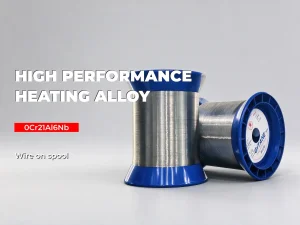
| 0Cr21Al6Nb | FeCrAl + Niobium | 1350°C | 1250°C | 1280°C | High | Heavy-Duty Industrial Heat Treatment |
| 0Cr25Al5 / 0Cr23Al5 | Standard FeCrAl | 1250°C | 1150°C | 1200°C | Moderate | General Industrial Furnaces, Heaters |
| Cr20Ni80 | 80/20 Nichrome | 1200°C | 1200°C | 1150°C | Low (Green Rot Risk) | Precision Lab Furnaces, Cycling Appliances |
| Cr30Ni70 | 70/30 Nichrome | 1250°C | 1220°C | 1180°C | Moderate-Low | High-Stress Cycling & Nitriding Environments |
China Industry 4.0: Supply Chain Resilience & Manufacturing Synergy
As a cornerstone enterprise under the historic Shougang Group, Beijing Shougang Gitane New Materials Co., Ltd. represents the apex of Chinese metallurgical precision. Operating out of an 88,000 m² advanced manufacturing complex in Shahe, Beijing, Gitane integrates raw material melting, hot rolling, cold wire drawing, strip processing, and final element fabrication within a fully traceable Industry 4.0 ecosystem.
Vacuum Induction Melting (VIM) & ESR
To operate flawlessly in inert and reducing gases, alloys must be free of harmful non-metallic inclusions and dissolved gas impurities ($O_2, N_2, H_2$). Gitane utilizes state-of-the-art Vacuum Induction Melting followed by Electro-Slag Remelting (ESR) to guarantee ultra-clean melt chemistries, precise Rare Earth Element (REE) micro-alloying (Yttrium, Zirconium, Hafnium), and minimal trace impurities.
Automated Precision Wire Drawing
Our smart drawing facility utilizes multi-pass tungsten carbide and diamond dies with real-time laser micrometer inspection. This ensures dimensional tolerances within ±0.01 mm across kilometer-long wire spools, maintaining constant electrical resistance ($\Omega/m$) crucial for multi-zone industrial furnaces.
Vertical Supply Chain Cost Leadership
By controlling every step from primary ferroalloy refining to finished heating elements, Gitane eliminates tier-two intermediary markups. Global buyers gain access to tier-one quality at highly competitive factory-direct pricing, backed by reliable lead times and robust global logistics buffers.
Macro Industry Solutions: Tailored Engineering Applications
From semiconductor crystal growth to lithium-battery cathode calcination, SPARK resistance alloys deliver precise thermal performance tailored to advanced industrial sectors.
1. Semiconductor & Photovoltaic Epitaxy
In silicon wafer diffusion, LPCVD furnaces, and monocrystalline ingot pullers, heating elements operate under ultra-pure Argon or Hydrogen environments. Micro-particle shedding from flaking oxide scales destroys semiconductor yield. SPARK's powder metallurgy SGHT grade forms a non-spalling, microscopic α-Al₂O₃ layer, delivering zero-particle contamination at temperatures up to 1425°C.
2. Lithium Battery Cathode Material Sintering
Roller hearth kilns (RHK) synthesizing NCM or LFP cathode materials require precise continuous heating in oxygen-enriched or controlled nitrogen atmospheres. 0Cr21Al6Nb and SGHYZ strip elements resist corrosive lithium-vapor condensation and severe thermal cycling, significantly extending kiln maintenance intervals.
3. Aerospace & Automotive Powder Metallurgy
Sintering of metal injection molded (MIM) titanium and stainless components demands dry Hydrogen or cracked ammonia atmospheres to prevent oxidation. SPARK FeCrAl alloys eliminate carburization risk, preventing carbon pickup in critical aerospace structural alloys.
Technology Roadmap & Future Outlook (2025–2030)
Driven by global industrial decarbonization, electric heating technologies are rapidly replacing fossil-fuel combustion burners in high-temperature kilns. Shougang Gitane's R&D division is leading the next generation of alloy innovation.
Oxide Dispersion Strengthened (ODS) Alloys
Commercial deployment of Y₂O₃-strengthened PM FeCrAl alloys offering 5x higher creep strength at 1350°C, eliminating element sagging in vertical atmosphere furnaces.
Ultra-Thin Resistance Foils (15µm)
Nanoscale cold-rolling technology producing precision foils for fast-response micro-heaters in hydrogen fuel cell stack pre-heating systems.
Green Hydrogen Sintering Compatibility
Advanced surface modification treatments tailored specifically for 100% pure steam and pure hydrogen ultra-high thermal stress environments.
AI-Driven Predictive Life Modeling
Integration of digital-twin corrosion modeling into furnace design software, enabling real-time element life forecasting based on atmospheric dew point sensors.
Global Procurement Guide: Specifications & Delivery Forms
Shougang Gitane provides custom engineering support, supplying resistance materials tailored to international dimensional standards (SWG, AWG, Metric) and custom geometric shapes.
Round Wire & Rods
Diameter Range: 0.05 mm to 12.0 mm (0.002" to 0.472").
Surface Finish: Bright annealed, oxidized, or acid-pickled.
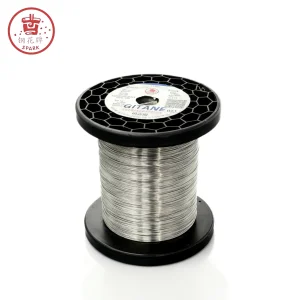
Packaging: Spooling (DIN125, DIN160, DIN200, DIN250), coils, or straightened cut lengths.
Flat Wire & Strip
Thickness: 0.10 mm to 4.0 mm; Width: 0.5 mm to 200 mm.
Edge Profile: Rounded, slitted, or deburred edges.
Application: Heavy-duty industrial furnace heating ribbons and corrugated elements.
Fabricated Heating Elements
Custom Geometries: Spiral coils, meander elements, tubular elements, and furnace ceramic insert racks.
Engineering Support: Power calculation ($W/cm^2$ surface load analysis) and terminal connection sizing.
Localized Support, Certification & Global Quality Compliance
Every shipment of SPARK electric heating wire and strip is accompanied by a certified 3.1 Mill Test Report (MTR) detailing exact chemical heat analysis, room-temperature tensile properties, electrical resistivity ($\mu\Omega\cdot m$), and yield tolerances in accordance with GB/T 1234-2012, ASTM B603, ASTM B344, and DIN 17470 standards.
Shougang Gitane holds full certification under ISO 9001:2015 Quality Management Systems and ISO 14001:2015 Environmental Systems. Products comply fully with EU RoHS and REACH chemical directives, ensuring seamless compliance for export into European, North American, and Asia-Pacific markets.
High-Performance Resistance Alloys: Featured Catalogue (Part II)
Explore our full line of nickel-chrome heating alloys, powder metallurgy solutions, and specialized industrial furnace elements.

Frequently Asked Questions: Atmosphere Alloy Selection
Expert technical responses to common engineering and procurement inquiries regarding controlled-atmosphere electric heating wire.
Factory Pricelist Guidance & RFQ Consultation
Electrical resistance alloy pricing is influenced by base metal market rates (specifically Nickel and Chromium LME indices), micro-alloying additives (Niobium, Rare Earths), wire diameter, and heat treatment finishing. Below is an estimated tier framework for technical planning.
Standard FeCrAl Alloys
Grades: 0Cr23Al5, 0Cr25Al5
Price Range: $6.50 – $12.00 / kg
Best For: Cost-sensitive industrial kilns, standard heat treatment in ambient air or nitrogen.
Advanced & PM FeCrAl
Grades: 0Cr21Al6Nb, SGHYZ, SGHT
Price Range: $14.00 – $38.00 / kg
Best For: High-temperature controlled atmosphere furnaces, semiconductor epitaxy, 1300°C+ applications.
Nickel-Chromium Alloys
Grades: Cr20Ni40, Cr15Ni60, Cr20Ni80, Cr30Ni70
Price Range: $22.00 – $48.00 / kg
Best For: Rapid thermal cycling, high ductility needs, inert noble gas chambers.