
Industrial Heating Elements & Furnace Components
Explore our factory-direct electric resistance alloys and industrial furnace units engineered for maximum creep resistance and thermal efficiency.


Engineering Principles of Industrial Furnace Nickel-Chromium Alloys
An in-depth analysis of high-temperature phase stability, chromia film growth kinetics, and hot tensile resilience in continuous industrial heat treatment environments.
Chromia ($\text{Cr}_2\text{O}_3$) Passivation Layer
Nickel-Chromium alloys (Cr20Ni80, Cr30Ni70, Cr15Ni60) derive their exceptional oxidation resistance from the formation of an adherent, continuous chromium oxide ($\text{Cr}_2\text{O}_3$) scale at temperatures up to 1200°C. Unlike FeCrAl alloys which rely on alumina oxide, NiCr films exhibit superior self-healing characteristics during thermal shock, preventing catastrophic spallation and core metal degradation in cyclic furnace operations.
Superior Hot Tensile & Creep Strength
The face-centered cubic (FCC) austenitic matrix of NiCr alloys provides remarkably high hot strength and resistance to sagging compared to ferritic body-centered cubic (BCC) alloys. Industrial heating coils crafted from Cr20Ni80 maintain structural elasticity post-heating, permitting easy maintenance, re-coiling, and mechanical handling without brittle fracture even after thousands of operational hours.
Atmospheric Compatibility
NiCr alloys show exceptional resistance to green-rot corrosion when treated with proper rare-earth additives. They perform impeccably in non-oxidizing, nitrogen-rich, and moist air environments. For continuous carburizing or endothermic gas furnaces, specialized micro-alloying with Silicon (Si) and Rare Earth Elements (REE) drastically minimizes carbon ingress and internal oxidation.
Industrial Nickel Chromium Alloy Grade Specifications & Pricing Structure
Standard technical parameters and reference B2B procurement pricelist metrics according to GB/T 1234-2012, ASTM B344, and DIN 17470 international engineering standards.
| Alloy Grade | Chemical Composition (%) | Max Operating Temp (°C) | Resistivity at 20°C ($\mu\Omega\cdot\text{m}$) | Density ($\text{g/cm}^3$) | Melting Point (°C) | FOB Reference Pricelist ($/kg) |
|---|---|---|---|---|---|---|
| Cr20Ni80 (Ni80Cr20) | Ni: ~80%, Cr: 20-23% | 1200°C | 1.09 ± 0.05 | 8.40 | 1400°C | $22.50 – $28.00 / kg |
| Cr30Ni70 (Ni70Cr30) | Ni: ~70%, Cr: 28-31% | 1250°C | 1.18 ± 0.05 | 8.10 | 1380°C | $20.00 – $25.50 / kg |
| Cr15Ni60 (Ni60Cr15) | Ni: ~60%, Cr: 15-18%, Fe: Bal. | 1150°C | 1.11 ± 0.05 | 8.20 | 1390°C | $17.20 – $21.80 / kg |
| Cr20Ni35 (Ni35Cr20) | Ni: ~35%, Cr: 18-21%, Fe: Bal. | 1050°C | 1.00 ± 0.05 | 7.90 | 1390°C | $12.80 – $16.50 / kg |
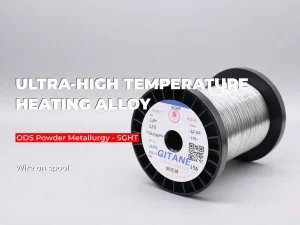
| SGHT / Ultra-FeCrAl | Fe-Cr-Al Powder Metallurgy | 1425°C | 1.45 ± 0.07 | 7.10 | 1500°C | $18.50 – $24.00 / kg |
China Factory 4.0: Supply Chain Resilience & Manufacturing Mastery
Integrating raw material electrolytic refining, state-of-the-art cold drawing, continuous bright annealing, and digital quality monitoring under Shougang Group's industrial ecosystem.
Vacuum Metallurgy & Smelting
Our production utilizes Vacuum Induction Melting (VIM) and Electroslag Remelting (ESR) technologies to eliminate non-metallic inclusions, dissolved gases (oxygen, nitrogen, hydrogen), and harmful trace elements (lead, bismuth, antimony). This delivers ultra-clean melt heats with exact stoichiometric control.
Precision Cold Drawing & Rolling
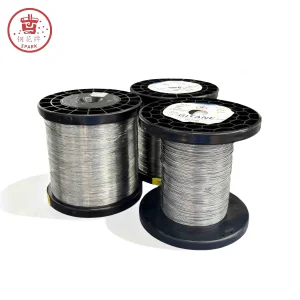
Equipped with natural diamond drawing dies and multi-pass continuous cold rolling mills, our facilities craft round wire from 0.05 mm to 12.0 mm and flat strip/ribbon down to ultra-thin profiles. Real-time online laser micrometers ensure uniform diameter tolerances across every meter of spool.
Hydrogen Bright Annealing
To preserve maximum surface purity and ductility, all drawn wire undergoes continuous inline hydrogen tube furnace annealing. This eliminates drawing lubricant residues, prevents surface oxidation, and provides a mirror-bright finish that guarantees consistent contact resistance and long element lifespan.
Macro Industry Solutions: Where SPARK Alloys Excel
Tailored resistance heating configurations engineered for thermal processing, glass tempering, semiconductor fabrication, photovoltaic crystal growth, and aerospace metallurgy.
Automotive & Aerospace Heat Treatment
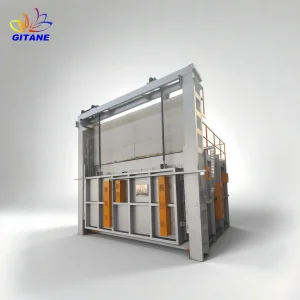
Continuous mesh belt furnaces, pit carburizing units, and sealed quench furnaces require heating elements that resist carbon deposition and cycling fatigue. SPARK Cr20Ni80 strip and heavy-gauge wire deliver uniform thermal distribution and exceptional structural integrity during rapid batch quenching.
Semiconductor & Photovoltaic Wafer Processing
Diffusion furnaces and SiC crystal growth reactors demand ultra-clean heating elements with near-zero trace outgassing. Our vacuum-refined SGHT powder metallurgy and high-purity NiCr alloys ensure stable heat zones up to 1425°C without contaminating silicon wafers or quartz tubes.
Glass Tempering & Technical Ceramics
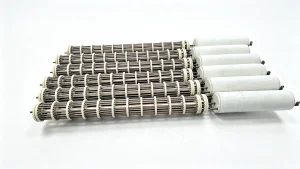
For radiant tube cores, ceramic bundle rods, and glass bending kilns, SPARK supplies pre-wound spiral elements and heavy ribbon assemblies designed to handle continuous thermal shock, high surface loading ($W/cm^2$), and rapid radiation transfer.
Technology Roadmap & Future Outlook of Electrothermal Alloys
Driving the next generation of high-temperature resistance materials through nano-rare-earth dopants, powder metallurgy, and zero-carbon industrial electrification technology.
Nano-Rare Earth Reactive Doping
By micro-alloying NiCr and FeCrAl matrices with nano-scale Yttrium (Y), Zirconium (Zr), Cerium (Ce), and Hafnium (Hf), our research team has achieved "peg-effect" oxide film anchoring. This dramatically reduces oxide layer growth speed, virtually eliminates spallation, and extends element life by over 35% at 1200°C+.
Powder Metallurgy (PM) Advancements
Traditional melt-cast alloys suffer from grain coarsening at extreme temperatures. Our advanced Powder Metallurgy (PM) process yields ultrafine grain structures with dispersed oxide particles (ODS), giving alloys like SGHT unmatched creep strength and structural shape retention up to 1425°C.
Decarbonized Industrial Heating
As global industries transition from fossil gas burners to green electric heating, furnace designers face higher power densities and harsher atmosphere challenges. SPARK electrothermal alloys provide the foundation for zero-carbon electric furnace conversions, supporting global Net-Zero targets.
Global Procurement, Quality Assurance & Export Compliance
Rigorous quality control protocols, international certifications, and customized export logistics guaranteeing reliable long-distance supply chain performance.
ISO 9001 & GB/T 1234 Certified
Shougang Gitane holds ISO 9002 (since 1996) and ISO 9001 quality management certifications. All products are manufactured in full compliance with GB/T 1234-2012, ASTM B344, DIN 17470, and JIS C2520 standards, accompanied by EN 10204 3.1 Mill Test Certificates.
Heavy Export Packaging Protocols
Alloy spools and coils are protected using desiccants, anti-corrosion VCI films, vacuum aluminum foil sealing, and custom reinforced wooden crates compliant with ISPM 15 fumigation standards, preventing sea-freight humidity damage.
Third-Party Verification & RoHS/REACH
Chemical composition, electrical resistivity ($\mu\Omega\cdot\text{m}$), and mechanical tensile properties are verified per batch via Optical Emission Spectrometry (OES) and automated tensile testers. Full compliance with EU RoHS and REACH environmental directives is certified.
Explore SPARK Specialized Heating Alloys & Radiant Cores
Factory-direct quotes, comprehensive technical data sheets, and custom coil fabrication for high-temperature industrial kilns.




Frequently Asked Technical Questions
Expert answers on material selection, surface load design, atmosphere resistance, and pricelist calculation parameters for industrial furnaces.
What are the main selection criteria between Nickel-Chromium (NiCr) and Iron-Chromium-Aluminum (FeCrAl) wires? +
How does SPARK calculate the wholesale B2B pricelist for industrial furnace NiCr wire? +
What surface watt-loading ($W/cm^2$) is recommended for industrial furnace NiCr elements? +
How do SPARK Nickel-Chromium alloys perform in protective or carburizing atmospheres? +
Which international testing certifications accompany SPARK alloy shipments? +
What are the lead times and customized manufacturing capabilities for global OEMs? +
Request an Engineering Quotation & Technical Catalog
Partner directly with China's leading electrothermal alloy manufacturer. Speak with our technical metallurgical engineering team for material selection, element design calculations, and factory-direct pricelist quotes.