
Primary Industrial Furnace Heating Alloys & Components
Direct factory supply of high-temperature resistance wire, flat strips, and tubular furnace elements manufactured under ISO 9001 and GB/T 1234-2012 quality systems.


Engineering Fundamentals of Industrial Heating Strips
An in-depth evaluation of electric resistance alloys, high-temperature oxide scale kinetics, and phase stability for heavy-duty industrial furnaces.
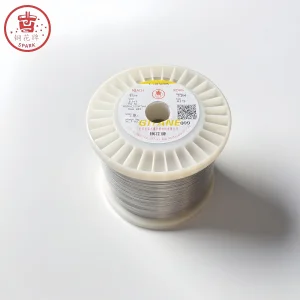
Industrial electric furnaces rely heavily on resistance heating elements to convert electrical energy into uniform, controlled thermal energy via Joule heating ($P = I^2 R$). Among various geometric forms—including round wire, coiled spirals, and tubular rods—industrial furnace heating strips (flat ribbons and rolled strips) provide distinct thermal advantages in high-power industrial applications. The flat geometry yields a significantly higher surface-area-to-volume ratio ($S/V$), allowing superior radiative and convective heat transfer to the furnace workload while maintaining a lower internal core temperature.
Microstructural Physics & Oxidation Kinetics
During prolonged exposure to elevated temperatures in oxidizing atmospheres, industrial furnace heating strips depend entirely on the formation of a self-healing, passivating oxide scale to prevent rapid destructive oxidation:
FeCrAl Alloys ($\alpha$-Phase Ferritic)
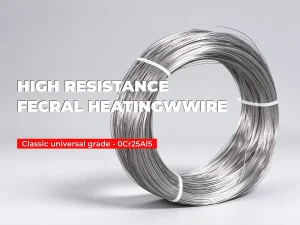
FeCrAl strip alloys (e.g., 0Cr25Al5, 0Cr21Al6Nb, SGHT) form a dense, thermodynamically stable alpha-alumina ($\alpha\text{-Al}_2\text{O}_3$) scale. This scale possesses exceptionally low ion diffusivity, granting superior oxidation resistance up to $1425^\circ\text{C}$. The addition of reactive rare-earth elements (Yttrium, Haffnium, Zirconium) pins the oxide scale to the substrate, preventing thermal spallation during rapid thermal cycling.
NiCr Alloys ($\gamma$-Phase Austenitic)
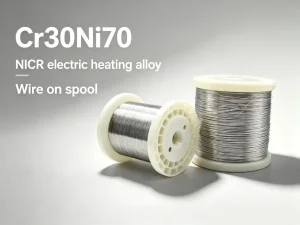
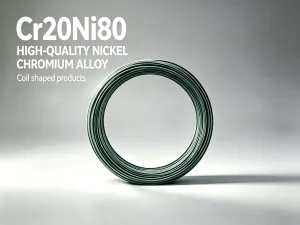
NiCr strip alloys (e.g., Cr20Ni80, Cr30Ni70) form a protective chromia ($\text{Cr}_2\text{O}_3$) and nickel-chromite spinel ($\text{NiCr}_2\text{O}_4$) surface layer. Operating up to $1200^\circ\text{C}$–$1250^\circ\text{C}$, NiCr alloys exhibit outstanding face-centered cubic (FCC) austenitic mechanical strength, resisting high-temperature creep and mechanical deformation under vertical hanging loads.
Comparative Technical Matrix: Resistance Alloy Families
Selecting the optimal heating strip material requires balancing electrical resistivity, temperature coefficients, physical density, and mechanical yield strength at operating temperature.
| Alloy Grade | Alloy Family | Max Element Temp (°C) | Resistivity @20°C ($\mu\Omega\cdot\text{m}$) | Density ($\text{g/cm}^3$) | Hot Creep Strength | Primary Atmosphere Compatibility |
|---|---|---|---|---|---|---|
| SGHT / SGHYZ | PM FeCrAl (RE) | 1400°C – 1425°C | 1.45 | 7.10 | Very High (Dispersion) | Oxidizing, Carburizing, Vacuum, Air |
| 0Cr25Al5 / 0Cr27Al7Mo2 | Standard FeCrAl | 1250°C – 1350°C | 1.42 – 1.45 | 7.10 | Moderate (Requires Support) | Air, Neutral, Sulfur-Rich |
| Cr20Ni80 / Cr20Ni80S | NiCr (80/20) | 1200°C | 1.09 | 8.40 | Excellent (Austenitic) | Exothermic, Nitrogen, Ammonia |
| Cr30Ni70 | NiCr (70/30) | 1250°C | 1.18 | 8.10 | Superior (High Creep) | Green Rot Resistant, Alternating Ox/Red |
| Cr20Ni40 | Ni-Fe-Cr | 1100°C | 1.04 | 8.60 | Good | Cost-effective Industrial Heating |
China Supply Chain Infrastructure for Industrial Heating Strips
How vertically integrated metallurgy, precision cold-rolling mills, and rare-earth doping create unmatched global cost and technical advantages.
Vacuum Induction Melting (VIM & ESR)
Leading Chinese factories utilize Vacuum Induction Melting (VIM) coupled with Electroslag Remelting (ESR) technology. This doubly refined process minimizes non-metallic inclusions, gases (oxygen, nitrogen, hydrogen), and trace tramp elements, ensuring uniform cold-workability and consistent electrical resistance batch after batch.
Rare-Earth Element Integration
China holds over 70% of global rare-earth element (REE) reserves. Chinese alloy manufacturers leverage micro-alloying techniques—adding precise ratios of Yttrium (Y), Neodymium (Nd), Zirconium (Zr), and Titanium (Ti)—to dramatically refine grain structures and inhibit high-temperature grain growth during continuous duty.
Precision Strip Rolling Mills
Advanced 20-high Sendzimir cold rolling mills process alloy hot bands into continuous thin strips ranging from 0.1mm to 4.0mm in thickness and 5mm to 300mm in width, maintaining extreme dimensional tolerances ($\pm 0.01\text{mm}$) and mirror-smooth bright annealed surfaces.
Global Enterprise Sourcing & Total Cost of Ownership (TCO)
Critical evaluation factors for procurement heads, furnace OEMs, and plant maintenance managers when importing industrial heating strips.
For international furnace manufacturers and industrial thermal process plants in Europe, North America, Southeast Asia, and the Middle East, selecting a Chinese supplier for industrial furnace heating strips involves evaluating far more than initial purchase price per kilogram. Total Cost of Ownership (TCO) is driven by operational uptime, resistance tolerance uniformity, shipping reliability, and compliance certifications.
1. Dimensional & Resistance Consistency
Variations in electrical resistivity ($\Omega/\text{m}$) or strip cross-sectional area lead to uneven temperature distribution across industrial furnace zones. This creates dangerous local hotspots that burn out heating elements prematurely. Strategic buyers require Chinese factories to guarantee a narrow resistance tolerance window ($\le \pm 3\%$).
2. Edge Quality & Surface Integrity
Slitting high-hardness resistance alloy strip produces mechanical micro-burrs along the strip edge. Under thermal expansion cycles in an industrial furnace, edge burrs cause dielectric arc discharges between adjacent wavy-folded elements. Premium suppliers perform precision edge deburring and bright hydrogen annealing to guarantee stress-free strips.
3. Lead Time & Custom Coiling Options
Industrial thermal facilities cannot afford extended furnace downtime. Sourcing direct from China mills offering pre-formed, wave-shaped, or corrugated heating strip elements reduces on-site fabrication labor, allowing plug-and-play installation during planned maintenance shut-downs.
4. International Compliance & Certification
Leading Chinese industrial furnace heating strip suppliers strictly comply with international metallurgical standards (ASTM B603, DIN 17470, JIS C2520, and GB/T 1234-2012). Every export shipment includes full chemical composition analysis, mechanical properties test, and mill test certificates per EN 10204 3.1.
Technological Innovation & Industry Trends (2025–2030)
Next-generation powder metallurgy, green steel decarbonization, and digital thermal twin modeling driving resistance alloy evolution.
Powder Metallurgy (PM) Dispersion Alloys
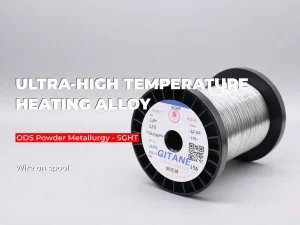
Traditional cast-and-wrought FeCrAl strips suffer from rapid grain growth at temperatures above $1300^\circ\text{C}$, leading to room-temperature brittleness and sag. Advanced Chinese mills are expanding production of Powder Metallurgy (PM) alloys (e.g., SGHT grade). Oxide Dispersion Strengthened (ODS) particles prevent grain boundary sliding, providing unprecedented creep resistance up to $1425^\circ\text{C}$.
Decarbonization & Furnace Electrification
As global heavy industry shifts away from fossil gas burners to meet zero-carbon targets, massive high-capacity industrial electric furnaces are replacing gas-fired kilns. This shift increases demand for large-section heating strips ($5\text{mm}\times 50\text{mm}$ and wider) capable of handling mega-watt power ratings in steel, aluminum, and ceramic processing plants.
Digital Twin & Life Prediction Modeling
Leading suppliers now offer custom thermal dissipation simulations. By inputting furnace dimensions, wall insulation thermal conductivity, process gas atmosphere, and electrical supply parameters, engineers model heat flux ($W/\text{cm}^2$) and predict strip service life before physical element installation.
Localized Application Scenarios & Engineering Field Notes
Tailoring industrial furnace heating strip selection, wave-pitch design, and support geometry to target industrial environments.
1. Automotive Heat Treatment & Carburizing Lines
Environment: Continuous mesh-belt and roller-hearth furnaces operating under endothermic, carburizing, or carbon-itriding atmospheres ($850^\circ\text{C}$ to $1050^\circ\text{C}$).
Engineering Challenge: Carbon soot deposition leads to localized electrical shorting and destructive "green rot" oxidation on standard NiCr elements.
Field Recommendation: Utilize high-chromium, low-nickel or specialized FeCrAl strips (0Cr21Al6Nb) fitted with ceramic spacer hangers. FeCrAl's alumina scale actively repels carbon diffusion, preventing structural carburization and embrittlement.
2. Lithium-Battery Cathode Calcination Kilns
Environment: Roller hearth kilns (RHK) synthesizing LFP and NCM lithium-ion battery cathode powders under highly corrosive alkaline vapor and pure oxygen streams ($750^\circ\text{C}$ to $1100^\circ\text{C}$).
Engineering Challenge: Vaporized lithium salts react aggressively with silica refractories and chromium oxide scales.
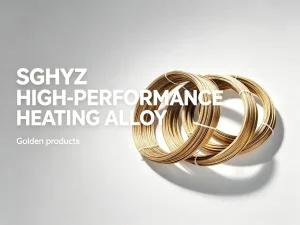
Field Recommendation: Deploy ultra-pure FeCrAl heating strips doped with Rare Earths (SGHYZ) equipped with high-purity alumina ($>99.5\%\text{ Al}_2\text{O}_3$) supporting hooks to prevent contact reactions.
3. Photovoltaic & Semiconductor Crystal Growth
Environment: Polysilicon ingot casting furnaces and diffusion tube reactors operating above $1350^\circ\text{C}$ in ultra-clean, dust-free vacuum or argon environments.
Engineering Challenge: Zero tolerance for metallic contamination or particulate flaking onto semiconductor wafers.
Field Recommendation: Specify PM-FeCrAl (SGHT) heating strips. Powder metallurgy guarantees absolute absence of trace volatile elements and structural sag, extending heater life across multi-day crystal growth cycles.
4. Heavy Glass Tempering & Ceramic Kilns
Environment: Large-span architectural glass tempering furnaces requiring high power densities ($W/\text{cm}^2$) and rapid thermal recovery during sheet throughput.
Engineering Challenge: High mechanical vibration and rapid on/off pulse-width modulation (PWM) power control.
Field Recommendation: Cr20Ni80 or Cr30Ni70 heating strips folded into corrugated (wavy) element profiles. Austenitic NiCr withstands thermal-mechanical shock without fracturing during cyclical heating pulses.
Localized Support, Global Compliance & Technical Services
Bridge the distance between Chinese manufacturing mills and international job sites with tailored technical assistance and seamless logistics.
Certified Quality Compliance
Every batch of industrial furnace heating strip undergoes rigorous laboratory testing prior to packing: chemical spectroscopy, tensile yield testing, room temperature resistivity checks, and accelerated oxidation life testing per GB/T 1234 standards. Fully traceable Mill Test Certificates (EN 10204 3.1) accompany every shipment.
Custom Bending & Element Fabrication
Eliminate local workshop re-processing costs. Chinese factories provide pre-formed corrugated ribbon elements, terminal lead rod welding (Ni-rod or double-strip terminals), and ceramic support insulators pre-assembled according to client CAD drawings.
Flexible Global Logistics
Supported by export hubs in Tianjin, Shanghai, and Shenzhen, shipments are packaged in heavy-duty moisture-proof wooden crates lined with VCI anti-corrosion film. Express air freight is available for emergency furnace repairs, alongside regular sea and rail freight options.
Frequently Asked Questions (FAQ) & Engineering Q&A
Expert solutions to common installation, design calculation, atmosphere selection, and troubleshooting queries.
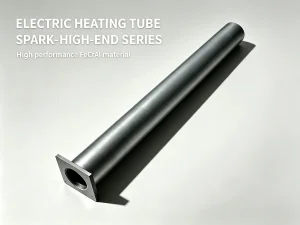
Specialized High-Temp Tubes, Wires & FeCrAl Alloys
Additional resistance heating products, seamless high-pressure tubes, and ultra-high-temperature elements from trusted Chinese factories.



Optimize Your Industrial Furnace Thermal Efficiency Today
Connect directly with senior metallurgical engineers and procurement specialists. Request custom strip cross-section calculations, resistance alloy datasheets, or factory-direct price quotations.
Contact Factory Engineering Team