
Explore our premier engineered heating wires, seamless heat exchanger tubes, and heavy-duty industrial furnace components manufactured under ISO 9001 and GB/T 1234-2012 specifications.



The global industrial thermal processing market is undergoing a radical paradigm shift. As environmental mandates drive manufacturing facilities away from fossil fuel combustion toward carbon-neutral electric heat treatment, the demand for ultra-reliable industrial furnace heater wires made in China has reached unprecedented peaks.
Industrial Electrification Paradigm
Global steel mills, ceramic processing facilities, and semiconductor foundry networks are replacing direct gas burners with electric resistance heating elements. Resistance heating wires must offer exceptional thermal density ($W/cm^2$) and dimensional stability under continuous heavy thermal cycling without structural sag or hot-spot formation.
Advanced Oxidation Barrier Science
The core distinction of China industrial furnace heater wire manufacturers lies in melt-chemistry purity. Through rare-earth reactive element additions (Yttrium, Zirconium, Reactive Earth additions), our 0Cr25Al5, 0Cr21Al6Nb, and SGHT alloys form a self-healing, adherent $\alpha-Al_2O_3$ (alpha-alumina) oxide scale that shields internal crystal structures from destructive thermal degradation.
Total Cost of Ownership (TCO) ROI
Premature heating element failure causes thousands of dollars per hour in production downtime. By leveraging high electrical resistivity ($1.42\ \mu\Omega\cdot m$ for FeCrAl alloys) combined with lower material density, furnace operators achieve up to 20% reduced material weight per element and 3x extended operational life compared to standard market wires.
Selecting the optimal resistance heating alloy wire requires a deep understanding of thermodynamics, mechanical strength at temperature, atmosphere compatibility, and chemical phase transitions.
| Alloy Grade / Family | Nominal Composition | Max Temp (°C) | Resistivity at 20°C ($\mu\Omega\cdot m$) | Density ($g/cm^3$) | Primary Oxide Layer Formed | Recommended Atmosphere |
|---|---|---|---|---|---|---|
| SGHT (Powder Metallurgy) | Fe-Cr-Al + Reactive Elements | 1425°C | 1.45 | 7.10 | Dense $\alpha-Al_2O_3$ | Air, Oxidizing, Inert, Vacuum |
| SGHYZ / HRE Grade | Fe-Cr-Al + Yttrium/Zirconium | 1400°C / 1350°C | 1.42 | 7.10 | Self-healing $\alpha-Al_2O_3$ | Air, High Temp Kilns, Carburizing |
| 0Cr25Al5 FeCrAl Wire | 25% Cr, 5% Al, Bal. Fe | 1250°C | 1.42 | 7.10 | Alumina ($Al_2O_3$) Scale | Air, Neutral, Sulfur-Resistant |
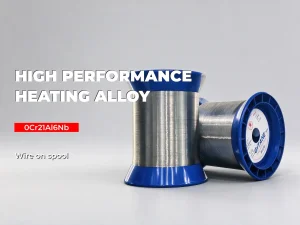
| 0Cr21Al6Nb High Temp Wire | 21% Cr, 6% Al, Nb Added | 1350°C | 1.45 | 7.10 | Niobium-Stabilized Alumina | Air, Sintering Furnaces |
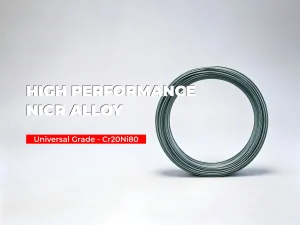
| Cr20Ni80 Nichrome Wire | 80% Ni, 20% Cr | 1200°C | 1.09 | 8.40 | Chromia ($Cr_2O_3$) Scale | Nitrogen, Ammonia, Reducing, Cyclic |
| Cr30Ni70 Alloy Wire | 70% Ni, 30% Cr | 1250°C | 1.18 | 8.10 | Chromia ($Cr_2O_3$) Scale | Carburizing, Heavy Cycling Duty |
Thermodynamic Mechanics of FeCrAl
FeCrAl alloys offer significant cost and weight advantages. Because iron-chromium-aluminum wire possesses a higher electrical resistivity than nickel-chromium ($1.42\ \mu\Omega\cdot m$ vs $1.09\ \mu\Omega\cdot m$) and a ~15% lower density, furnace element designers can utilize thicker wire gauges for the same electrical resistance, extending wire service lifespan by dramatically reducing surface load intensity ($W/cm^2$).
Mechanical Ductility Advantage of NiCr
While FeCrAl alloys form a fragile crystal grain structure after prolonged exposure to temperatures above 1000°C (making post-use mechanical movement prone to snapping), Nickel-Chromium (Cr20Ni80) retains superb ductility after heating. NiCr is highly recommended for equipment requiring frequent maintenance disassembly, tight spiral winding, or high mechanical vibration resilience.
From semiconductor wafer crystal growth furnaces to high-speed rail gear heat treatment, Chinese industrial furnace heater wire manufacturers support the world's most demanding thermal engineering sectors.
1. Photovoltaic & Semiconductor Manufacturing
In silicon ingot pulling, diffusion furnaces, and LPCVD quartz tube heaters operating up to 1350°C–1400°C, extreme atmosphere purity is mandatory. Powder metallurgy FeCrAl alloys (SGHT) prevent element deformation and avoid heavy-metal contamination, ensuring pristine wafer processing.
2. Automotive & Heavy Gear Heat Treatment
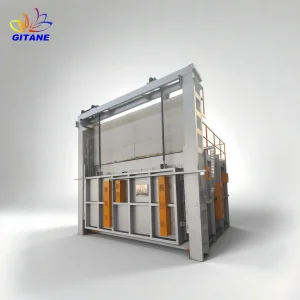
Continuous pit furnaces, roller hearth furnaces, and carburizing kilns require heavy-gauge corrugated heating ribbons or meander elements. SPARK brand 0Cr25Al5 and Cr30Ni70 elements withstand harsh carbon-potential atmospheres and sulfur contamination.
3. Advanced Structural Ceramics & Ferrite Sintering
Tunnel kilns and shuttle kilns firing zirconia, alumina insulators, and MLCC electronic components rely on 0Cr21Al6Nb spiral heating wire. The niobium addition enhances high-temperature creep resistance, maintaining uniform heating coil geometry over thousands of continuous thermal cycles.
Beijing Shougang Gitane New Materials Co., Ltd. continues to drive the frontier of high-temperature alloy research. Our metallurgical engineering roadmap focuses on three crucial breakthroughs:
Ultra-Low Carbon Formulation ($00Cr20Al6$)
By lowering carbon impurity levels to near-zero ($C \le 0.015\%$), our ultra-low carbon FeCrAl resistance wires prevent intergranular carbide precipitation, dramatically improving room-temperature cold ductility and bending radius without compromising extreme-temperature oxidation resistance.
Powder Metallurgy Dispersion Strengthening (ODS)
Next-gen powder metallurgy processing embeds sub-micron yttrium oxide ($Y_2O_3$) nanoparticles directly inside the metal matrix. This locks grain boundaries, raising maximum continuous service temperature limits to 1425°C - 1450°C while virtually eliminating high-temperature sag in vertical element installations.
Integrated Smart Thermal Management Elements
Combining precision resistance alloys with embedded digital diagnostic monitoring enables real-time resistance drift monitoring. Furnace operators can predict element wear and schedule preventive maintenance weeks before a physical heater break occurs.
As a enterprise member of Shougang Group, Beijing Shougang Gitane New Materials ensures every coil of wire shipped complies strictly with domestic and international industrial quality benchmarks.
Quality Assurance & ISO Certification
Our facility obtained ISO 9002 certification in 1996 and updated to ISO 9001:2015 certification in 2003. All electric heating alloy wires undergo rigorous melt-spectrum chemical analysis, cold-drawing dimensional tolerance verification, electrical resistivity testing, and 50-hour high-temperature accelerated life testing per GB/T 1234-2012.
Global Export & Localized Technical Consulting
We export to over 50 countries across North America, Europe, Southeast Asia, and the Middle East. Our engineering group provides custom surface load calculation ($W/cm^2$), alloy grade substitution consultations (e.g., matching Kanthal A1, APM, or Nichrome 80 specs), custom coiling drawings, and localized door-to-door delivery logistics.
Select from our ultra-high temperature FeCrAl tubes, low-carbon resistance wires, and complete furnace heating assembly modules.

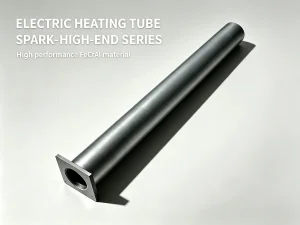
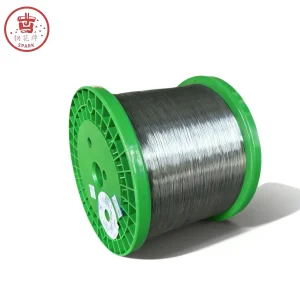
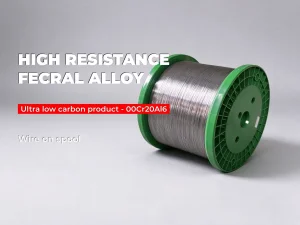



Technical insights and practical selection advice directly from our senior metallurgical application engineering team.
How do I calculate the recommended maximum surface load ($W/cm^2$) for my furnace wire?
Surface load ($W/cm^2$) measures the electrical power emitted per unit area of wire surface. It directly dictates wire temperature and operational longevity. For standard air atmosphere industrial kilns operating at 1100°C–1200°C, a surface load of $1.5 - 2.5\ W/cm^2$ is recommended for FeCrAl wires (such as 0Cr25Al5). In vacuum, protective gas ($N_2/H_2$), or dense ceramic fiber tube environments, the surface load must be derated to $0.8 - 1.2\ W/cm^2$ to prevent localized thermal runaways and hot spots.
What is the key difference between standard FeCrAl and Powder Metallurgy SGHT grade alloy?
Standard ingot-melted FeCrAl alloys undergo grain coarsening when held above 1100°C, causing sagging in unsupported elements. Powder metallurgy SGHT grade is produced via ultra-clean alloy atomization and hot isostatic pressing. It incorporates dispersed reactive element oxides that pin grain boundaries. This allows SGHT wire to maintain extraordinary creep resistance, zero structural sag, and stable resistance behavior at continuous temperatures up to 1425°C.
Why is FeCrAl wire preferred over Nichrome (NiCr) for high-sulfur atmosphere furnaces?
Nickel is highly susceptible to attack by sulfur compounds at elevated temperatures, forming low-melting-point nickel sulfide ($Ni_3S_2$) eutectics that cause rapid wire destruction ("green rot"). FeCrAl wire contains no nickel; its surface alumina ($\alpha-Al_2O_3$) barrier scale provides outstanding resistance to sulfur-bearing gases, making it the premier choice for petrochem heating, glass melting, and coal gasification atmospheres.
In what delivery forms can China industrial furnace heater wire manufacturers supply material?
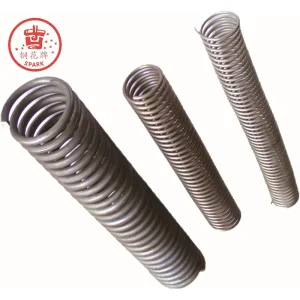
Beijing Shougang Gitane supplies resistance materials across the full spectrum of industrial forms: round wire ($\Phi 0.10mm - 12.0mm$), cold-rolled flat ribbon/strip (thickness $0.2mm - 4.0mm$, width $5mm - 200mm$), pre-wound spiral heating elements, corrugated meander coils, radiant heating tubes, and custom fabricated ceramic heater assemblies ready for immediate installation.
How does thermal resistance growth affect heating element power output over time?
As resistance alloys oxidize during operation, aluminum or chromium ions diffuse to the surface to rebuild the oxide oxide film, slightly decreasing the effective conductive metal core diameter and raising total electrical resistance ($R$). For high-purity SPARK alloys, the total resistance growth rate is controlled to less than 5% over 1,000 hours at 1200°C, ensuring stable power output without requiring oversized SCR power supply transformers.