
Executive Metallurgical Overview & Manufacturing Legacy
Engineering high-performance thermal resistance wire requires an exact synthesis of raw elemental purity, rapid-solidification melting, precise cold drawing, and specialized atmospheric annealing. Beijing Shougang Gitane New Materials Co., Ltd. stands as China’s premier industrial authority in electrothermal alloys.
Metallurgical Expertise
Operating out of an 88,000 m² advanced production campus in Changping, Beijing, Shougang Gitane leverages six decades of specialized steelmaking and thermal alloy drawing heritage under the global Shougang Group umbrella.
National Standards Compliance
Every melt heat is fully compliant with China GB/T 1234-2012, ASTM B603, DIN 17470, and ISO 9001 standards. 100% full-traceability mill test certificates (MTC) accompany all export shipments across Europe, the Americas, and Asia.
Super-Alloy Innovations
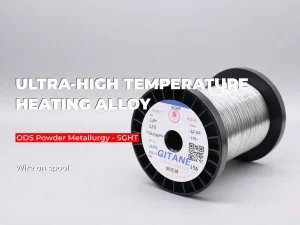
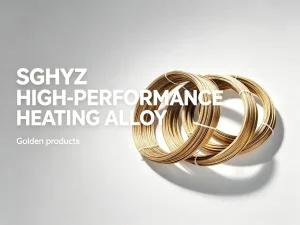
Pioneering ultra-high-temperature resistance alloys like SGHYZ (1400°C) and powder-metallurgy SGHT (1425°C), engineered to eliminate grain growth sag and resist severe carburizing and oxidizing environments.
Primary High-Temperature Resistance Alloy Catalog (Part 1)
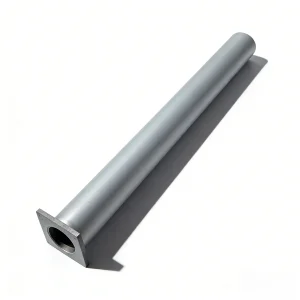
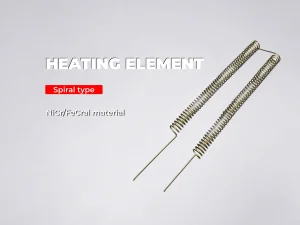
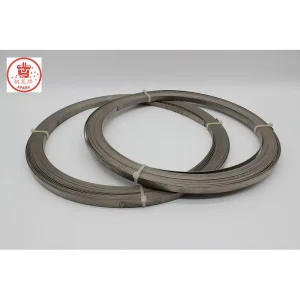
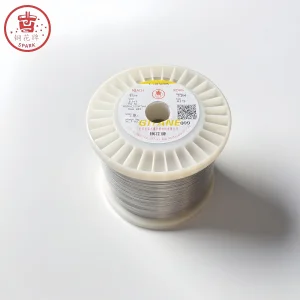
Explore factory-direct pricing, specifications, and wholesale availability for high-grade FeCrAl and NiCr heating elements manufactured in Beijing, China.



China Manufacturing Superpowers: Why Sourcing Resistance Alloys from China Dominates Global Supply Chains
The global thermal processing and furnace manufacturing sectors have experienced a paradigm shift over the last two decades. Sourcing high-temperature resistance wire (FeCrAl and NiCr) from Chinese tier-1 manufacturers like Shougang Gitane offers unmistakable competitive advantages in total cost of ownership (TCO), material purity, lead times, and metallurgical customization.
1. Complete Upstream-to-Downstream Integration
Unlike regional re-drawers who buy intermediate rod stock from third-party mills, Chinese industrial leaders control the entire value chain—vacuum induction melting (VIM), electroslag remelting (ESR), hot rolling, heavy-duty wire drawing, hydrogen bright annealing, and spool packaging. This vertical integration guarantees batch-to-batch chemical homogeneity and strict electrical resistance tolerances within ±3%.
2. Micro-Alloying & Rare-Earth Doping Technology
Modern Chinese electrothermal metallurgy utilizes precise additions of active rare-earth elements (REE)—specifically Yttrium (Y), Cerium (Ce), and Zirconium (Zr). Doping iron-chromium-aluminium alloys with micro-quantities of REE dramatically improves the adhesion of the protective surface alpha-alumina ($\alpha-Al_2O_3$) scale, suppressing oxide spallation under severe thermal cycling.
3. Economic Scale & Custom Form-Factors
China's colossal industrial heating eco-system enables large-scale production runs that lower unit costs without compromising precision. From ultra-fine gauge ribbon ($0.05 \times 0.2 \text{ mm}$) used in micro-sensors to heavy industrial furnace rod elements ($\varnothing 12.0 \text{ mm}$), Chinese manufacturing caters directly to global OEM drawings.
Metallurgical Selection Matrix: FeCrAl vs. Nickel-Chromium (NiCr) Alloys
Selecting the correct resistance alloy requires balancing maximum continuous service temperature, electrical resistivity, mechanical ductility, atmosphere compatibility, and material weight density.
| Alloy Grade & Family | Composition Nominal (%) | Max Temp (°C) | Resistivity @20°C (μΩ·m) | Density (g/cm³) | Oxide Scale Type | Atmosphere Suitability |
|---|---|---|---|---|---|---|
| SPARK SGHT (Powder Met) | Fe-Cr24-Al5.8 + Rare Earths | 1425°C | 1.45 | 7.10 | $\alpha-Al_2O_3$ (Highly Dense) | Oxidizing, Carburizing, Vacuum |
| SPARK SGHYZ (FeCrAl) | Fe-Cr23.5-Al5.3 + REE | 1400°C | 1.42 | 7.15 | $\alpha-Al_2O_3$ (Adherent) | Air, Neutral, Sulfur-rich |
| 0Cr25Al5 / HRE (FeCrAl) | Fe-Cr25-Al5.0 | 1350°C | 1.42 | 7.10 | $Al_2O_3$ Scale | Industrial Kilns, Clean Air |
| 0Cr23Al5 (FeCrAl) | Fe-Cr23-Al4.8 | 1250°C | 1.35 | 7.25 | $Al_2O_3$ Scale | Heat Treatment, Appliances |
| Cr30Ni70 (Nichrome) | Ni70-Cr30 | 1250°C | 1.18 | 8.10 | $Cr_2O_3$ Protective | Reducing, Nitrogen, Wet Air |
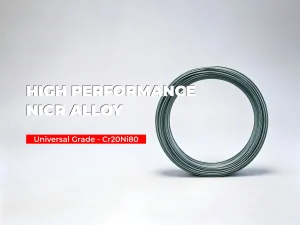
| Cr20Ni80 / 80/20 (Nichrome) | Ni80-Cr20 | 1200°C | 1.09 | 8.40 | $Cr_2O_3$ Tough Oxide | Cyclic Heating, Ammonia, Nitrogen |
Macro Industry Solutions: Engineering Resistance Wire Across Global Verticals
Resistance heating alloys serve as the thermal engine inside critical global infrastructure. Our wire, strip, and pre-formed heating element spirals are engineered for high-demand specialized industries.
Semiconductor & Photovoltaic (PV) Wafer Processing
High-temperature diffusion furnaces and LPCVD reactors require zero metal contamination and extreme thermal uniformity across 1000°C–1300°C zones. SPARK SGHT powder-metallurgy FeCrAl wire prevents drooping, sagging, and particulate shedding during extended semiconductor fabrication cycles.
Automotive Thermal Treatment & Fastener Hardening
Continuous mesh-belt furnaces, carburizing pit furnaces, and sealed-quench lines rely heavily on 0Cr25Al5 and Cr20Ni80 heavy strip elements. The superior hot yield strength prevents deformation during rapid oil/nitrogen quenching, maximizing element operating hours.
Advanced Technical Ceramics & Powder Metallurgy
Sintering structural ceramics ($\text{ZrO}_2, \text{Al}_2\text{O}_3$), hard metal carbides, and additive manufacturing metal powders demands sustained operation between 1300°C and 1400°C. SPARK SGHYZ alloy forms an impermeable oxide layer that resists aggressive sintering binders and volatile fluxes.
Glass Tempering, Annealing & Bending Kilns
Flat glass tempering for architectural and automotive glazing needs rapid thermal response and exact radiant power density ($W/\text{cm}^2$). NiCr (Cr20Ni80) spiral coils offer exceptional resistance to thermal cycling shock without embrittlement upon cooling down.
Clean Energy & Hydrogen Thermal Storage
As green energy transitions toward electrical thermal energy storage (ETES) and high-temperature steam electrolysis (HTSE) for green hydrogen generation, SPARK high-resistivity heating strip converts renewable electricity into high-grade process heat with near 100% efficiency.
Commercial & Home Electrical Appliances
From high-performance mica heating frames in hair dryers and toaster elements to ceramic storage heaters, fine-gauge 0Cr23Al5 and Cr15Ni60 drawn wire provide consistent resistance and long component life under constant cyclic operation.
Global Enterprise Procurement Framework: RFQs, Surface Loading & TCO
Prevent premature heating element failure by mastering key engineering parameters prior to issuing a Request for Quote (RFQ).
Calculating Element Surface Load ($W/\text{cm}^2$)
The single most critical factor determining heating element life is surface load density. Operating a wire at excessive power density causes localized overheating, rapid oxidation, and early burnout.
- Continuous Furnace (Air Atmosphere): Recommend $1.5 \text{ to } 2.5 W/\text{cm}^2$ for FeCrAl; $1.2 \text{ to } 2.0 W/\text{cm}^2$ for NiCr.
- Intermittent High-Temp Kilns (>1300°C): Limit load to $< 1.2 W/\text{cm}^2$ using SGHYZ or SGHT grades.
- Enclosed Tubular Heating Elements: Surface load depends on internal insulation medium (e.g., compacted high-purity MgO powder).
Procurement Checklist for Factory RFQs
To receive instant, accurate quotes from Shougang Gitane’s sales engineering department, specify the following details in your inquiry:
- Alloy Grade: (e.g., 0Cr25Al5, Cr20Ni80, SGHYZ, SGHT).
- Delivery Form & Dimensions: Wire diameter ($\text{mm}$), Strip thickness $\times$ width ($\text{mm}$), or Spiral element drawing.
- Resistivity Tolerance: Standard ($\pm 5\%$) or Precision ($\pm 3\%$).
- Package Type: Plastic spools (DIN160, DIN200, DIN250), steel coils, or wooden crate export packing.
- Target Operating Environment: Furnace temperature, atmosphere gas ($\text{N}_2, \text{H}_2, \text{CO}$, Vacuum), and duty cycle.
Specialized Resistance Wire & High-Temp Alloy Catalog (Part 2)
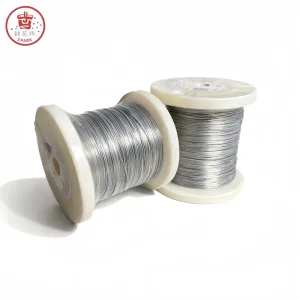
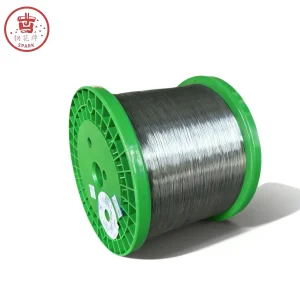
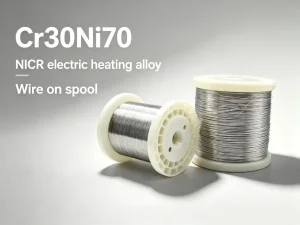
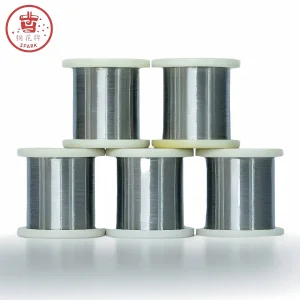
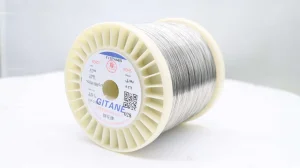
Explore our complete lineup of nickel-chromium, iron-chromium-aluminium, and custom-engineered resistance wire stock ready for global export.
Industry Trends 2025–2030: The Next Generation of Electrothermal Metallurgy
Industrial heat processing accounts for over 20% of global manufacturing energy consumption. Technological developments in electrical resistance alloys are enabling decarbonization and extreme thermal efficiency.
1. Decarbonization & Direct Electric Heating (DEH)
Global steel, glass, and chemical industries are rapidly replacing fossil-fuel burners with zero-emission electric radiant heating systems. This transition requires extra-heavy gauge FeCrAl wire ($\varnothing 8\text{mm} \text{ to } 12\text{mm}$) capable of radiating high thermal power output continuously without sag.
2. Powder Metallurgy (PM) Superior Creep Resistance
Traditional ingot-cast alloys suffer from grain coarsening at temperatures above 1200°C, leading to thermal distortion. Powder metallurgy (e.g., SPARK SGHT) uses micro-dispersed oxide particles ($\text{Y}_2\text{O}_3$) to pin grain boundaries, delivering 3x higher hot yield strength and zero sag over tens of thousands of operating hours.
3. Smart Surface Oxivane Passivation
Advanced factory pre-oxidation treatments create a pre-formed, dense $\alpha-Al_2O_3$ passivating scale on FeCrAl wire before shipment. This eliminates initial furnace commissioning burn-in time and immediately shields elements against aggressive volatile atmospheric contaminants.
Frequently Asked Questions (FAQ) & Technical Clarifications
Expert answers to common engineering, procurement, and quality control questions regarding high-temperature heating wire sourced from China.
Ready to Optimize Your Furnace Thermal Performance?
Partner directly with China's leading resistance alloy manufacturer. Get certified wire, custom heating elements, and engineering assistance tailored to your specific industrial temperature envelope.