Featured High-Temperature Alloys (Direct Factory Catalog)





The global industrial heating landscape is undergoing a monumental shift towards decarbonization, thermal efficiency, and electrification. As heavy industries—ranging from automotive metallurgy and photovoltaic ingot pulling to advanced ceramics and semiconductor processing—transition away from fossil-fueled combustion systems, the demand for precision-engineered high-temperature electric heating wires has reached an unprecedented peak.
Modern industrial electric furnaces require heating elements that offer extreme oxidation resistance, minimal creep rate at temperatures exceeding 1200°C to 1425°C, uniform electrical resistivity, and extended operational lifespans. Chinese manufacturing hubs, empowered by Industry 4.0 automation and specialized metallurgical research, have evolved from low-cost material suppliers into world-class innovation leaders in Iron-Chromium-Aluminum (FeCrAl) and Nickel-Chromium (NiCr) resistance alloys.
To select the ideal heating wire for industrial applications, procurement directors and thermal design engineers must evaluate the underlying physical and chemical properties of the two main families of electrical resistance alloys: Iron-Chromium-Aluminum (FeCrAl) and Nickel-Chromium (NiCr).
FeCrAl Alloys (e.g., 0Cr25Al5, SGHYZ)
FeCrAl alloys form a dense protective scale of alpha-alumina ($\alpha\text{-Al}_2\text{O}_3$) when heated. This ceramic oxide layer acts as an exceptional barrier against further oxidation at continuous operating temperatures up to 1400°C–1425°C. With a higher resistivity (up to $1.45\,\mu\Omega\cdot\text{m}$) and lower density than NiCr, FeCrAl yields significant material weight savings (up to 20% less mass required for equivalent power output).
NiCr Alloys (e.g., Cr20Ni80, Cr30Ni70)
NiCr alloys generate a chromia ($\text{Cr}_2\text{O}_3$) scale. While their max temperature limit is slightly lower (~1200°C–1250°C), NiCr retains high mechanical ductility after prolonged use, meaning elements can be repaired or reshaped without cracking. NiCr exhibits non-magnetic qualities at room temperature and possesses exceptional hot strength, preventing sagging in vertically mounted elements.
Rare Earth Doping Technology
Leading Chinese state-of-the-art mills incorporate micro-alloying elements such as Yttrium (Y), Zirconium (Zr), Hafnium (Hf), and Neodymium (Nd). This rare-earth modification refines grain boundaries, suppresses spallation of the oxide film during thermal cycling, and dramatically increases element life under rapid power pulsing conditions.
Technical Property Comparison Matrix
| Alloy Grade | Alloy Type | Max Temp (°C) | Resistivity at 20°C ($\mu\Omega\cdot\text{m}$) | Density ($\text{g/cm}^3$) | Oxide Layer Composition | Primary Industrial Use |
|---|---|---|---|---|---|---|
| SGHT | FeCrAl (PM Technology) | 1425°C | 1.45 | 7.10 | $\alpha\text{-Al}_2\text{O}_3$ (Ultra-Dense) | Semiconductor, Cleanroom Kilns |
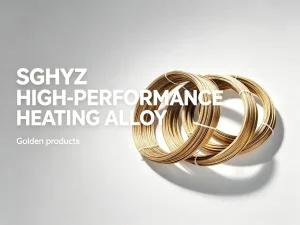
| SPARK SGHYZ | FeCrAl (Rare Earth Doped) | 1400°C | 1.42 | 7.10 | Golden $\alpha\text{-Al}_2\text{O}_3$ Scale | High-temp Muffle Furnaces |
| 0Cr25Al5 | Standard FeCrAl | 1250°C | 1.42 | 7.10 | $\text{Al}_2\text{O}_3$ | Industrial Furnaces, Heat Treatment |
| 0Cr23Al5 | Standard FeCrAl | 1250°C | 1.35 | 7.25 | $\text{Al}_2\text{O}_3$ | Industrial & Domestic Heaters |
| Cr20Ni80 | Nichrome (80/20) | 1200°C | 1.09 | 8.40 | $\text{Cr}_2\text{O}_3$ | Precision Medical, Appliances, Lab Furnaces |
| Cr30Ni70 | Nichrome (70/30) | 1250°C | 1.18 | 8.10 | $\text{Cr}_2\text{O}_3$ / $\text{NiCr}_2\text{O}_4$ | Corrosive Gas Heating, Heavy Duty Radiants |
China’s dominance in the electric heating alloy market is grounded in full-spectrum vertical integration—from raw material melting to final wire spooling. Modern Chinese manufacturing plants, such as those affiliated with the Shougang Group, utilize advanced digital control systems across every step of production.
Precision Metallurgy & Vacuum Melting
The foundation of wire longevity lies in elemental purity. Chinese factories deploy Vacuum Induction Melting (VIM) followed by Electroslag Remelting (ESR). This double-vacuum purification process reduces non-metallic inclusions, controls sulfur and carbon impurities down to sub-ppm levels, and prevents premature creep rupture at high temperatures.
Continuous Cold Drawing & Automated Annealing
Utilizing multi-pass continuous diamond die wire drawing machines with inline laser micrometer gauge measurement, Chinese factories achieve tight dimensional tolerances ($\pm 0.01\,\text{mm}$). Hydrogen-atmosphere bright annealing guarantees mirror-like surface finishes free from lubricants, ensuring immediate formation of a pure oxide scale upon initial firing.
Supply Chain Resilience & Cost Advantages
China produces over 70% of the world's refined rare-earth oxides and primary chromium inputs. This localized upstream supply chain insulates Chinese high-temperature wire factories from global raw material bottlenecks. Coupled with high-capacity automated continuous rolling mills, factories can process large batch orders quickly, reducing lead times from months to weeks while offering transparent, highly competitive pricing.
When global B2B procurement managers evaluate high-temperature electric heating wire suppliers, looking solely at FOB wire prices per kilogram leads to sub-optimal purchasing decisions. A complete analysis requires calculating the Total Cost of Ownership (TCO), which factors in operational energy efficiency, element lifetime, downtime costs, and freight economics.
Pricelist Dynamics & Sourcing Factors
Heating wire prices fluctuate based on LME (London Metal Exchange) raw material indices for Nickel (Ni) and Chromium (Cr), alongside processing fees dictated by wire diameter. Ultra-fine wires ($< 0.10\,\text{mm}$) incur higher drawing passes and annealing costs per kilo compared to heavy gauge rod elements ($5.0\,\text{mm}–10.0\,\text{mm}$). Factory-direct quotes from Chinese manufacturers remove intermediary margins, saving buyers 25% to 40% on equivalent international alloy grades.
Quality Assurance & Compliance Standard
Leading Chinese export factories adhere rigidly to international quality specifications, including GB/T 1234-2012, ASTM B603 (FeCrAl), ASTM B344 (NiCr), and DIN 17470. Every shipment is accompanied by Mill Test Certificates (MTC) detailing chemical composition, room temperature resistivity, temperature coefficient of resistance ($C_t$), tensile strength, and elongation tests.
High-temperature resistance wire is the active thermal core in various industrial systems. Selecting the correct alloy requires matching operating environments, atmosphere chemistries, and surface load density parameters ($W/\text{cm}^2$).
Photovoltaic & Solar Ingot Manufacturing
Recommended Alloy: SPARK SGHYZ / SGHT
Polysilicon crystal growing and diffusion furnaces operate at continuous temperatures of 1350°C–1400°C under strict purity standards. SGHYZ FeCrAl wire prevents particulate contamination and maintains shape stability over long growth cycles.
Automobile Heat Treatment
Recommended Alloy: 0Cr25Al5 / Cr20Ni80
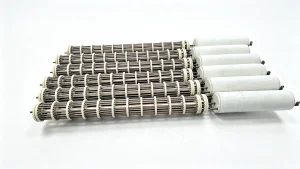
Carburizing, nitriding, and annealing lines require robust heating elements capable of enduring thermal shock. Radiant tube heating cores built with 0Cr25Al5 wire ensure uniform thermal distribution across large workpiece chambers.
Industrial Glass & Ceramics Kilns
Recommended Alloy: 0Cr23Al5 / SGHT
Sintering technical ceramics and glass bending kilns require high power density. Powder-metallurgy derived FeCrAl wires prevent element deformation, sagging, and oxidation degradation under continuous firing at 1250°C+.
Appliances & Commercial Heating
Recommended Alloy: Cr20Ni80 / Cr15Ni60
Small domestic appliances, air heaters, sealers, and precision medical sterilizers rely on Nichrome wire due to its high ductility, cold-workability, and superior mechanical strength when turned on and off repeatedly.
Engineered responses to common technical inquiries encountered by furnace manufacturers and international procurement teams.