
Featured SPARK FeCrAl & Industrial Element Catalog (Part I)
Factory-direct electric resistance alloys, ultra-high temperature FeCrAl wire, and custom industrial heating solutions manufactured under ISO 9001 and GB/T 1234-2012 quality standards.

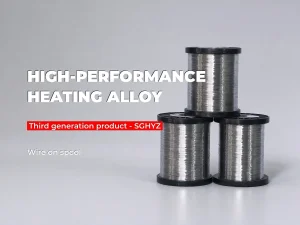

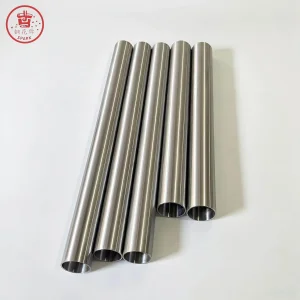
Executive Metallurgical Briefing: China FeCrAl Kanthal D Equivalents
As a leading China FeCrAl Kanthal D equivalent heating wire supplier and factory, Beijing Shougang Gitane New Materials Co., Ltd. provides direct technical drop-in replacements for standard global iron-chromium-aluminium alloys. Kanthal D is renowned for its combination of high electrical resistivity ($1.35\,\mu\Omega\cdot\text{m}$ at 20°C), thermal efficiency, and operating durability up to 1300°C.
While standard Kanthal D relies on a nominal chemistry of ~22% Chromium, ~4.8% Aluminium, and an Iron balance, Shougang Gitane's SPARK 0Cr23Al5 and 0Cr25Al5 grades incorporate controlled addition of rare-earth elements (Yttrium, Zirconium, and Niobium). This micro-structural refinement accelerates the formation of an ultra-adherent $Al_2O_3$ (alpha-alumina) protective ceramic film, drastically reducing oxidation spallation during rapid thermal cycling.
| Property Parameter | Kanthal D Standard Specs | SPARK 0Cr23Al5 (Standard Direct Equivalent) | SPARK 0Cr25Al5 (Enhanced Life Upgrade) | SPARK SGHT (Powder Metallurgy PM Grade) |
|---|---|---|---|---|
| Nominal Composition | Cr 20.5–23.5%, Al 4.8%, Fe Bal. | Cr 21.0–23.0%, Al 4.5–5.3%, Fe Bal. | Cr 23.0–26.0%, Al 4.5–6.5%, Fe Bal. | Cr 24.0–27.0%, Al 5.0–7.0% + Y/RE |
| Max Operating Temperature | 1300°C (2370°F) | 1250°C - 1300°C | 1300°C - 1350°C | 1425°C (2597°F) |
| Electrical Resistivity (20°C) | $1.35\,\mu\Omega\cdot\text{m}$ | $1.35 \pm 0.05\,\mu\Omega\cdot\text{m}$ | $1.42 \pm 0.05\,\mu\Omega\cdot\text{m}$ | $1.45 \pm 0.05\,\mu\Omega\cdot\text{m}$ |
| Density | $7.25\,\text{g/cm}^3$ | $7.25\,\text{g/cm}^3$ | $7.10\,\text{g/cm}^3$ | $7.10\,\text{g/cm}^3$ |
| Melting Point | 1500°C | 1500°C | 1500°C | 1520°C |
| Elongation Rate (%) | > 12% | > 12% | > 10% | > 15% (Superior Ductility) |
| Creep Resistance at >1000°C | Standard | Standard Equivalent | Enhanced | Ultra-High (Anti-Sag) |
Global Procurement Trends & Industrial Demand Analysis
The global resistance heating alloy market is undergoing a structural transition. Energy-intensive industries are shifting away from expensive Nickel-Chromium (NiCr) alloys toward high-performance Ferritic FeCrAl alternatives due to three key market drivers:
1. Raw Material Cost Optimization
FeCrAl alloys contain zero nickel, shielding procurement teams from volatile LME Nickel market fluctuations. Furthermore, FeCrAl has a lower mass density ($7.10 - 7.25\,\text{g/cm}^3$) compared to NiCr ($8.40\,\text{g/cm}^3$), allowing engineers to yield ~16% more linear heating length per kilogram of wire purchased.
2. Decarbonization & Kiln Electrification
Global net-zero mandates are pushing heat-treatment, glass tempering, and ceramic plants to replace fossil-fuel burners with electric heating elements. FeCrAl alloys support higher surface loads ($W/\text{cm}^2$), enabling compact high-power electrical element designs.
3. Supply Chain Resilience & Vendor Audit
International OEMs are diversifying beyond traditional single-source European suppliers. Partnering directly with Chinese tier-1 factories like Shougang Gitane guarantees continuous stock availability, competitive lead times, and certified heat-batch consistency.
Macro-Industry Technical Solutions & Application Scenarios
FeCrAl resistance wires perform distinct operational functions across high-temperature engineering sectors. Below are custom element design configurations developed by Shougang Gitane engineers:
1. Industrial Heat-Treatment & Annealing
Challenge: Continuous mesh-belt furnaces operating at 950°C–1150°C require heating wires with minimal sagging and resistance drift under heavy load.
Solution: Replacing standard Kanthal D with SPARK 0Cr25Al5 ribbon or heavy-gauge wire ($d \ge 5.0\,\text{mm}$). The increased aluminium content forms a dense oxide film, preventing premature burnout caused by atmosphere contaminants.
2. Semiconductor & Solar Wafer Processing
Challenge: Quartz tube diffusion furnaces operating at 1200°C demand particle-free heating elements to avoid silicon wafer contamination.
Solution: Implementation of SPARK SGHYZ and SGHT powder metallurgy alloys. High chemical purity prevents trace-element vapor release, maintaining high-yield semiconductor thermal oxidation processes.
3. Petrochemical Catalytic Cracking
Challenge: Sulfur-containing or carburizing refinery gas heaters degrade standard nickel-chromium alloys rapidly due to green rot.
Solution: FeCrAl alloys possess absolute immunity to sulfurous attack and superior carburization resistance up to 1250°C, extending heating bundle lifespans by 300%.
Quality Control, International Compliance & OEM Support
Shougang Gitane ensures complete compliance with global industrial procurement standards. Every order undergoes rigorous metallurgical validation prior to export shipment.
ISO 9001:2015 System
Certified quality control protocols spanning raw vacuum induction melting (VIM), hot rolling, cold drawing, and continuous bright annealing.
GB/T 1234-2012 Compliance
Manufactured strictly according to China's national standard for high-resistance electric heating alloys (matching ASTM B603 & DIN 17470 norms).
Mill Test Reports (3.1)
Full batch traceability provided with EN 10204 3.1 certificates detailing exact spectrographic chemical analysis and resistivity readings.
RoHS & REACH Compliant
Environmentally safe materials tested for heavy metals, hazardous substances, and non-conflict mineral sourcing compliance.
Technical Roadmap: Next-Generation FeCrAl Alloy Innovations
Shougang Gitane’s R&D department is pioneering advanced metallurgical techniques to expand the boundary of electrical heating elements from 1300°C up to 1425°C+:
Rare Earth Grain Refinement
Precise Yttrium (Y) and Zirconium (Zr) additions lock grain boundaries, inhibiting high-temperature grain growth and thermal embrittlement.
SGHT Anti-Sag Technology
Powder metallurgy synthesis creates isotropic grain distribution, yielding unprecedented creep strength and zero structural deformation at 1400°C.
Golden Pre-Oxidized Coating
Factory pre-treatment forms a golden $Al_2O_3$ protective layer, enabling immediate full-power operation without initial slow seasoning steps.
Low-Carbon Production
Utilizing clean hydro and solar power in scrap refining to deliver carbon-neutral certified resistance alloy wire coils to international buyers.
Featured SPARK FeCrAl & Industrial Element Catalog (Part II)
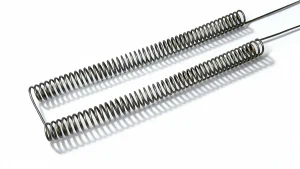
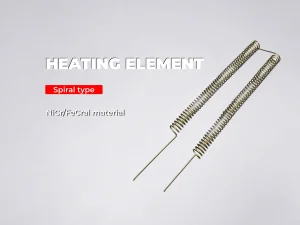
Complete OEM resistance wire, spiral element configurations, and specialized alloy grades engineered for maximum heat-treatment efficiency.
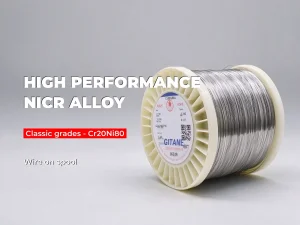
Frequently Asked Questions: Technical Engineering & Procurement
Detailed technical answers to common questions asked by industrial furnace engineers and procurement specialists when sourcing Kanthal D equivalents from China.
1. How does SPARK 0Cr23Al5 compare directly to Kanthal D in chemical and thermal performance?
SPARK 0Cr23Al5 is a direct metallurgical equivalent to Kanthal D. Both alloys feature an Iron-Chromium-Aluminium base with ~21-23% Cr and ~4.5-5.3% Al. They share identical electrical resistivity ($1.35\,\mu\Omega\cdot\text{m}$ at 20°C) and density ($7.25\,\text{g/cm}^3$). SPARK 0Cr23Al5 can be interchanged directly into existing element calculations without modifying wire diameter, pitch, or transformer voltage settings.
2. What surface loading ($W/\text{cm}^2$) is recommended for FeCrAl heating elements in furnace design?
Surface loading depends heavily on furnace operating temperature and element installation style. For air atmosphere industrial furnaces operating at 1000°C, typical recommended surface load for 0Cr25Al5 is $1.8 - 2.5\,\text{W/cm}^2$. For high-temperature applications reaching 1250°C, surface load should be reduced to $1.2 - 1.5\,\text{W/cm}^2$ to prevent localized overheating and sagging.
3. Why is FeCrAl wire preferred over Nichrome (Cr20Ni80) in industrial electric furnaces?
FeCrAl offers three major advantages over NiCr: (1) Higher maximum operating temperature (up to 1425°C vs 1200°C for NiCr), (2) Higher electrical resistivity ($1.45\,\mu\Omega\cdot\text{m}$ vs $1.09\,\mu\Omega\cdot\text{m}$), which allows larger wire cross-sections and longer element service life, and (3) Lower density, yielding ~16% more material length per kilogram, providing substantial cost savings.
4. What delivery forms and dimension ranges are available from Shougang Gitane factory?
We supply FeCrAl alloys in full commercial delivery forms: Round wire from $\Phi 0.05\,\text{mm}$ to $\Phi 12.0\,\text{mm}$, flat ribbon and cold-rolled strip (thickness $0.1 - 4.0\,\text{mm}$, width $2.0 - 200\,\text{mm}$), pre-wound spiral heating coils, and complete assembled ceramic furnace elements built to customer engineering drawings.
5. What is the minimum order quantity (MOQ) and sample evaluation process for export clients?
For standard wire diameters ($\Phi 1.0\,\text{mm} - \Phi 6.0\,\text{mm}$ in 0Cr25Al5 or 0Cr23Al5), stock spools are available with an MOQ as low as 10 kg for sample testing. Custom strip or non-standard alloys typically carry a 50 kg - 100 kg MOQ. Free sample spools can be dispatched for lab resistivity and metallurgical testing upon request.
6. How does Shougang Gitane ensure consistent electrical resistance across wire spools?
Resistance consistency is governed by tight diameter control and uniform chemical homogenization during vacuum melting. Shougang Gitane utilizes online laser micrometers during wire drawing to maintain diameter tolerances within $\pm 0.01\,\text{mm}$. Continuous bright annealing ensures uniform grain structure, maintaining electrical resistance variation within $\pm 3\%$ across entire 100 kg wire spools.