Metallurgical Engineering & Material Performance Overview
An authoritative technical analysis of Iron-Chromium-Aluminum (FeCrAl) electrical resistance heating alloys engineered for industrial furnace ignition systems, high-temperature thermal processing, and extreme-duty industrial heating environments.
The Physics of Passivating Alumina Film ($\alpha$-Al₂O₃)
FeCrAl alloys represent the gold standard in high-temperature metallic heating elements, primarily due to their unique capability to form an adherent, thermodynamically stable alpha-alumina ($\alpha$-$\text{Al}_2\text{O}_3$) oxide layer. Unlike Nickel-Chromium (NiCr) alloys which rely on chromia ($\text{Cr}_2\text{O}_3$) scale, FeCrAl's alumina film acts as an exceptional electrical insulator and chemical barrier against hot corrosion, carburization, and thermal degradation up to operating temperatures of 1425°C (2597°F).
When deployed as industrial furnace ignition heating elements, the rapid thermal response and high physical resistivity ($\sim 1.45 \, \mu\Omega\cdot\text{m}$) of modern FeCrAl formulations ensure rapid surface oxidation, instantly forming a self-healing dielectric shield. This scale prevents internal alloy depletion, lowers watt-density stress, and significantly extends component operational lifespans under continuous cyclic ignition regimes.
Microstructural Stability & Rare-Earth (RE) Doping
Conventional FeCrAl materials historically faced challenges related to high-temperature grain growth, causing post-operational brittleness and sagging. Modern Chinese metallurgical facilities have overcome these limitations through advanced micro-alloying techniques—specifically precision doping with Rare Earth elements including Yttrium (Y), Zirconium (Zr), Hafnium (Hf), and Cerium (Ce).
This micro-alloying refinement leads to severe grain-boundary pinning, suppressing abnormal grain coalescence during prolonged exposure above 1100°C. The resulting element structure exhibits elevated creep strength, optimized thermal fatigue resistance, and superior mechanical durability during high-velocity gas burner ignitions.
Featured Heating Alloys & Engineering Products (Part I)
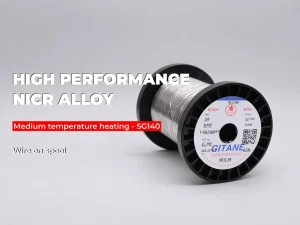
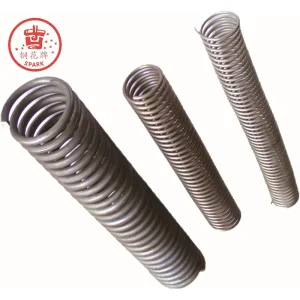
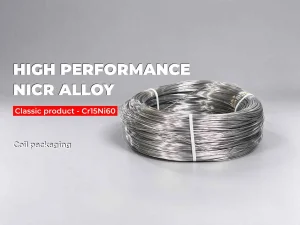
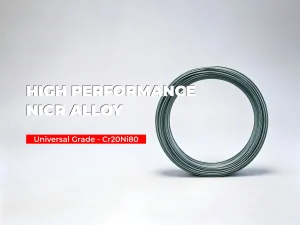
Explore our primary inventory of high-temperature electrical resistance wires, high-pressure alloy tubing, and specialized industrial furnace elements manufactured directly in China.





China's Strategic Manufacturing Ecosystem & Global Market Dominance
An evaluation of supply chain integration, rare-earth resource control, advanced powder metallurgy production, and total cost of ownership (TCO) benefits for global buyers.
Vertical Supply Chain Synergies
China accounts for over 70% of global primary refined aluminum production and holds a commanding lead in rare-earth extraction (Yttrium, Neodymium, Cerium). Chinese FeCrAl alloy factories leverage directly integrated upstream smelting facilities, state-of-the-art Vacuum Induction Melting (VIM), and Electroslag Remelting (ESR) infrastructure.
This vertical integration eliminates intermediary supply chain markups, guarantees rigid control over trace impurity limits (P < 0.02%, S < 0.01%), and accelerates lead times from raw melt to finished spooled ignition elements.
Powder Metallurgy (PM) Shift
The global heating element market is rapidly transitioning from traditional ingot smelting to Advanced Powder Metallurgy (APM) processing. Leading Chinese manufacturers now utilize gas atomization followed by Hot Isostatic Pressing (HIP) to yield ultrafine, homogeneous FeCrAl structures.
PM-grade FeCrAl elements display zero macro-segregation, significantly reduced room-temperature brittleness, and up to 4x higher sag resistance at 1350°C, matching or exceeding legacy European benchmarks at a fraction of the cost.
TCO Optimization & Economics
When selecting industrial ignition heating elements, engineering procurement officers must calculate Total Cost of Ownership (TCO) rather than upfront unit pricing alone. China's high-volume manufacturing lines deliver exceptional watt-density stability and reduced element burnouts.
By extending ignition element lifespans in high-frequency gas burners, plant operators minimize unscheduled downtime, reduce maintenance labor overhead, and lower overall thermal energy expenditure by up to 18% annually.
Macro-Industry Solutions & Field-Tested Deployment Scenarios
Detailed application mapping for high-performance FeCrAl ignition heating elements across critical global industries.
1. High-Velocity Gas & Oil Burner Ignition Systems
Industrial furnaces utilized in steel forging, aluminum melting, and structural heat treatment rely on automatic direct-spark or hot-surface ignition plugs. Ceramic-sheathed FeCrAl hot-surface igniters manufactured from 0Cr21Al6Nb or 0Cr27Al7Mo2 reach operating temperatures of 1200°C within 3 to 5 seconds.
These elements provide robust resistance to high-velocity combustion gases, moisture accumulation, and carbon soot buildup, ensuring instantaneous flame establishment without electrical breakdown.
2. Semiconductor & Photovoltaic Sintering Equipment
In high-purity semiconductor diffusion furnaces and PV solar cell sintering lines, furnace atmospheres must remain ultra-clean and contaminant-free. Standard metallic elements prone to heavy oxide flaking are unacceptable.
Chinese micro-refined, pre-oxidized FeCrAl elements feature a glass-smooth $\alpha$-alumina outer boundary layer that prevents micro-particle shedding, delivering contaminant-free thermal processing in continuous mesh-belt conveyor furnaces operating at 1050°C–1300°C.
3. Petrochemical Thermal Oxidizers & Flare Igniters
Offshore oil platforms, refineries, and chemical synthesis plants require flame ignition systems that operate continuously under harsh sulfurous and marine atmospheres. FeCrAl elements synthesized with high Chromium (21-26%) and Aluminum (5.5-7.5%) content exhibit exceptional resistance to hydrogen sulfide ($\text{H}_2\text{S}$) attack and thermal shock.
Housed within heavy-walled SGHT high-performance seamless steel tubes, these elements guarantee reliable automated ignition even under extreme sub-zero or equatorial offshore weather conditions.
4. Advanced Ceramic & Glass Tempering Furnaces
Architectural glass tempering and technical ceramic calcination demand absolute spatial thermal uniformity ($\pm 1.5^\circ\text{C}$). FeCrAl ribbon and heavy-gauge coiled elements mounted on ceramic radiant tubes ensure balanced infrared radiation output.
The high electrical resistivity of FeCrAl allows for thicker wire cross-sections at equivalent power ratings, reducing element sagging and preventing mid-process electrical opens during high-load glass processing runs.
Engineering Specifications & International Standard Alignment
A comprehensive comparison matrix of international alloy grades, physical constants, and operational limits to guide procurement engineers.
| Chinese Standard (GB/T 1234) | Kanthal Equivalent | ASTM / UNS Grade | Max Temp (°C) | Nominal Composition (%) | Resistivity ($\mu\Omega\cdot\text{m}$) | Primary Application |
|---|---|---|---|---|---|---|
| 0Cr27Al7Mo2 | Kanthal APM / APME | UNS K92500 | 1425°C | Fe-27Cr-7.0Al-2.0Mo + RE | 1.45 | Ultra-high-temp industrial furnaces, PM igniters |
| 0Cr25Al5 | Kanthal A1 / Alloy 875 | UNS K92500 | 1300°C | Fe-25Cr-5.0Al + RE | 1.42 | Furnace heating elements, industrial kilns |
| 0Cr21Al6Nb | Kanthal A / Alkrothal 14 | UNS K92100 | 1250°C | Fe-21Cr-5.5Al-0.5Nb + RE | 1.35 | Ignition elements, rapid heat burner pins |
| 0Cr23Al5 | Kanthal D / Alloy 815 | UNS K92300 | 1200°C | Fe-23Cr-5.0Al | 1.35 | Domestic & light industrial heaters |
| Cr20Ni80 (NiCr) | Nikrothal 80 | UNS N06003 | 1200°C | 80Ni - 20Cr | 1.09 | High-cycling appliances, reducing atmospheres |
Surface Watt-Density Calculation ($W/cm^2$)
To avoid premature burnout, ignition elements must be designed within optimal surface watt-density parameters. The maximum allowable surface load $p$ is governed by furnace operating temperature, sheath enclosure geometry, and local gas flow velocity:
For open-coil FeCrAl ignition elements operating at 1100°C, recommended watt densities range from 1.8 to 2.5 W/cm². Ceramic-encapsulated hot surface igniters can sustain localized densities up to 5.0 W/cm² under forced gas flow conditions.
Atmospheric Compatibility & Chemical Limits
While FeCrAl excels in oxidizing atmospheres, atmospheric selection critically impacts long-term survival:
- Air & Pure Oxygen: Excellent up to 1425°C. Re-builds protective alumina scale naturally.
- Dry Hydrogen ($H_2$): Fully compatible up to 1300°C; does not embrittle FeCrAl unlike refractory metals.
- Nitrogen ($N_2$) Atmospheres: Susceptible to nitridation above 1000°C if alumina film is damaged. NiCr preferred if dew point is extremely low.
- Carburizing / Endothermic Gas: Exceptional resistance due to tight $\alpha$-$\text{Al}_2\text{O}_3$ lattice structure blocking carbon atom diffusion.
B2B Wholesale Pricelist & Commercial Terms Framework
Transparent price benchmarks for factory-direct procurement from China. Prices fluctuate based on raw material market rates (Aluminum, Chromium, Nickel index).
| Alloy Grade / Product Form | Dimension Range | MOQ | FOB China Reference Price (USD/kg) | Lead Time |
|---|---|---|---|---|
| 0Cr25Al5 Bright Drawn Wire | $\Phi$ 0.10mm - 1.00mm | 100 kg | $6.50 - $9.80 / kg | 7 - 12 Days |
| 0Cr25Al5 Heavy Gauge Rod/Wire | $\Phi$ 1.20mm - 10.0mm | 200 kg | $5.20 - $7.50 / kg | 10 - 15 Days |
| 0Cr21Al6Nb Ignition Element Coils | Customized to Drawing | 500 Pcs | $1.80 - $4.50 / Pc | 14 - 20 Days |
| 0Cr27Al7Mo2 PM High-Temp Strip | Thk: 0.5-3.0mm, Wdt: 10-150mm | 150 kg | $14.00 - $19.50 / kg | 15 - 22 Days |
| SGHT High-Temp Steel Sheathed Igniters | Custom Assemblies | 100 Pcs | $12.50 - $35.00 / Assembly | 18 - 25 Days |
| Cr20Ni80 Nichrome Wire (Comparison) | $\Phi$ 0.20mm - 4.00mm | 50 kg | $18.50 - $26.00 / kg | 7 - 10 Days |
Frequently Asked Questions & Technical Knowledge Base
Addressing key operational, metallurgical, and procurement inquiries from global furnace design engineers and B2B buyers.
FeCrAl alloys offer three critical advantages over NiCr in high-temperature ignition applications: (1) Higher Maximum Operating Temperature: FeCrAl can reach 1425°C compared to NiCr's typical limit of 1200°C; (2) Lower Density: FeCrAl is ~15% lighter than NiCr ($7.10\,\text{g/cm}^3$ vs $8.40\,\text{g/cm}^3$), yielding more linear meters of heating element per kilogram purchased; (3) Superior Carburization & Sulfur Resistance: The passivating $\alpha$-$\text{Al}_2\text{O}_3$ scale protects FeCrAl against dirty combustion gases and sulfur attack far better than NiCr's chromia scale.
When conventional FeCrAl is exposed to temperatures above 950°C, rapid ferrite grain growth occurs, rendering the wire brittle at room temperature once cooled. This means cold adjustments post-use can cause element fracturing. Chinese manufacturers mitigate this via: (A) Adding Niobium (Nb) and Zirconium (Zr) to form stable carbides and nitrides that pin grain boundaries; (B) Utilizing Powder Metallurgy (APM route) to ensure ultrafine initial grain dispersion; and (C) Advising operators to pre-heat elements before mechanical servicing.
Pre-oxidation involves heating the bare FeCrAl elements in a clean, highly oxidizing atmosphere (dry air) at 1050°C–1150°C for 4 to 8 hours prior to installation. This controlled thermal process forms a uniform, dense, crack-free layer of $\alpha$-$\text{Al}_2\text{O}_3$ approximately 1-2 microns thick. When the element is later placed in service under aggressive combustion or reducing atmospheres, this pre-formed dielectric barrier immediately prevents gas-metal reactions and premature burnout.
Reputable Chinese manufacturers produce alloys in strict accordance with GB/T 1234-2012 (Chinese National Standard for High-Resistance Electrical Alloys), which equals or exceeds ASTM B603 and DIN 17470. Quality assurance protocols include: Continuous Eddy Current Flaw Detection, Optical Emission Spectroscopy (OES) heat chemical verification, Tensile & Elongation Testing, and High-Temperature Accelerated Life Testing (per GB/T 1234 method). Shipments are accompanied by 3.1 Mill Test Certificates (MTC).
Yes. Chinese OEMs specialize in custom element fabrication. Parameters such as coil outer diameter (OD), wire diameter (d), pitch ratio (S/d), cold terminal leg length, and ceramic insulation mounting blocks can be tailored precisely to CAD drawings or sample physical units provided by international buyers.
Featured Heating Alloys & Engineering Products (Part II)
Explore the remaining secondary line of our global high-temperature resistance alloy catalog, specialized glass-tempering wires, and petrochemical heat tubes.