
Featured FeCrAl & Resistance Wire Products (Batch 01)
Explore high-temperature electrical resistance alloys manufactured under ISO 9001:2015 specifications for industrial heat processing equipment.




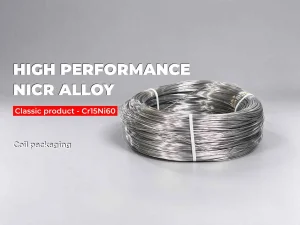
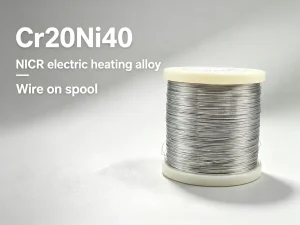

1. Executive Summary & Metallurgical Foundations of Iron-Chromium-Aluminum Alloys
In modern thermal process engineering, Iron-Chromium-Aluminum (Fe-Cr-Al) electrical resistance alloys serve as the cornerstone for high-temperature energy conversion. Operating across temperature regimes from 900°C to well over 1425°C, Fe-Cr-Al heating elements exhibit a rare combination of exceptional electrical resistivity ($1.25 \text{ to } 1.45 \, \mu\Omega\cdot\text{m}$), superior oxidation kinetic resistance, lower density compared to Nickel-Chromium counterparts ($7.10 \, \text{g/cm}^3$ vs $8.40 \, \text{g/cm}^3$), and immunity to sulfur-bearing reducing atmospheres.
The superior functional lifetime of Fe-Cr-Al elements relies on the thermodynamics of selective aluminum oxidation. At temperatures exceeding 900°C, aluminum diffuses rapidly outward to the alloy surface, reacting with ambient oxygen to generate a thermodynamically stable, highly adherent, electrically insulating alpha-alumina ($\alpha-\text{Al}_2\text{O}_3$) oxide layer. This ceramic scale exhibits extremely low parabolic oxidation rate constants, serving as a thermal diffusion barrier that protects the underlying metallic core from thermal degradation, carburization, and catastrophic spallation.
Chemical Composition & Phase Behavior Matrix
The performance of Chinese-manufactured Fe-Cr-Al wire and strip (commercially categorized as 0Cr25Al5, 0Cr23Al5, 0Cr21Al6Nb, SGHYZ 1400°C, and powder-metallurgy SGHT grades) is dictated by precise chemical stoichiometry and micro-alloying controls:
| Standard Grade | Chromium (Cr %) | Aluminum (Al %) | Reactive Additions (RE / Nb) | Max Continuous Temp | Resistivity @ 20°C |
|---|---|---|---|---|---|
| 0Cr23Al5 | 21.0 – 23.0% | 4.5 – 5.3% | Trace Rare Earths | 1250°C | 1.35 μΩ·m |
| 0Cr25Al5 | 23.0 – 26.0% | 4.8 – 5.8% | Zr / RE Micro-additions | 1250°C | 1.42 μΩ·m |
| 0Cr21Al6Nb | 21.0 – 23.0% | 5.5 – 6.5% | Nb (0.5 – 0.8%) + RE | 1350°C | 1.45 μΩ·m |
| SGHYZ (1400°C) | 22.0 – 24.0% | 6.0 – 6.8% | Yttrium + Zr Optimization | 1400°C | 1.45 μΩ·m |
| SGHT (PM Grade) | 21.0 – 24.0% | 8.0 – 9.0% | Dispersion Oxide ($Y_2O_3$) | 1425°C | 1.48 μΩ·m |
2. Fe-Cr-Al Metallurgy Technology Roadmap & Future Outlook
Historical limitations of conventional body-centered cubic (BCC) iron-chromium-aluminum alloys involved grain growth coarsening at temperatures exceeding 1100°C, causing low hot-yield strength, creep deformation (sagging under its own weight), and room-temperature brittleness following thermal cycling. Leading Chinese metallurgical clusters have overcome these legacy challenges through three technological innovations:
Precise doping of Yttrium (Y), Zirconium (Zr), Hafnium (Hf), and Cerium (Ce) pins grain boundaries via disperse oxide precipitates. This eliminates compressive stress build-up inside the $\alpha-\text{Al}_2\text{O}_3$ film, preventing micro-cracking during rapid thermal cycling.
Utilizing rapid solidification and Oxide Dispersion Strengthening (ODS), ultrafine $Y_2O_3$ particles are uniformly distributed across the metallic matrix. This elevates creep rupture strength by over 300% at 1200°C, enabling vertical element mounting without mechanical sagging.
Modern VIM-ESR double-melting techniques reduce interstitial carbon, nitrogen, and sulfur impurities below 20 ppm. Cleaner grain boundaries enhance room-temperature ductility, enabling tight spiral coiling without micro-fissuring.
3. Macro Industry Heating Solutions & Cross-Sector Deployment
China's Fe-Cr-Al elements are integrated across critical industrial supply chains, providing engineered heating units customized to demanding thermal, mechanical, and atmosphere requirements:
High-purity SGHYZ wire coils are deployed in POCl3 diffusion furnaces and LPCVD silicon wafer processing reactors. Zero volatile element outgassing guarantees defect-free wafer thermal processing up to 1300°C.
Used in continuous roller-hearth kilns for battery cathode powder synthesis (LFP/NMC calcination) and press-hardening steel quenching. FeCrAl ribbons deliver high thermal density with long-term resistance stability.
In shuttle kilns and glass tempering furnaces, 0Cr21Al6Nb elements withstand severe oxidative thermal shocks. The self-healing $\alpha-\text{Al}_2\text{O}_3$ layer maintains stable output across thousands of thermal cycles.
4. China Factory 4.0: Supply Chain Resilience & Manufacturing Dominance
The cost competitiveness and consistent quality of Chinese Fe-Cr-Al wire and elements stem from fully integrated manufacturing ecosystems. Advanced Chinese facilities control the entire production pipeline:
1. Raw Material Sourcing & Melt Synthesis: Direct integration with high-purity iron ore, chromium, and refined aluminum supplies isolates factories from raw metal volatility. Vacuum induction melting ensures tight tolerance on target chemical compositions.
2. Precision Wire Drawing & Strand Annealing: Continuous multi-pass cold drawing down to ultrafine wire ($\varnothing \, 0.05 \, \text{mm}$) combined with online hydrogen-atmosphere bright annealing eliminates surface oxidation during wire drafting.
3. Automated Resistance & Laser Diameter Inspection: 100% online laser micrometer gauge feedback guarantees dimensional uniformity ($\pm 0.01 \, \text{mm}$) and continuous electrical resistance monitoring ($\pm 3\%$), eliminating cold-zone hotspots in installed elements.
5. Global Enterprise Procurement Dynamics & Engineering Pricelist
B2B procurement teams evaluating factory-direct Fe-Cr-Al wire, ribbon, and pre-formed heating elements must account for five structural cost variables:
- Alloy Composition & Purity Tier: Standard 0Cr23Al5 carries baseline commodity pricing, whereas micro-alloyed SGHYZ and ODS Powder Metallurgy grades incur premium costs reflecting high-purity raw materials and processing steps.
- Gauge / Dimensions: Heavy rods ($\varnothing \, 6.0 – 12.0 \, \text{mm}$) incur low processing markups, whereas fine drawn wire ($\varnothing < 0.20 \, \text{mm}$) requires multiple annealing cycles, driving up per-kilogram costs.
- Delivery Form: Bare spooled wire vs coiled spirals vs pre-welded terminal assemblies with ceramic insulators.
- Surface Condition: Bright annealed, oxidized (pre-passivated), or pickled surface treatment.
- Order Volume & Packaging: Mill-run quantities (>1,000 kg) vs specialized small-batch custom drawings.
2025 Standard Fe-Cr-Al Factory Benchmark Pricelist Matrix (FOB China)
| Grade | Form / Specification | Diameter / Thickness | MOQ | Estimated Price Range (USD / kg) |
|---|---|---|---|---|
| 0Cr23Al5 | Bare Wire / Coil | 1.0mm – 6.0mm | 100 kg | $4.50 – $6.20 / kg |
| 0Cr25Al5 | Bare Wire / Spool | 0.5mm – 3.0mm | 100 kg | $5.20 – $7.50 / kg |
| 0Cr21Al6Nb | Cold Rolled Strip / Ribbon | 0.2mm – 2.0mm (Width 10-100mm) | 200 kg | $7.80 – $11.00 / kg |
| SGHYZ (1400°C) | Precision Drawn Wire | 0.8mm – 4.0mm | 50 kg | $12.50 – $18.00 / kg |
| SGHT (PM Grade) | Forged Rod / Wire | 2.0mm – 8.0mm | 25 kg | $28.00 – $42.00 / kg |
| Custom Element Assemblies | Wound Spirals with Terminals | Per Customer Drawing | 50 units | Quotation per Engineering Drawing |
6. Localized Technical Support, Quality Compliance & OEM Integration
To maintain strict E-E-A-T standards, top-tier Chinese manufacturers provide full metallurgical documentation and engineering support for international procurement teams:
Every shipment is accompanied by Mill Test Certificates to EN 10204 3.1, documenting spectrographic chemical analysis, room-temperature tensile properties, accelerated lifespan test data, and electrical resistivity values.
All Fe-Cr-Al alloy wire and element assemblies comply fully with EU RoHS 3 (Directive 2015/863/EU) and REACH regulations, ensuring safety for export to North American and European markets.
On-staff application engineers assist OEMs in calculating permissible surface loading ($W/\text{cm}^2$), pitch-to-diameter ratios, and cold-end terminal sizing to prevent premature element burnout.
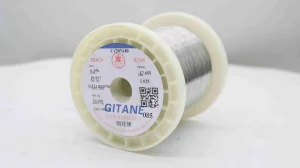
Featured FeCrAl & Resistance Wire Products (Batch 02)
Advanced high-temperature resistance alloy configurations, custom furnace wires, and heating elements engineered for high durability.
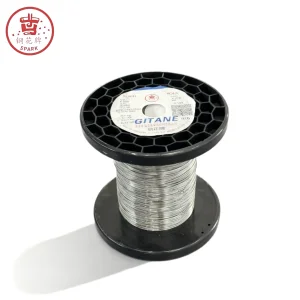


7. Technical FAQ & Sourcing Intelligence
Expert engineering answers to common technical queries regarding FeCrAl vs NiCr alloy selection, installation parameters, and thermal longevity.