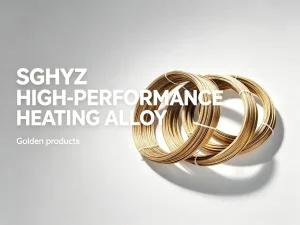
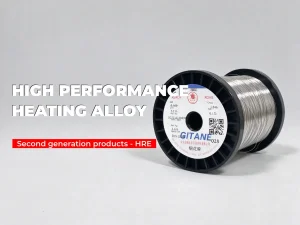
Featured Industrial Heating Alloys & Elements (Catalog Part I)
High-reliability resistance wire, strip, and pre-formed heating components manufactured under ISO 9001 and GB/T 1234-2012 quality control protocols.
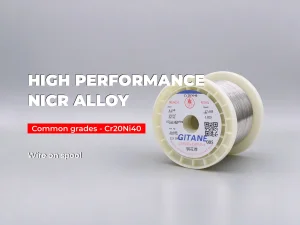

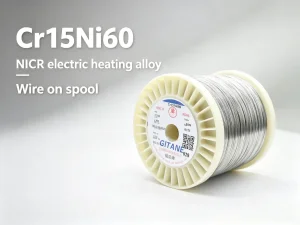


High-Precision Heating Element Manufacturing: Custom Power & Dimensional Engineering
Solving complex thermal challenges through specialized alloy chemistry, precise resistance tolerances, and state-of-the-art wire drawing and cold-rolling methodologies.
Custom Power & Watt Density Tailoring
Electric heating element performance hinges on precise Joule heating physics ($P = V^2 / R$). Industrial applications demand variable power output ratings across diverse temperature windows. China modern alloy factories utilize precise chemical stoichiometry—adjusting Chromium, Aluminium, Nickel, and Rare Earth (RE) micro-alloying additives—to achieve tight electrical resistivity tolerances ($\pm 3\%$). This enables custom linear resistance per meter, ensuring optimal surface load density ($W/cm^2$) without risk of premature localized burnout.
Comprehensive Dimensional Range
From micro-fine wires ($d \ge 0.05\text{ mm}$) for precision medical instruments and semiconductor sensors to heavy industrial round wires ($d \le 12.0\text{ mm}$) and thick cold-rolled strip ribbons ($0.1\times 1.0\text{ mm}$ up to $6.0\times 100\text{ mm}$), production lines accommodate full geometric spectrums. Advanced tungsten carbide die drawing and multi-stand cold rolling mills ensure outer diameter and thickness tolerances within $\pm 0.005\text{ mm}$, preventing hot spots caused by dimensional necking.
Phase Stability & Microstructural Integrity
At ultra-high operating temperatures up to 1425°C, grain boundary slippage and secondary phase precipitation can degrade structural mechanical strength. Through vacuum induction melting (VIM) coupled with electroslag remelting (ESR), impurities such as Sulfur, Phosphorus, and dissolved gases are reduced to ppm levels. This creates an ultra-clean alloy matrix with superior creep resistance, preventing sag in suspended furnace elements.
Tri-State Delivery Conditions: Processing Mechanics & Selection Criteria
The surface condition and mechanical hardness of resistance alloys fundamentally dictate their processing ease and service longevity. We offer three optimized delivery states.
1. Cold Drawn State (As-Drawn / Bare Surface)
Microstructural Characteristics: Produced directly through tungsten carbide or diamond drawing dies without final thermal annealing. Features elongated grain structures aligned along the drawing axis, yielding high tensile strength and yield point.
Surface Finish: Smooth, bright metallic lube-burnished finish with residual drawing lubricants washed or chemically degreased.
Best Applications: Ideal for automatic spring coiling machines, high-speed stamping of heating ribbon grids, and applications where post-forming rigidity is required prior to in-situ furnace conditioning.
2. Bright Annealed State (Hydrogen / Inert Atmosphere)
Microstructural Characteristics: Subjected to continuous strand annealing inside pure cracked Ammonia ($\text{H}_2 / \text{N}_2$) or pure Argon atmospheres at 1050°C–1150°C. Fully recrystallized equiaxed grain structure offering maximum elongation ($>20\%$) and low yield stress.
Surface Finish: Oxide-free, mirror-bright silver aesthetic with zero surface scale, preserving absolute chemical purity.
Best Applications: Essential for complex, tight-mandrel spiral winding, intricate element folding, appliance heating coils, and applications requiring zero carbon or scale contamination during assembly.
3. Pre-Oxidized State (Thermal Passivation Layer)
Microstructural Characteristics: Thermally conditioned in controlled oxygen furnaces to form an adherent, uniform $\alpha\text{-Al}_2\text{O}_3$ (Alumina for FeCrAl) or $\text{Cr}_2\text{O}_3$ (Chromia for NiCr) oxide scale prior to shipment.
Surface Finish: Characteristic dark grey, golden-brown, or deep blue passivation layer with high thermal emissivity ($\varepsilon > 0.70$).
Best Applications: Critical for carbon-rich or reducing atmosphere furnaces. The pre-grown oxide scale acts as a diffusion barrier against "Green Rot" (carburization) and prevents short-circuits in ceramic tube-mounted element assemblies.
| Delivery State | Tensile Strength (MPa) | Elongation (%) | Surface Color | Oxidation Resistance | Key Handling Benefit |
|---|---|---|---|---|---|
| Cold Drawn | 850 - 1100 | < 5% | Bright Metallic Lube | Unpassivated | High springiness, excellent for automatic grid stamping |
| Bright Annealed | 600 - 750 | > 22% | Mirror Silver | Unpassivated | Maximum ductility; zero wire breakage during tight coiling |
| Pre-Oxidized | 620 - 780 | > 18% | Dark Grey / Golden | Pre-Passivated Scale | Immediate high-temperature stability & carburization barrier |
Macro-Industry Heating Solutions
Translating advanced alloy metallurgy into engineered thermal systems across global strategic manufacturing sectors.
Photovoltaic & Semiconductor Solar Ingot Growth
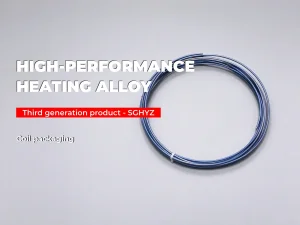
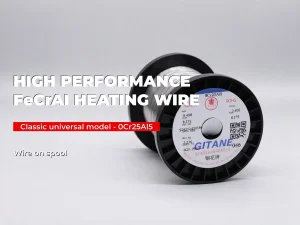
Polysilicon crystallization furnaces and monocrystalline Czochralski (CZ) pullers demand contamination-free environments and continuous 1350°C thermal stability. Our powder-metallurgy FeCrAl grades (SGHT / SGHYZ) deliver ultra-low sag and negligible heavy metal vapor pressure, ensuring silicon ingot purity while operating continuously for thousands of hours.
Automotive & Aerospace Heat Treatment
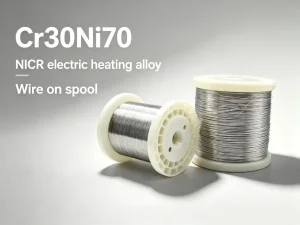
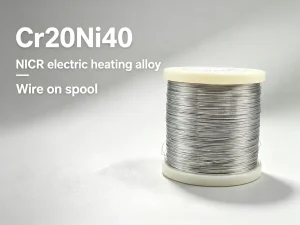
Continuous carburizing, nitriding, and solution annealing lines require rapid thermal cycling and resistance to furnace atmosphere attack. Specialized NiCr (Cr20Ni80, Cr30Ni70) and heavy-gauge FeCrAl ribbons integrated into radiant tube heaters provide long service life under high watt densities and mechanical vibrations.
Petrochemical & High-Temperature Process Pipe
High-temperature SGHT seamless alloy tubes and heavy resistance heating elements withstand corrosive gas flows, hydrocarbon cracking environments, and aggressive thermal shock in petrochemical cracking heaters and catalytic reformers.
Advanced Technical Ceramics & Glass Kilns
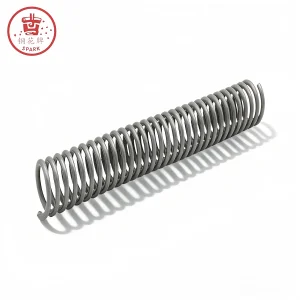
Sintering Zirconia, Alumina, and specialized optical glass tempering requires extreme spatial temperature uniformity ($\pm 1^\circ\text{C}$). Tailored spiral coil elements engineered with varying coil pitches compensate for furnace end-losses, maximizing yield in ceramic firing.
China Factory 4.0: Metallurgical Heritage & Supply Chain Resilience
Leveraging over 60 years of metallurgy expertise under Shougang Group to deliver uncompromised chemical purity, production capacity, and global delivery speed.
State-of-the-Art Melting & Refining Control
Production begins with virgin raw materials—high-purity electrolytic Nickel, low-carbon Ferro-Chrome, and refined Aluminium. Utilizing Vacuum Induction Melting (VIM) followed by Electroslag Remelting (ESR), residual trace element impurities (such as Lead, Tin, and Zinc) are controlled to sub-ppm levels, ensuring stable interatomic bonding during extended high-temperature exposure.
Multi-Stage Quality Inspection & NDT Testing
Every production coil undergoes 100% online Eddy Current non-destructive flaw detection to eliminate internal micro-cracks or inclusions. Post-drawing inspection includes continuous laser diameter micrometer profiling, resistance per meter verification ($\pm 1\%$), and mechanical tensile/elongation testing in accordance with GB/T 1234-2012.
End-to-End Vertical Supply Chain Integration
From raw ore refining and ingot casting to hot rolling, wire drawing, bright annealing, and pre-formation of finished heating elements, complete internal supply chain ownership guarantees strict delivery schedules, batch-to-batch repeatability, and total cost transparency.
All SPARK heating alloy shipments are accompanied by official EN 10204 3.1 Mill Test Reports (MTRs) detailing complete heat-specific chemical ladle analysis, measured 20°C electrical resistivity ($\mu\Omega\cdot\text{m}$), temperature coefficient of resistance ($C_t$), and mechanical test data.
Global Enterprise Procurement: TCO Optimization & Standards Compliance
Empowering procurement directors to lower Total Cost of Ownership (TCO) through material longevity, reduced maintenance downtime, and certified global compliance.
Total Cost of Ownership (TCO) Calculation
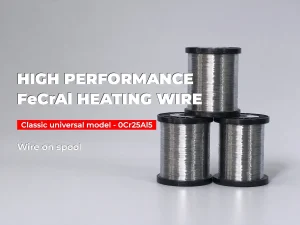
Initial wire cost accounts for less than 15% of total industrial furnace lifecycle expenses. Standardizing on high-purity FeCrAl (such as SGHYZ rated to 1400°C) extends element operating hours by $1.8\times$ to $2.5\times$ compared to conventional grades. This significantly reduces unplanned production line shutdowns, labor replacement costs, and energy consumption caused by thermal degradation.
Density & Weight Economy: FeCrAl vs. NiCr
FeCrAl alloys feature a density of approximately $7.10\text{ g/cm}^3$, whereas NiCr alloys average $8.40\text{ g/cm}^3$. Purchasing FeCrAl wire yields roughly 15-18% more linear meterage per kilogram of material. Combined with higher electrical resistivity ($1.45\text{ vs } 1.09\ \mu\Omega\cdot\text{m}$), FeCrAl provides significant weight and cost savings for heavy industrial kilns.
Global Regulatory Compliance
Products strictly conform to international standards including ASTM B603, DIN 17470, JIS C2520, and domestic standard GB/T 1234-2012. Fully compliant with EU REACH regulations and RoHS Directive 2011/65/EU, prohibiting heavy metal contaminants and hazardous substance emissions.
Technology Roadmap & Future Outlook (2025–2035)
Pioneering next-generation thermal alloys to support green industrial electrification, semiconductor expansion, and ultra-high temperature processing.
1. Powder Metallurgy (PM) & ODS Alloy Evolution
Traditional ingot metallurgy faces creep limitations at temperatures above 1350°C due to rapid grain coarsening. Development of Oxide Dispersion Strengthened (ODS) alloys—incorporating nanoscale Yttrium Oxide ($\text{Y}_2\text{O}_3$) particles via mechanical alloying—locks grain boundaries, raising structural creep strength by over 300% at 1400°C.
2. AI-Driven Thermal & Life Prediction Modeling
Integrating finite element analysis (FEA) and machine learning algorithms to simulate localized oxidation kinetics, thermal strain, and surface load limits under complex atmosphere gas mixtures ($\text{CO}, \text{H}_2, \text{N}_2, \text{NH}_3$). This allows precise lifecycle prediction before installation.
3. Zero-Carbon Green Metallurgy
Transitioning melting operations toward 100% green hydrogen-powered refining and closed-loop scrap recycling, reducing Scope 1 and Scope 2 carbon intensity across the entire electric heating alloy manufacturing lifecycle.
Frequently Asked Questions (Engineering Q&A)
Detailed technical answers from our senior metallurgical engineering team to assist your selection and operational maintenance.
What is the key functional difference between FeCrAl and NiCr resistance alloys?
NiCr Alloys (e.g., Cr20Ni80, Cr30Ni70): Offer superior hot strength, higher creep resistance, and retain excellent room-temperature ductility even after extended high-temperature operation. They form a Chromium Oxide ($\text{Cr}_2\text{O}_3$) scale and are ideal for frequent thermal cycling and nitrogen/reducing atmospheres.
Why is the delivery state (Cold Drawn vs Bright Annealed vs Pre-Oxidized) critical for element fabrication?
• Cold Drawn: Best for automated stamping/cutting where high stiffness is needed.
• Bright Annealed: Essential when winding tight helical spirals or bending sharp radii to prevent wire cracking.
• Pre-Oxidized: Crucial when operating in carbon-bearing or corrosive atmospheres immediately upon installation, bypassing the need for an in-situ oxidation burn-in cycle.
How do I determine the optimal surface load density (Watt Density, W/cm²) for my furnace?
Can FeCrAl heating elements be used in Carburizing or Carbon-Rich Atmospheres?
What parameters are required to calculate custom heating wire specifications?
1. Total Supply Voltage ($V$) and Target Power Output ($W$).
2. Operating Furnace Temperature (°C) and Atmosphere type.
3. Available Installation Dimensions (Length, Pitch, Coil Diameter $D$).
4. Preferred Alloy Family (FeCrAl vs. NiCr) or environment constraints.
What is the significance of the Temperature Coefficient of Resistance (Ct)?
What quality documentation accompanies international orders?
Specialized Heating Alloys & Tubes (Catalog Part II)
High-grade resistance materials engineered for demanding energy, petrochemical, and ultra-high-temperature industrial environments.