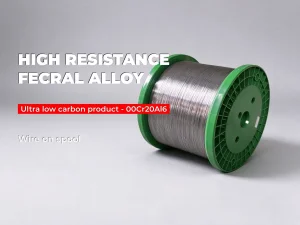
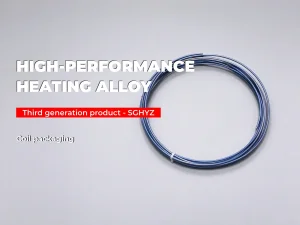
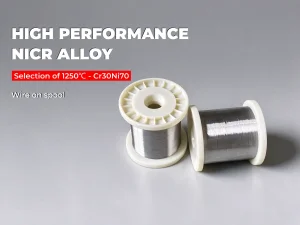
Featured Electrothermal Resistance Alloys & Heating Elements
High-precision FeCrAl and NiCr heating wire, custom spiral elements, and high-temp alloy solutions engineered for extreme thermal stability.


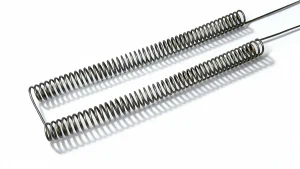



How Micro-Resistivity Consistency Directly Reduces Industrial Furnace Maintenance Overhead
An In-Depth Engineering Analysis on Eliminating Hot Spots, Creep Strain, and Thermal Runaway in High-Temperature Industrial Operations.
Core Metallurgical Fact: In continuous industrial heating operations exceeding 1000°C, a cross-sectional electrical resistance variance as small as ±3% in resistance heating wire induces localized temperature spikes exceeding 85°C. This localized overheating accelerates grain growth, causes rapid spallation of the protective alumina oxide scale ($\alpha\text{-Al}_2\text{O}_3$), and reduces total element service life by up to 60%. Advanced Vacuum Melting paired with Multi-Pass Precision Wire Drawing stabilizes electrical resistivity within a strict $\pm1.5\%$ tolerance, directly driving down emergency factory downtime and long-term MRO costs.
Extended Component Lifespan
Stabilized grain structures prevent hot-spot generation, allowing heating elements to operate continuously for thousands of additional thermal cycles without element sagging or embrittlement failure.
Energy Efficiency & Thermal Balance
Uniform electrical resistance across the entire length of the coil ensures even thermal radiation throughout the furnace chamber, reducing power loss and improving heat transfer efficiency.
Predictable Maintenance Scheduling
By eliminating premature localized burnouts, facility engineers can shift from emergency reactive maintenance to structured, scheduled preventive overhauls, drastically reducing labor cost.
1. The Metallurgical Root Cause of Heating Alloy Failure & Maintenance Overhead
Understanding how microscopic impurities, inclusions, and dimensional deviations turn into multi-thousand-dollar unscheduled downtime events.
Industrial electric furnaces—whether utilized in semiconductor wafer manufacturing, automotive heat treatment, powder metallurgy sintering, or glass tempering—rely entirely on the predictable conversion of electrical energy into thermal energy via Joule heating ($P = I^2 R$). However, maintaining operational efficiency requires strict control over the fundamental physical properties of the electrothermal resistance wire.
When low-tier alloys melted via conventional Air Induction Melting (AIM) are used, non-metallic inclusions (such as sulfur, phosphorus, dissolved oxygen, and hydrogen) remain trapped within the matrix. Under elevated temperatures ($1100^\circ\text{C}$ to $1425^\circ\text{C}$), these tramp elements migrate along grain boundaries. This micro-segregation creates three primary failure mechanisms:
- Local Resistance Fluctuations ($R = \rho \cdot \frac{L}{A}$): Variations in chemical composition affect local resistivity ($\rho$), while diameter inconsistent wire drawing affects cross-sectional area ($A$). Even a $0.02\text{ mm}$ variance in $2.00\text{ mm}$ wire causes a localized resistance jump, generating severe thermal hot spots.
- Accelerated Oxide Scale Breakdown: FeCrAl alloys rely on a continuous, self-healing Alpha-Alumina ($\alpha\text{-Al}_2\text{O}_3$) protective scale. Non-metallic inclusions disrupt scale adhesion. During continuous heating/cooling cycles, the oxide film spalls off, causing rapid internal aluminum depletion and element burn-through.
- High-Temperature Creep Deformation: Impure grain boundaries weaken intergranular shear strength at elevated temperatures, leading to element sagging, touching adjacent coils, short-circuiting, and immediate furnace shutdown.
| Metallurgical Parameter | Standard Air Induction Melting (AIM) | Advanced VIM + VAR Vacuum Process |
|---|---|---|
| Sulfur & Phosphorus Content | $\ge 0.025\%$ (High Grain Segregation) | $\le 0.005\%$ (Ultra-Clean Grain Boundary) |
| Dissolved Gas (O, N, H) | $150 - 300\text{ ppm}$ | $\le 15\text{ ppm}$ |
| Electrical Resistance Tolerance | $\pm 4.0\%$ to $\pm 6.0\%$ | $\pm 1.0\%$ to $\pm 1.5\%$ |
| Wire Diameter Tolerance | $\pm 0.03\text{ mm}$ | $\pm 0.005\text{ mm}$ (Laser Micrometer Feedback) |
| Oxide Scale Integrity | Porosity & Early Spallation | Dense, Adherent $\alpha\text{-Al}_2\text{O}_3$ Passive Layer |
| Average Element Operating Life | $3,000 - 5,000\text{ Hours}$ | $12,000 - 18,000+\text{ Hours}$ |
2. Engineering Excellence: Vacuum Melting & Multi-Pass Precision Drawing
How China's leading electrothermal alloy manufacturing facilities achieve unrivaled resistance consistency through dual-stage vacuum processing and precision cold drawing.
Stage 1: VIM & VAR Melting
Raw materials are melted inside Vacuum Induction Melting (VIM) furnaces to outgas volatile impurities. Secondary Vacuum Arc Remelting (VAR) cleans the ingot microstructure, establishing an ultra-pure alloy base with ideal chemical stoichiometry.
Stage 2: Rare-Earth Micro-Alloying
Precise micro-additions of Rare Earth (RE) elements such as Yttrium (Y), Zirconium (Zr), Hafnium (Hf), and Lanthanum (La) are introduced. These RE dopants anchor the oxide scale to the substrate, quadrupling high-temperature oxidation resistance.
Stage 3: Multi-Pass Precision Drawing
Ingots are hot-rolled into wire rods and passed through dozens of continuous multi-pass tungsten-carbide and polycrystalline diamond (PCD) dies. Real-time dual-axis laser micrometers adjust die pressure instantly, maintaining concentricity.
Stage 4: Continuous Bright Annealing
Drawn wire undergoes online hydrogen-shielded continuous bright annealing. This relieves cold-working stress, ensures uniform tensile strength, and produces a mirror-like surface finish free of carbonaceous residues or drawing oils.
3. Global Procurement Trends & Industrial Price Structure Matrix
Evaluating Levelized Cost of Heating (LCOH), direct factory pricing structures, and export grade selections for B2B procurement managers.
Global furnace manufacturers and heat-treatment plant operators are transitioning away from buying heating alloys purely based on initial purchase cost per kilogram ($/kg). Modern industrial procurement frameworks now measure the Levelized Cost of Heating (LCOH), which accounts for element failure rates, emergency repair labor, lost factory output, and energy consumption.
$$\text{TCO} = \text{CAPEX}_{\text{Wire}} + \sum \left( \text{Downtime Cost} + \text{Replacement Labor} + \text{Power Loss}_{\text{HotSpots}} \right)$$
By sourcing directly from tier-1 accredited manufacturing facilities in China utilizing VIM/VAR melting and multi-pass drawing, global procurement operations achieve a 30% to 45% CAPEX savings compared to Western European or North American supply chains, while gaining superior resistance consistency and extended element life.
Overview of Core Alloy Grade Families & Industrial Sourcing Guide
| Alloy Grade Family | Nominal Composition | Max Operating Temp | Resistivity ($\mu\Omega\cdot\text{m}, 20^\circ\text{C}$) | Primary Application Profile |
|---|---|---|---|---|
| 0Cr25Al5 (FeCrAl) | $25\%\text{ Cr}, 5.0\%\text{ Al}, \text{Bal. Fe}$ | $1250^\circ\text{C}$ | $1.42$ | Industrial batch furnaces, ceramic kilns, radiant tube heaters. |
| 0Cr21Al6Nb (FeCrAl+Nb) | $21\%\text{ Cr}, 6.0\%\text{ Al}, \text{Nb Added}$ | $1350^\circ\text{C}$ | $1.45$ | Heavy-duty heat treatment, high creep resistance requirement. |
| HRE / SGHYZ | Ultra-Pure FeCrAl + Rare Earth | $1350^\circ\text{C} - 1400^\circ\text{C}$ | $1.45 - 1.50$ | Semiconductor diffusion, solar PV wafer sintering, PM furnaces. |
| Cr20Ni80 (Nichrome) | $80\%\text{ Ni}, 20\%\text{ Cr}$ | $1200^\circ\text{C}$ | $1.09$ | Cyclic heating, plastic sealing, medical equipment, appliances. |
| Cr30Ni70 (Nichrome) | $70\%\text{ Ni}, 30\%\text{ Cr}$ | $1250^\circ\text{C}$ | $1.18$ | Carburizing atmospheres, heavy industrial furnaces with thermal shock. |
4. Macro Industry Solutions & Heavy OEM Integration
Tailored electrothermal alloy configurations engineered specifically for severe industrial thermal environments.
Photovoltaic & Semiconductor Wafer Sintering
High-purity SGHYZ and SGHT FeCrAl alloys rated up to 1425°C. Unmatched dimensional stability during continuous diffusion tube operations, ensuring zero particle contamination and uniform silicon wafer sheet resistance.
Automotive Heat Treatment & Carburizing Lines
NiCr alloys (Cr30Ni70 and Cr20Ni80) resistant to carbon pickup and green-rot corrosion. Specially formulated to withstand aggressive endothermic and exothermic gas atmospheres in continuous mesh belt furnace lines.
Heavy Industrial Ceramic & Glass Kilns
Large-diameter 0Cr25Al5 and 0Cr21Al6Nb wire and strip products designed for high surface-load applications ($W/\text{cm}^2$). Engineered to maintain structural ductility and resist thermal fatigue over multi-year kiln campaigns.
5. Compliance, Quality Assurance & Global Logistics Infrastructure
Rigorous metallurgical certification, traceable mill test reports, and end-to-end supply chain reliability.
ISO 9001:2015 & GB/T 1234 Audit Traceability
Every production batch undergoes strict spectral analysis (OES), tensile testing, room-temperature resistivity measurement, and accelerated high-temperature life testing according to national standards GB/T 1234-2012.
EN 10204 3.1 Mill Test Certificates
Shipments are dispatched with full EN 10204 3.1 certification, detailing exact chemical heat analysis, mechanical elongation, coil-by-coil resistance measurements, and dimensional tolerances.
Custom Packaging & Export Logistics
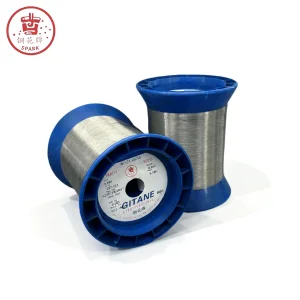
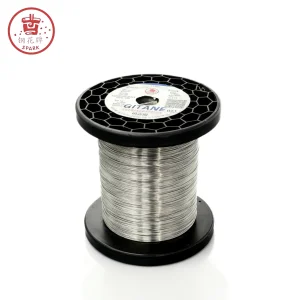
Precision wire is supplied on plastic spools (DIN 200, DIN 250, K350), waterproof foil wrapping, and fumigated sea-worthy wooden cases, preventing transit moisture oxidation and mechanical damage.
6. Technological Roadmap & Next-Generation Electrothermal Alloys
Driving the clean-energy industrial thermal transition through nanostructured dispersion alloys and digitalized manufacturing control.
As global manufacturing sectors accelerate decarbonization goals, heavy industry is rapidly replacing fossil-gas combustion heating with green electric resistance heating. To support higher thermal power densities and extreme temperature requirements, China's leading metallurgical research centers are pioneering three major technology fronts:
1. Oxide Dispersion Strengthened (ODS) FeCrAl
Integrating nanoscale Yttrium Oxide ($\text{Y}_2\text{O}_3$) particles into the alloy matrix via powder metallurgy to raise maximum operational temperatures to $1450^\circ\text{C}$ with near-zero creep deformation.
2. AI Closed-Loop Wire Drawing
Deploying AI-driven optical closed-loop tension and diameter control systems during drawing, reducing resistance variance to an unheard-of $\pm 0.5\%$ across multi-kilometer wire spools.
3. Advanced Pre-Oxidation Coatings
Factory-applied, controlled atmosphere pre-oxidation processes that create a mature, dense Alpha-Alumina barrier layer prior to customer installation, eliminating initial burn-in conditioning time.
Frequently Asked Engineering & Procurement Questions
Expert responses to critical questions asked by furnace designers, plant engineers, and international buyers.
High-Performance Resistance Alloy Supply Pricelist Catalog
Explore our full line of low-carbon, creep-resistant FeCrAl and Nichrome alloys available at factory-direct wholesale pricing.