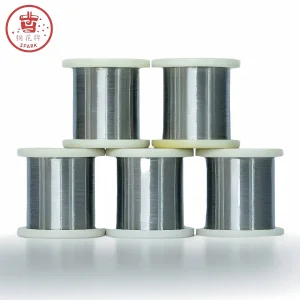
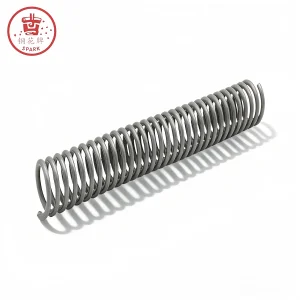
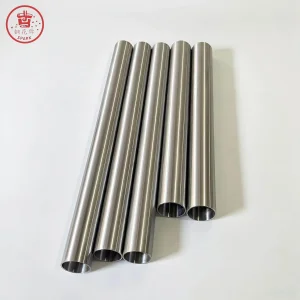
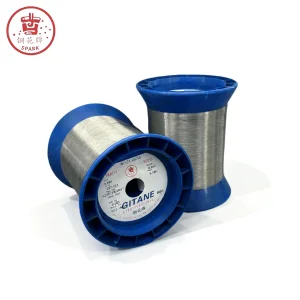
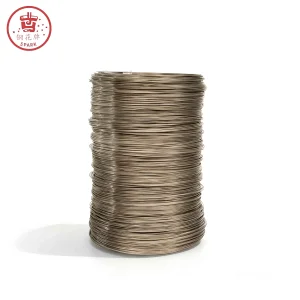
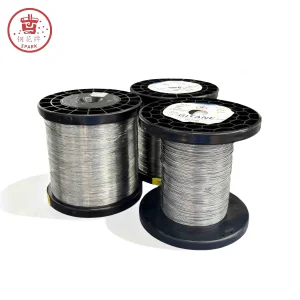
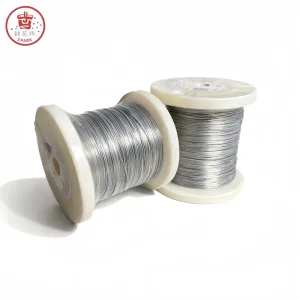
Explore our engineered FeCrAl and NiCr electric resistance materials optimized for tight resistance tolerances and prolonged high-temperature operational life.
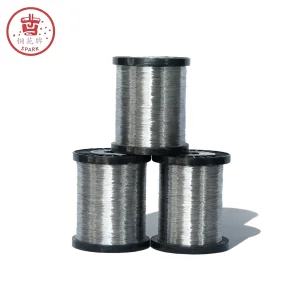
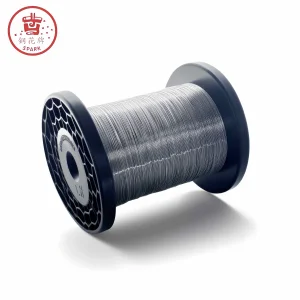
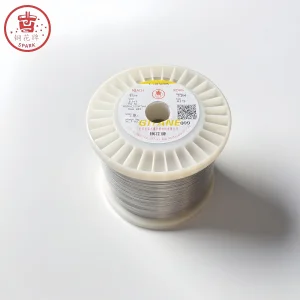
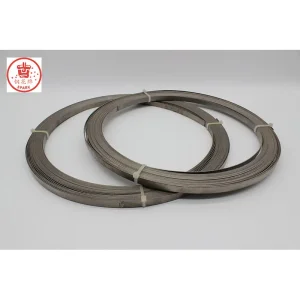
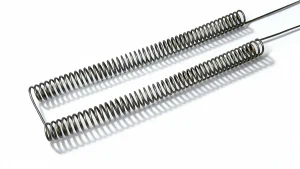
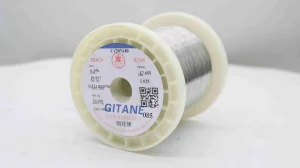
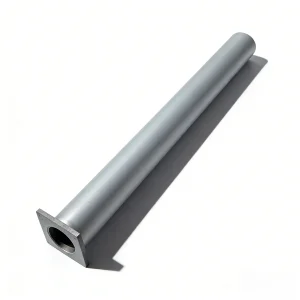
Why tight tolerance control (±5% Standard / ±3% High-Precision) is the non-negotiable metric for preventing localized thermal runaway, element sagging, and premature burnout in high-temperature heating applications.
1. Technical Fundamentals: Joule Heating & Cross-Sectional Variance
In electric thermal engineering, heat generation within a resistive element is governed by Joule’s First Law:
Here, P represents thermal power output (Watts), I is the electric current (Amperes), R is electrical resistance (Ohms), ρ is electrical resistivity ($\Omega\cdot\text{m}$), L is element length, and A is cross-sectional area ($\text{m}^2$).
When an electric heating wire exhibits cross-sectional variations—due to inaccurate cold-drawing dies or chemical micro-segregation—the resistance per unit length fluctuates. According to the differential relationship:
Because current I remains constant across a series-connected heating element, any local increase in resistance ($\Delta R > 0$) driven by a restricted cross-sectional area ($\Delta A < 0$) causes a proportional spike in localized power dissipation ($\Delta P > 0$). This localized excess heat generates a phenomenon known as a Thermal Hotspot.
Standard grade resistance alloy wire manufactured to a ±5% resistance deviation threshold is engineered for heavy-duty industrial furnaces, batch heat-treatment lines, and commercial heating units. By keeping diameter variations strictly under $\pm 0.005\text{ mm}$ via diamond die finishing, standard grades limit localized thermal spikes to under $15^\circ\text{C}$, preventing premature grain boundary degradation and oxide spallation under typical atmospheric conditions.
Designed for semiconductor diffusion tubes, photovoltaic crystal growth kilns, ceramic sintering, and laboratory muffles, high-precision grade wire guarantees a narrow ±3% resistance deviation. Achieving this level of uniformity requires ultra-fine laser micrometer closed-loop control during continuous drawing, alongside vacuum induction melting (VIM) to ensure chemical homogeneity across thousands of meters of continuous alloy spools.
Understanding oxide film formation ($\alpha\text{-Al}_2\text{O}_3$ vs $\text{Cr}_2\text{O}_3$), hot strength, and electrical resistivity profiles to match your industrial thermal envelope.
| Alloy Grade / Family | Alloy System | Max Operating Temp (°C) | Resistivity @ 20°C (μΩ·m) | Density (g/cm³) | Resistance Tolerance | Primary Industrial Application |
|---|---|---|---|---|---|---|
| SPARK SGHT | FeCrAl (PM Technology) | 1425°C | 1.45 | 7.10 | ±3% Precision | Semiconductor diffusion & ceramic sintering |
| SPARK SGHYZ | FeCrAl + Rare Earth | 1400°C | 1.43 | 7.15 | ±3% Precision | Ultra-high-temp industrial kilns |
| HRE | FeCrAl (Al 5.5%+) | 1350°C | 1.42 | 7.15 | ±5% Standard | Powder metallurgy & heat treatment |
| 0Cr25Al5 | FeCrAl Standard | 1250°C | 1.42 | 7.10 | ±5% Standard | Industrial electric furnaces & tube heaters |
| 0Cr23Al5 | FeCrAl Standard | 1250°C | 1.35 | 7.25 | ±5% Standard | General heating elements & appliances |
| Cr20Ni80 / Cr20Ni80S | NiCr High Nickel | 1200°C | 1.09 | 8.40 | ±3% Precision | Cyclic heating, plastic sealing, medical equipment |
| Cr30Ni70 | NiCr Premium | 1250°C | 1.18 | 8.10 | ±3% Precision | High-temperature industrial heaters & furnaces |
| Cr20Ni40 | NiCr Economic | 1100°C | 1.04 | 8.60 | ±5% Standard | Domestic heating & medium-temp furnaces |
FeCrAl alloys (such as 0Cr25Al5, HRE, and SGHYZ) form a continuous, thermodynamically stable alpha-alumina ($\alpha\text{-Al}_2\text{O}_3$) oxide layer at temperatures exceeding 900°C. This oxide scale acts as an exceptional electrical insulator and oxygen barrier. Combined with a higher resistivity (up to $1.45\,\mu\Omega\cdot\text{m}$) and lower density ($7.10\,\text{g/cm}^3$), FeCrAl delivers up to 15-20% weight savings compared to NiCr wire for equivalent power ratings.
Nickel-Chromium alloys (Cr20Ni80, Cr30Ni70) develop a protective chromia ($\text{Cr}_2\text{O}_3$) scale. While limited to 1200°C–1250°C, NiCr alloys exhibit outstanding hot mechanical strength, resistance to room-temperature embrittlement after thermal cycling, and zero magnetic signature. They are preferred in applications subject to high mechanical vibration or frequent dynamic thermal cycles.
Our flagship powder metallurgy grade SGHT (1425°C rating) overcomes traditional FeCrAl creep weakness. By dispersing reactive rare-earth oxides (Yttrium, Zirconium) into the grain matrix, SGHT prevents high-temperature grain growth and coil sag. Combined with a tight $\pm 3\%$ resistance tolerance, SGHT element life exceeds conventional alloys by more than 50%.
How precise electrical tolerance control translates directly into thermal stability across high-stakes industrial processing environments.
In silicon wafer diffusion, oxidation, and crystal growth furnaces, axial temperature gradients must not exceed $\pm 0.5^\circ\text{C}$. High-precision $\pm 3\%$ resistance deviation heating wire ensures that every heating zone dissipates exact thermal power matching system control loops. This eliminates thermal tilt, preserves wafer crystal lattice integrity, and boosts yield rates.
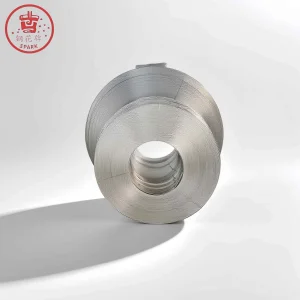
Continuous pit furnaces and mesh-belt carburizing lines depend on heavy-gauge FeCrAl (0Cr25Al5 / 0Cr21Al6Nb) strip and spiral elements. Consistent $\pm 5\%$ resistance tolerances ensure equal current draw across multi-phase delta/wye electric configurations, preventing phase imbalance and localized element burnout in carbon-rich controlled atmospheres.
Sintering technical ceramics (Zirconia, Alumina, Nitrides) requires uniform thermal ramps up to 1400°C. Utilizing SGHYZ and SGHT wire with uniform resistance distribution prevents cold corners and hot core zones inside large furnace chambers, delivering isotropic shrinkage and uniform density across sintered ceramic components.
Compact cartridge heaters, tubular immersion elements, and medical autoclave heaters demand absolute repeatability. By integrating Cr20Ni80S wire with tight resistance tolerances, heater manufacturers avoid watt-density hot spots, ensuring compliance with strict international medical device thermal profiles and UL/CE insulation requirements.
Advanced metallurgical processing, automated laser inspection, and integrated supply chain capabilities driving global competitiveness.
Every melt heat originates in Vacuum Induction Melting (VIM) furnaces followed by Electroslag Remelting (ESR). This double-vacuum purification process removes non-metallic inclusions, gases ($\text{O}_2, \text{N}_2, \text{H}_2$), and trace tramp elements, establishing ultra-pure chemical homogeneity prior to hot rolling.
Multi-pass wire drawing units are integrated with dual-axis laser micrometers that measure wire diameter at 1,000 Hz. Automated feedback loops adjust capstan drawing tension in real-time, holding wire diameter variations to within $\pm 0.002\text{ mm}$, guaranteeing the promised $\pm 3\%$ resistance window.
Final heat treatment occurs in continuous tube furnaces under a 100% pure hydrogen protective atmosphere. This process restores optimal grain structure and ductility while ensuring a mirror-bright, oxide-free surface finish ready for precision coiling or element fabrication.
Why procuring tightly controlled resistance alloy wire directly from Chinese direct-manufacturing sources reduces long-term operational expenditure.
Calculating the Financial ROI of Tightly Controlled Resistance Wire
For furnace OEMs and heat-treatment plant managers, the purchase price of resistance wire accounts for less than 15% of total thermal system lifetime costs. The remaining 85% is consumed by electrical energy, scheduled maintenance labor, and catastrophic downtime lost to element replacement.
By selecting precision wire with a ±3% resistance tolerance, facilities achieve:
- Energy Optimization: Elimination of localized overheating reduces power consumption by up to 5-8% over the element lifetime.
- Extended Element Lifetime: Even thermal dissipation prevents localized grain growth and scale failure, expanding operational cycles by 35% to 50%.
- Reduced Labor Costs: Fewer element failures mean less maintenance crew intervention and uninterrupted batch production schedules.
Rigorous quality verification protocols guaranteeing international standard compliance and complete mill test traceability.
All electric heating wire and strip batches are produced in strict compliance with GB/T 1234-2012 (High Resistance Electric Heating Alloys), while offering full equivalence to global standards including:
- ASTM B603: FeCrAl Electric Resistance Alloys
- ASTM B344: Nickel-Chromium Electric Resistance Alloys
- DIN 17470: High-temperature heating conductor materials
- JIS C2520: Electric resistance wires and ribbons
Every shipment is accompanied by a certified EN 10204 3.1 Mill Test Report detailing heat number, chemical composition via optical emission spectroscopy, cold resistance ($\Omega/\text{m}$), tensile strength, elongation, and 50-hour accelerated high-temperature life test results (ASTM B78). Facilities maintain full ISO 9001:2015, ISO 14001, and REACH/RoHS compliance.
Expert answers to key engineering and procurement queries regarding resistance wire tolerance, alloy selection, and element lifespan.
Explore additional specialized alloy grades, ultra-high temperature SGHT series, and custom engineered heating element products.