
Featured High-Temperature Heating Alloys (Top Direct-Sourcing Solutions)
Explore our core metallurgical products designed for continuous thermal processing up to 1300°C and beyond. Certified to GB/T 1234-2012, ISO 9001, and international high-temperature compliance standards.


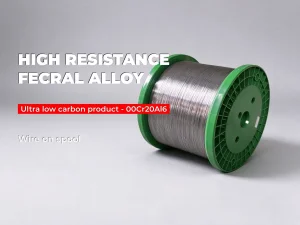

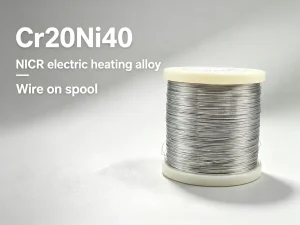
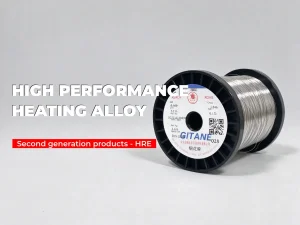

1. Metallurgical Engineering of 1300°C Electric Heating Alloys
When operating thermal processing systems at extreme temperatures—specifically within the 1200°C to 1350°C window—the physics of resistance heating alloys shift dramatically from simple electrical conductivity to complex high-temperature oxidation kinetics and grain growth dynamics. Electric heating wire engineered for 1300°C service environments must withstand continuous thermal stress, thermal cycling, and aggressive chemical atmospheres without structural collapse or electrical resistance drift.
FeCrAl vs. NiCr: Phase Behavior at Extreme Temperatures
High-temperature industrial heating relies primarily on two family groups of alloys: Iron-Chromium-Aluminum (FeCrAl) and Nickel-Chromium (NiCr). While Nickel-Chromium alloys such as Cr20Ni80 offer superior hot strength and room-temperature ductility post-service, their operational limit peaks near 1200°C due to the formation of chromium oxide ($\text{Cr}_2\text{O}_3$), which volatilizes at temperatures exceeding 1200°C. For sustained operation at 1300°C, high-purity FeCrAl alloys (such as 00Cr27Al7Mo2, HRE, and SGHYZ) are mandatory.
| Alloy Parameter | FeCrAl (e.g., HRE / 00Cr27Al7Mo2) | NiCr (e.g., Cr20Ni80 / Cr30Ni70) |
|---|---|---|
| Maximum Service Temp (Air) | 1350°C - 1425°C (Ideal for 1300°C duty) | 1200°C - 1250°C (Limited at 1300°C) |
| Protective Oxide Layer | $\alpha-\text{Al}_2\text{O}_3$ (Adherent, dense, non-volatile) | $\text{Cr}_2\text{O}_3$ (Tends to volatilize above 1200°C) |
| Electrical Resistivity (20°C) | High (~1.45 $\mu\Omega\cdot\text{m}$) | Moderate (~1.09 - 1.18 $\mu\Omega\cdot\text{m}$) |
| Density | 7.10 g/cm³ (Saves ~15% material weight) | 8.40 g/cm³ |
| Hot Strength & Creep | Requires structural support/ribbing | Excellent hot strength and sag resistance |
| Atmosphere Tolerance | Superior in Oxidizing, Sulfurous, and Carburizing | Superior in Reducing, Nitrogen, and Moist air |
Our specialized Chinese manufacturing plants utilize Vacuum Induction Melting (VIM) coupled with Electroslag Remelting (ESR) to introduce precise micro-alloying reactive elements (RE) such as Yttrium (Y), Zirconium (Zr), and Hafnium (Hf). This RE micro-doping technology locks the grain boundaries, preventing premature oxidation spallation and dramatically improving creep resistance during 1300°C operation.
China Supply Chain Metrics & Manufacturing Capability
2. The China Factory Ecosystem: Strategic Cost & Quality Dominance
Global procurement managers evaluating Chinese resistance heating wire manufacturers often weigh unit cost against long-term reliability. China's industrial thermal alloy sector—anchored by state-level metallurgical research clusters and integrated steel enterprises like Beijing Shougang Gitane New Materials Co., Ltd.—delivers unmatched structural competitive advantages across four dimensions:
Upstream Rare Earth Integration
China commands over 70% of the world's rare earth mineral refining capacity. High-performance 1300°C FeCrAl alloys require precise micro-doping of Yttrium, Cerium, and Lanthanum. Domestic Chinese factories source these critical alloying elements directly, eliminating supply chain risk and stabilizing raw material pricing.
End-to-End Manufacturing
From raw virgin metal melting in multi-ton Vacuum Induction Furnaces to hot rolling, multi-stage cold drawing, continuous hydrogen atmosphere annealing, and high-speed precision spooling—every processing step occurs under one quality management umbrella, guaranteeing batch-to-batch consistency.
Full Standard Compliance
Top Chinese suppliers manufacture strictly in accordance with GB/T 1234-2012 (Chinese National Standard for High-Resistance Electric Heating Alloys), while offering full cross-referencing and equivalence to ASTM B603, DIN 17470, and JIS C2520 standards.
3. Global Enterprise Procurement: TCO & Technical Specification
When procuring 1300°C electric heating wire for original equipment manufacturing (OEM) or plant retrofit projects, procurement teams must evaluate the Total Cost of Ownership (TCO) rather than simple price-per-kilogram metrics. Poor quality resistance wire leads to premature hot-spot formation, localized element burn-out, and catastrophic production line downtime.
Technical RFQ Checklist for High-Temperature Resistance Wire
To ensure your supplier quotes match your exact operating environment, ensure your Request for Quote (RFQ) includes the following critical engineering parameters:
- Nominal Operating Temperature & Atmosphere: Specify whether the furnace operates under ambient air, vacuum, endothermic gas, nitrogen, hydrogen, or sulfur-heavy combustion gases.
- Wire Geometry & Dimensional Tolerances: Wire diameter (mm/AWG), strip thickness × width, or pre-coiled spiral pitch-to-diameter ratio. Request standard tolerances of ±0.02mm for precision drawing.
- Electrical Resistance Tolerance: Demand resistance tolerances within ±3% (or ±1.5% for high-precision applications) measured at 20°C per meter.
- Surface Load Calculation ($W/\text{cm}^2$): Validate that the proposed wire gauge maintains a safe surface power loading (typically 1.5 to 2.5 $W/\text{cm}^2$ at 1300°C) to avoid thermal runaway.
- Delivery Form Requirements: Continuous spools (DIN 160, DIN 200, DIN 250), loose coils, straight rods, or pre-fabricated corrugated heating elements ready for ceramic tube mounting.
4. Application Scenarios & Engineering Case Studies
1300°C electric heating wires engineered in China serve as the critical heating core across diverse global industrial applications. Below are specific field application scenarios where our materials demonstrate superior operational lifespan:
Advanced Ceramics & Glass Sintering
Shuttle kilns, roller hearth kilns, and sagger furnaces firing technical ceramics (Zirconia, Alumina, Substrates) operating continuously at 1250°C–1350°C. FeCrAl grade HRE and SGHYZ wire coils eliminate glaze contamination by forming a non-flaking alumina protective oxide shell.
Industrial Heat Treatment Furnaces
Pit furnaces, box kilns, and continuous mesh-belt furnaces used for aerospace alloy hardening, carburizing, and annealing. Heavy-gauge corrugated FeCrAl strip elements hanging on ceramic hooks ensure uniform radiant heat transfer across large heating chambers.
Semiconductor & Solar Photovoltaics
Diffusion furnaces and crystal growth equipment in photovoltaic silicon wafer production. Ultra-low carbon FeCrAl wires (e.g., 00Cr20Al6) prevent carbon migration into ultra-clean semiconductor quartz tube chambers.
5. Localized Support, Quality Compliance & Export Assurance
Bridging international sourcing with localized operational reliability requires robust compliance frameworks and rapid technical support. Leading Chinese exporters provide dedicated engineering interface services tailored to European, North American, Southeast Asian, and Middle Eastern markets:
Complete Regulatory Documentation
Every shipment is accompanied by certified EN 10204 3.1 Mill Test Certificates (MTC) detailing exact chemical melt heat analysis, room-temperature tensile properties, resistivity test results, and dimensional tolerance inspection logs. RoHS and REACH SVHC compliance guarantees environmental suitability.
Export Seaworthy Packaging
To prevent surface oxidation and moisture exposure during transit, wires are wound on high-impact plastic spools, sealed in desiccated plastic vacuum wrapping, and crated in fumigation-free ISPM-15 compliant plywood cases with reinforced steel strapping.
Field Engineering Consultation
On-demand CAD element design assistance, calculating wire gauge selection, coil expansion ratios, terminal lead sizing, and power balance optimization for new thermal engineering builds or furnace retrofits.
6. Future Outlook: Industry Trends (2025–2030)
The global push for industrial decarbonization is accelerating the replacement of fossil fuel gas burners with high-efficiency electric thermal processing systems. Key technological trends reshaping the 1300°C resistance heating landscape include:
- Powder Metallurgy FeCrAl (ODS Alloys): Oxide Dispersion Strengthened alloys produced via powder metallurgy (e.g., SGHT grades) push operational thresholds to 1425°C while virtually eliminating thermal sag and high-temperature creep.
- Green Industrial Electrification: Steel forging, glass melting, and chemical cracking plants are retrofitting heavy gas furnaces with megawatt-scale electric heating banks powered by renewable electricity.
- Smart Thermal Monitoring: Integrating embedded micro-sensors within element terminal leads to monitor real-time resistance drift and predict element lifecycle failure before furnace shutdown occurs.
7. Frequently Asked Questions (Technical & Procurement FAQ)
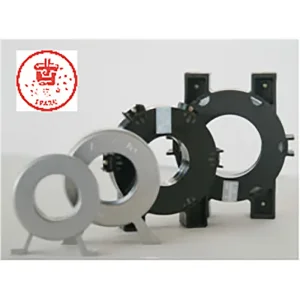
Complete Resistance Wire & Industrial Furnace Equipment Lineup
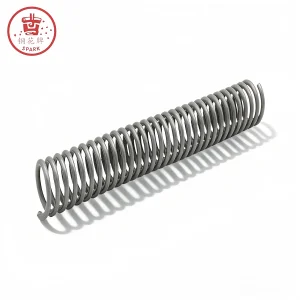
Explore additional high-performance products including custom furnace assemblies, specialized inductor components, and multi-alloy spiral elements direct from our Beijing manufacturing base.




Request Engineering Data Sheets & Wholesale Quotations
Consult directly with our metallurgical engineering team in Beijing. Whether you require custom spooling, sample wires for thermal testing, or full megawatt furnace element design calculations, our sales engineering desk responds within 24 hours.