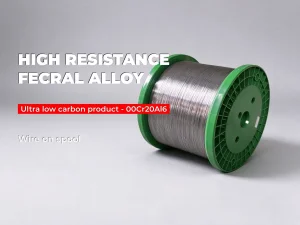
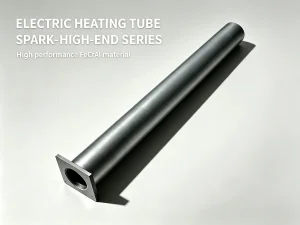
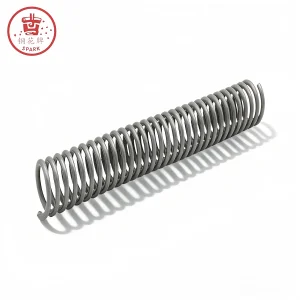
Featured High-Temperature FeCrAl & Alloy Heating Elements
Explore our flagship industrial heating alloy components engineered specifically for high-stress continuous operating environments up to 1425°C.


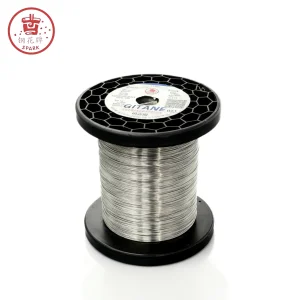
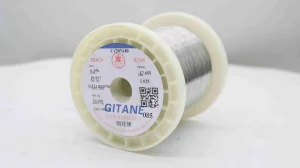


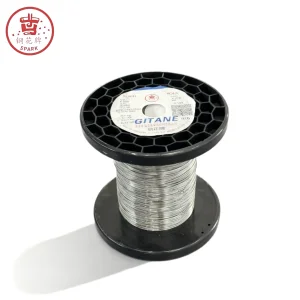
Executive White Paper: High-Temperature Metallurgical Mechanics of FeCrAl in Carburizing Environments
Industrial gas carburizing represents one of the most chemically aggressive thermal processing environments in modern manufacturing. Operating continuous or batch carburizing furnaces at elevated temperatures up to 1300℃ accelerates carbon mass transfer into target steel components. However, this aggressive carbon-rich potential (αc > 1.0) poses catastrophic structural degradation risks to electric heating elements through carbon ingress, internal carbide precipitation, and metal dusting.
As a premier China 1300℃ FeCrAl industrial carburizing furnace heating wire manufacturer, Beijing Shougang Gitane New Materials Co., Ltd. (SPARK) has engineered specialized Iron-Chromium-Aluminum (FeCrAl) resistance alloys—specifically advanced grades like 0Cr21Al6Nb, SGHYZ, and powder-metallurgy SGHT—capable of maintaining structural integrity and electrical stability under intense carbon-bearing and fluctuating oxidation-reduction atmospheres.
Unlike conventional Nickel-Chromium (NiCr) alloys, which suffer from "green rot" (internal chromium oxidation beneath a carbon-rich layer) when exposed to carburizing gases at temperatures exceeding 900℃, FeCrAl alloys form a self-healing, non-porous, thermodynamically stable α-Al₂O₃ protective surface layer. At 1300℃, this alumina scale acts as an impermeable diffusion barrier against carbon atom penetration, preventing internal embrittlement and catastrophic element failure.
Global Industrial Status: The Shift Toward High-Temperature Carburizing
The global thermal processing sector is undergoing a massive paradigm shift. Driven by automotive electrification demands, heavy machinery durability requirements, and green-manufacturing decarbonization mandates, heat-treatment engineers are increasing process temperatures from traditional gas carburizing regimes (880℃–950℃) to high-temperature carburizing (1050℃–1300℃).
Process Time Reduction
According to Fick's Second Law of Diffusion, the diffusion coefficient of carbon in austenite increases exponentially with temperature. Carburizing at 1300℃ reduces cycle times by up to 80% compared to 920℃, enabling massive throughput improvements for gear and bearing manufacturers.
Energy Efficiency Gains
Shorter cycle times drastically decrease overall kilowatt-hour energy consumption per ton of processed steel. Electric furnaces powered by high-density FeCrAl elements reduce operational carbon footprints compared to direct fossil-fuel-fired radiant tube installations.
Extreme Environment Stress
Operating at 1300℃ under high carbon potentials demands furnace heating elements with virtually zero sag, high hot strength, and immunity to carbon deposition. Chinese manufacturing excellence now delivers world-class FeCrAl alloys matching or exceeding traditional European standards.
Thermodynamic Mechanics: Why FeCrAl Outperforms NiCr in Carburizing
In atmosphere-controlled carburizing furnaces using endothermic gas, gas-injected propane/butane, or vacuum acetylene (&C_2H_2&), the equilibrium reaction involves carbon monoxide cracking and hydrocarbon decomposition:
2CO ⇌ C(s) + CO₂ | CH₄ ⇌ C(s) + 2H₂
When free carbon C(s) deposits onto heating elements, it migrates into the metallic matrix if unblocked. The fundamental differences between FeCrAl and NiCr under these conditions are detailed below:
| Performance Parameter | FeCrAl Alloys (e.g., SPARK SGHYZ / 0Cr21Al6Nb) | NiCr Alloys (e.g., Cr20Ni80 / Cr30Ni70) |
|---|---|---|
| Protective Oxide Scale | Dense, single-phase α-Al₂O₃ (Alpha-Alumina) | Cr₂O₃ (Chromia) scale; permeable to carbon at >900℃ |
| Carburization Resistance | Extremely High; α-Al₂O₃ prevents carbon diffusion | Low to Moderate; forms internal M₂₃C₆ carbides leading to embrittlement |
| Green Rot Susceptibility | Immune (Nickel-free matrix) | Highly Susceptible under alternating carburizing/oxidizing states |
| Resistivity at 20℃ (μΩ·m) | 1.40 – 1.45 (Higher electrical efficiency) | 1.09 – 1.18 (Lower resistivity) |
| Density (g/cm³) | 7.10 (Lighter weight, less raw material per element) | 8.40 (Heavier element weight) |
| Max Operating Temperature | 1350℃ – 1425℃ | 1200℃ – 1250℃ |
Micro-Alloying Precision: The Role of Nb, Y, and Zr Reactive Elements
At 1300℃, grain growth in standard FeCrAl alloys can lead to sagging and mechanical brittleness. Beijing Shougang Gitane addresses this through precise addition of Niobium (Nb), Yttrium (Y), and Zirconium (Zr). These reactive elements anchor grain boundaries through fine carbide/nitride dispersoids, dramatically enhancing high-temperature creep strength and scale adhesion during thermal cycling.
Macro Industry Solutions: Furnace System Engineering & Design Rules
Designing 1300℃ carburizing furnace heating systems requires holistic engineering. Selecting the wire grade is only half the equation; geometry, surface loading, ceramic support structures, and power control play equal roles in long-term reliability.
Surface Load (&W/cm²) Optimization
In carbon-rich atmospheres at 1300℃, surface power density must be conservative to prevent localized overheating. While FeCrAl can handle up to 4.0 W/cm² in clean air, carburizing applications require designing elements between 1.2 and 2.2 W/cm² to extend operational life and minimize soot-induced electrical shorting.
- Heavy-gauge round wire (Ø 6.0mm – 10.0mm) to maximize cross-sectional area.
- Corrugated strip elements for maximum heat dissipation surface.
- Pre-oxidation treatment at 1150℃ for 8 hours prior to gas exposure.
Radiant Tube & Ceramic Bundle Rod Integration
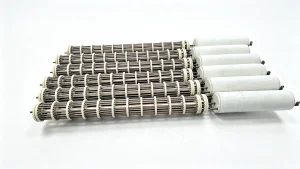
For indirect-fired carburizing furnaces, heating wires are assembled into bundle rod cores inserted within high-purity ceramic or silicon carbide (SiC) radiant tubes. This isolates elements from direct soot exposure while ensuring efficient radiative heat transfer to the furnace workload.
- High-alumina (95%+ Al₂O₃) ceramic support spools to prevent silica reaction.
- Low-voltage, high-current power transformer configurations.
- Integrated purge gas capabilities for localized soot removal.
Localized Application Scenarios & Global Field Deployments
SPARK FeCrAl heating wire solutions are deployed across major industrial manufacturing hubs globally, supporting diverse heat-treatment methodologies:
Continuous Push-Rod Gas Carburizers (Germany/Europe)
Engineered for automotive transmission gear lines operating under endothermic gas at 1050℃–1100℃. Heavy-gauge SPARK SGHYZ wire coils mounted on ceramic hangers provide unbroken service lifetimes exceeding 24 months without sagging.
Low-Pressure Vacuum Carburizing (LPC) (North America)
In aerospace gear heat-treating using C₂H₂ pulse carburizing up to 1300℃, SPARK Powder-Metallurgy SGHT heating elements demonstrate superior resistance to thermal shock during high-pressure gas quenching (HPGQ) cycles.
Pit-Type Heavy Machinery Furnaces (East Asia)
Large-diameter pit carburizers for mining and wind turbine gearboxes utilize SPARK 0Cr21Al6Nb wave-shaped ribbon elements, delivering uniform thermal distribution across 6-meter deep heating chambers.
Compliance, Quality Control & Technical Support
Beijing Shougang Gitane New Materials Co., Ltd. enforces complete metallurgical traceability from vacuum induction melting (VIM) to final wire drawing and spooling. Operating under ISO 9001:2015 and ISO 14001 certification, every batch of 1300℃ FeCrAl heating wire undergoes strict quality verification:
- Chemical Composition Verification: Spectrographic analysis ensuring precise aluminum (6.0%–6.8%) and rare-earth element tolerances per GB/T 1234-2012 standards.
- Accelerated High-Temperature Life Testing: Standardized 1300℃–1400℃ cyclic oxidation testing to verify oxide layer adherence and resistance to spallation.
- Electrical Resistance Tolerance: Uniformity within ±3% per reel, eliminating hot-spot formation during furnace operation.
- Global Logistics & Compliance: Full compliance with RoHS, REACH, and export customs documentation, accompanied by certified Mill Test Certificates (EN 10204 3.1).
Technology Roadmap (2025–2035): Next-Generation Heating Alloys
As global industry transitions toward green hydrogen-assisted carburizing and ultra-high-temperature processing, SPARK R&D is pioneering advanced resistance alloy innovations:
ODS-FeCrAl Technology
Oxide Dispersion Strengthened (ODS) FeCrAl alloys utilizing yttrium oxide (Y₂O₃) nano-particles to achieve non-sagging properties at temperatures up to 1450℃, extending wire life by 300% under severe stress.
Hydrogen-Resistant Scales
Developing modified alumina scales engineered to resist hydrogen embrittlement and steam reduction in zero-carbon hybrid carburizing atmospheres.
3D Formed Strip Elements
Precision cold-rolled, computer-modeled element geometries designed to optimize radiant view factors inside energy-efficient ceramic-fiber furnaces.
Frequently Asked Questions: Technical & Procurement Engineering
In-depth answers to critical questions faced by furnace builders, heat-treatment engineers, and procurement teams when selecting 1300℃ carburizing heating wire.
Complete High-Temperature Resistance Alloy Product Portfolio
Discover additional industry-leading resistance alloy grades, tubular components, and furnace accessories from Shougang Gitane.