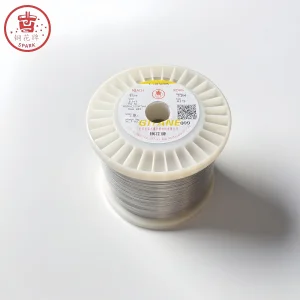
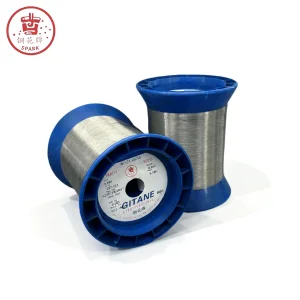
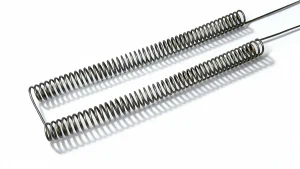
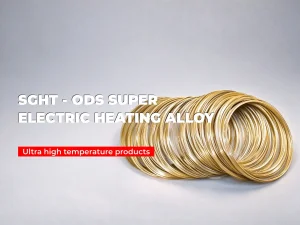
Featured 1200°C–1425°C High-Temperature Resistance Alloys (Series 1)
Explore our precision-drawn resistance heating wires, strips, and furnace elements engineered for low oxidation rates and long service life in aggressive thermal environments.


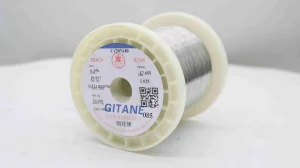
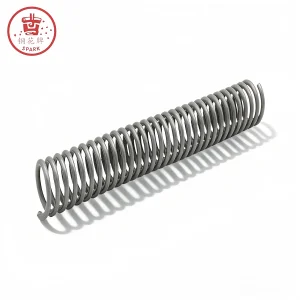

Executive Summary: Micro-Alloying Breakthroughs in 1200°C Oxidation Inhibition
In ultra-high-temperature thermal processing systems running at or above 1200°C in dry air environments, metallic heating elements face catastrophic degradation caused by rapid oxidative erosion, grain boundary oxidation, and scale spallation. Standard resistance alloys under prolonged exposure suffer from accelerated mass loss, localized resistance drift, and structural sagging.
Through decades of metallurgical research, Beijing Shougang Gitane New Materials Co., Ltd. (operating the premier SPARK® brand) has solved these core failure modes. By optimizing reactive element addition—specifically Yttrium (Y), Zirconium (Zr), Hafnium (Hf), and Niobium (Nb)—our advanced Iron-Chromium-Aluminium (FeCrAl) and Nickel-Chromium (NiCr) alloys form a highly adherent, thermodynamically stable α-Al₂O₃ (alpha-alumina) protective scale. This scale dramatically depresses the parabolic oxidation rate constant ($K_p$) by up to 65% compared to conventional materials.
Thermodynamic Mechanics of α-Al₂O₃ Oxide Scale Growth in Dry Air
In dry air (containing ~21% O₂ and negligible H₂O vapor), the thermal oxidation of FeCrAl resistance alloys follows parabolic rate kinetics described by Wagner's theory of oxidation:
Where Δx is the oxide film thickness, K_p is the parabolic rate constant, and t is the time under exposure. At 1200°C, ordinary alloys suffer from cationic diffusion outwards and oxygen ion diffusion inwards, creating internal Kirkendall voids at the alloy-oxide interface. This leads to scale buckling and spallation during thermal cycling.
The SPARK® Solution: Reactive Element Effect (REE). Our proprietary micro-alloying doping technology alters the ion transport mechanism. Yttrium and Zirconium segregate to the grain boundaries of the scale, suppressing aluminum outward transport and allowing growth primarily by inward oxygen grain boundary diffusion. This eliminates void formation, anchors the protective scale via "peg-rooting" mechanisms into the substrate, and significantly inhibits further oxidation erosion.
Comprehensive Material Property & Kinetics Comparison Table
| Alloy Grade | Alloy Family | Max Temp (°C) | Resistivity at 20°C (μΩ·m) | Oxidation Scale Type | Relative Creep Strength | Primary Industrial Application |
|---|---|---|---|---|---|---|
| SGHT (PM FeCrAl) | Powder Metallurgy FeCrAl | 1425°C | 1.45 ± 0.05 | Dense α-Al₂O₃ + Hf/Y Pegs | Very High (Dispersion) | Semiconductor Sintering, Diffusion Furnaces |
| SGHYZ | Advanced FeCrAl | 1400°C | 1.43 ± 0.04 | Ultra-dense α-Al₂O₃ | High | Ceramic Kilns, Heavy Industrial Furnaces |
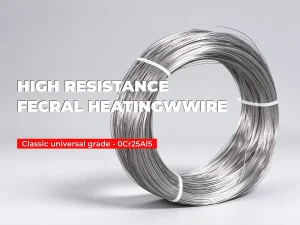
| 0Cr21Al6Nb | Standard FeCrAl + Nb | 1350°C | 1.40 ± 0.04 | α-Al₂O₃ Scale | Moderate-High | Heat Treatment, Industrial Elements |
| 0Cr25Al5 | Standard High-Temp FeCrAl | 1300°C | 1.42 ± 0.05 | Standard Al₂O₃ Scale | Moderate | Kiln Heating, Resistance Banks |
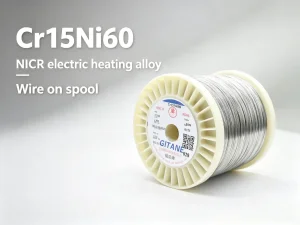
| Cr20Ni80 | Nickel-Chromium (Nichrome) | 1200°C | 1.09 ± 0.03 | Cr₂O₃ / NiCr₂O₄ Spinel | High Ductility post-use | Cyclic Electric Furnaces, Medical Heaters |
Macro Industry Solutions: Mission-Critical Thermal Systems
Different heavy industrial sectors face distinct thermodynamic and mechanical stresses. SPARK® alloys are tailored to overcome specific operational bottlenecks across major manufacturing verticals.
Wafer Diffusion & Crystal Growth Furnaces
Ultra-clean thermal environments require zero metallic dust contamination. Our SGHT powder-metallurgy FeCrAl wire maintains exceptional dimensional stability at 1200°C–1300°C, preventing coil sag and particle shedding during long diffusion runs.
Lithium Cathode Calcination Roller Hearth Kilns
Corrosive off-gassing combined with 1200°C continuous dry air heat causes severe alloy decay. SPARK® 0Cr21Al6Nb and SGHYZ ribbons form self-healing oxide barriers that resist chemical attack while maintaining uniform thermal output across kiln widths.
Vacuum & Inert Heat Treatment Continuous Belts
Aerospace components require tight temperature uniformity (±3°C). Our Cr20Ni80 and high-temp FeCrAl elements deliver repeatable electrical resistance over thousands of heating cycles without premature embrittlement.
China Factory 4.0: Integrated Supply Chain & Precision Manufacturing
As part of the renowned Shougang Group, Beijing Shougang Gitane New Materials Co., Ltd. operates a vertically integrated production ecosystem covering 88,000 square meters. From raw element refining to final element winding, every step is controlled under ISO 9001:2015 quality frameworks.
VIM & ESR Vacuum Melting
Vacuum Induction Melting (VIM) paired with Electroslag Remelting (ESR) guarantees ultra-low gas content (O, N, H < 20 ppm) and eliminates macro-segregation, forming the basis for high-purity alloy heats.
Continuous Cold Drawing & Annealing
State-of-the-art multi-pass continuous wire drawing machines and hydrogen bright-annealing lines achieve surface roughness Ra < 0.2 μm and tight diameter tolerances within ±0.01 mm.
Full-Heat Traceability & SPC
Every master coil is tagged with a unique QR identifier linked to Spectrographic Chemical Analysis, Electrical Resistivity Testing, and High-Temperature Accelerated Life Tests (per GB/T 1234 standards).
Global Enterprise Procurement: Engineering Selection Framework
International EPCs, furnace OEMs, and procurement specialists must balance upfront raw material costs against long-term maintenance cycles. Designing a 1200°C furnace system requires evaluating surface load (W/cm²), atmospheric compatibility, and density benefits.
Surface Watt Density Optimization
At 1200°C, operating near maximum thermal limit requires lowering the surface load to 1.5 - 2.5 W/cm² to prevent localized hot spots. SPARK® FeCrAl's high electrical resistivity allows thicker wire gauges at identical resistance, significantly extending element lifespan.
Total Cost of Ownership (TCO) Calculations
FeCrAl alloys possess a lower density (~7.10 g/cm³) compared to NiCr alloys (~8.40 g/cm³). Purchasing FeCrAl results in approximately 15% material weight savings for the same electrical heating surface area, yielding immediate freight and raw material cost reductions.
Atmospheric Compatibility Checks
While dry air favors FeCrAl due to its protective α-Al₂O₃ scale, nitrogenous or reducing gas atmospheres require specialized evaluation. Our technical support team assists global clients in matching specific gas compositions to optimal wire chemistries.
Localization Support & Global Compliance Assurance
To streamline international procurement, Shougang Gitane provides end-to-end technical documentation, localized engineering consultation, and complete compliance certification.
International Certifications
Our products strictly adhere to GB/T 1234-2012 standards and can be cross-referenced to ASTM B603, DIN 17470, and JIS C2520. Every shipment includes 3.1 Material Test Certificates (EN 10204).
Custom Pre-Forming & Assembly
We provide turn-key pre-wound spiral coils, meander elements, and ceramic-supported heating cassettes tailored to your CAD drawings, minimizing field assembly labor.
Global Logistics & DDP Shipping
With robust ocean, air, and express transport partners, we provide flexible Incoterms including FOB, CIF, DDP, and DAP with custom export packaging ensuring zero moisture damage during transit.
Technical Roadmap & Future Outlook: The Next Horizon in Thermal Materials
As industrial decarbonization drives electrification across steel, glass, and chemical manufacturing, electric heating elements must operate at unprecedented temperatures and power densities. Shougang Gitane’s R&D division is executing a targeted metallurgical roadmap:
2025: Nanostructure Oxide Dispersion Strengthening (ODS)
Integrating yttrium-titanium complex nano-oxides into the matrix to boost 1200°C creep rupture strength by over 300%, enabling vertical free-hanging element designs without deformation.
2027: Smart Self-Healing Oxide Scale Chemistry
Engineered trace-element reservoirs that rapidly migrate to micro-cracks induced by severe thermal shock, regenerating the α-Al₂O₃ protective film in seconds.
2030: PM-FeCrAl Pushing 1450°C Limits
Scaling up next-generation powder metallurgy manufacturing to produce large-diameter billets for seamless heavy-gauge tubes and ribbons operating continuously at 1450°C in air.
Frequently Asked Technical & Sourcing Questions (FAQ)
Explore technical answers regarding 1200°C operation, dry air oxidation mechanics, alloy selection, and factory customization.
Featured High-Performance Resistance Alloys & Heating Elements (Series 2)
Select from our specialized high-nickel and ultra-high-temperature powder metallurgy series engineered for challenging industrial applications.